
Third Finding of the Head of the Forerunner
The Third Finding of the Precious Head of the Holy and Glorious Prophet, Forerunner and Baptist John
On May 25 the Church keeps the third and last of the discoveries of the Precious Head of John the Baptist: not a finding in Palestine or Syria, as the first two were, but a finding inside the Christian empire itself, and one whose occasion was the empire's own catastrophes. Carried out of Constantinople to the town of Comana to save it from Arab raiders, and then buried in the ground there through the long years of the second iconoclasm, the Head was revealed about the year 850 to the patriarch Ignatius, who saw in a vision the place where it lay; emissaries of the emperor went to Comana, dug where he had shown, and brought the relic back in triumph to the capital, where it was laid up in the church of the imperial palace. The feast is thus the sequel and completion of February 24, where the First and Second Findings are kept together — and its own hymnography knows it: the Menaion's apolytikion for this day sings of the Head as "a divine treasure hidden away in the earth," and the verses of the synaxarion of "the voice of one crying" that sounded out of the cleft ground. The Forerunner's full Life is given in his own entry, John the Forerunner; the first two Findings, with the whole earlier history of the relic, in the feast of February 24.

What the Third Finding presupposes
The received history of the relic, as the synaxaria transmit it, runs in three stages, and the third cannot be told without the first two. The severed head of the Forerunner, buried apart from his body by Herodias and recovered by Joanna the wife of Chuza, lay hidden on the Mount of Olives until two monk-pilgrims found it there in the fourth century (the First Finding); it passed through the hands of a potter of Emesa and of an Arian named Eustathius, who hid it in a cave, and was revealed there again in about 452 to the archimandrite Marcellus (the Second Finding). From Emesa it came in time to Constantinople, where it was received among the greatest relics of the city. All of this belongs to February 24 and is set out in that feast's own file. The Third Finding begins at the point where the Head is already an imperial relic in the capital — and where the capital ceases, for a time, to be a safe place to keep it.
Out of the City to Comana
The occasion of the removal was war. In the decades around 810–820 the frontiers of the empire were open and Arab raiding parties struck deep into Asia Minor and along the coasts; the synaxarial account has the Head carried out of Constantinople for safety in that period and taken to Comana, where it was kept in the possession of the local church. There followed the second and more grinding phase of the iconoclast controversy — from the council of 815 under Leo V to the restoration of the icons in 843 — and during those years, the account continues, the relic was buried in the ground at Comana and its hiding-place ceased to be generally known. The pattern is exactly that of the first two Findings, and the synaxaria draw the parallel deliberately: the Head is hidden by human fear or human malice, and given back by revelation.
Which Comana is meant the sources do not settle. Two towns of the name lie in the relevant country: Comana Pontica in the valley of the Iris near Amasea — the place where St John Chrysostom died in 407, and the place of the martyrdom of Basiliscus of Comana — and Comana Chryse in Cappadocia. The Slavonic and English retellings say simply "Comana"; the Greek notice is no more precise; the entry for the February feast in this repository follows the common identification with Cappadocia. The question matters little to the feast and cannot be decided from the hagiographic record, but it should not be quietly resolved either way.
The vision of Patriarch Ignatius and the finding of c. 850
With the icons restored and the Church at peace, the relic was sought. The account credits the discovery to Ignatius, patriarch of Constantinople in the years 847–858, who while at prayer saw in a vision the place at Comana where the Head of the Forerunner lay hidden. He made the vision known to the emperor — the young Michael III, in the years when his mother Theodora, who had restored the holy icons, still governed with him — and the emperor sent representatives to Comana with instructions to dig where the patriarch had described. There, about the year 850, the Precious Head was found a third time.
It was carried back to Constantinople with honour, and on May 25 was laid up in the church of the imperial palace, among the relics of the court. The Menaion's exaposteilarion for the day remembers precisely this: at the finding of the Head, it sings, "the Christ-loving emperor" received it. The relic was therefore restored not merely to the city but to the very centre of the imperial cult of relics, and the day of that enshrinement — not the day of the digging at Comana — is the day the Church keeps. From this Constantinopolitan shrine the later dispersion of portions proceeds; a portion of the Head is honoured on Mount Athos to this day, and the tangled question of the surviving head-relics — Amiens, Rome, and the shrine in the Umayyad Mosque at Damascus, built over the ancient basilica of the Forerunner in the patriarchate of Antioch's own second city — is treated in the entry for the Forerunner and in the February feast, not repeated here.
Feast and commemoration
May 25 (church date; New Calendar civil May 25; Old Calendar civil June 7). Because Orthodox Pascha falls between April 4 and May 8, this day always stands within the Pentecostarion, at earliest seventeen days and at latest fifty-one days after Pascha; it therefore never falls in Bright Week, may fall on either side of the Ascension (Pascha + 39), and in years of the earliest Pascha falls two days after Pentecost. Whatever the movable cycle appoints in a given year takes precedence over the fixed office. The Menaion appoints a proper festal office for the Finding — apolytikion, kontakion and oikos, stichera, exaposteilarion and a canon — distinct both from the propers of February 24 and from those of the Forerunner's other days, and this is one mark of how seriously the Byzantine Church took the relic's return.
In this collection the day is treated exactly as February 24 was, on the settled precedent of that entry: a feast file carries the account, propers and image of the Finding itself, while the commemoration is also listed in the Forerunner's own entry, whose feasts: array already carries this May 25 date with the rank translation-of-relics. He is not re-minted here.
Taxonomy flag — feast_type. As at February 24, the controlled feast_type
vocabulary of the project's constitution (indiction | theotokos-synaxis | icon-of-the-theotokos | angelic | dominical | theotokian | dedication | deliverance) has no value for
the finding, translation or veneration of a saint's relics. dedication is used
here as the nearest existing term, following the precedent of the
First and Second Finding, the
Veneration of the Chains of Peter, and the
translations of the relics of
Ignatius of Antioch and
John Chrysostom. No new term is
minted; the gap belongs to the standing question at the project's record of open questions.
Hymns
Apolytikion
As a divine treasure hidden away within the earth, Christ hath revealed thy Head to us, O Prophet and Forerunner. Wherefore, being all gathered together at the finding thereof, with songs inspired of God we hymn the Saviour, who saveth us from corruption by thine intercessions.
Kontakion
The luminous and divine pillar in the world, the lamp of the noetic Sun, the Forerunner, hath shown forth his light-bearing and godly Head unto the ends of the earth, and sanctifieth those who venerate it in faith and cry aloud: O wise Baptist of Christ, save us all.
Original translation from the Greek
Verses
The voice of one crying, hidden in the hollow of the earth, when the earth was cleft, sounded forth wondrously to all. On the five-and-twentieth they found the Forerunner's Head.
Appointed readings
Epistle — 2 Corinthians 4:6–15 (propers of the Forerunner, as at the First and Second Finding)
6For God, who commanded the light to shine out of darkness, hath shined in our hearts, to give the light of the knowledge of the glory of God in the face of Jesus Christ. 7But we have this treasure in earthen vessels, that the excellency of the power may be of God, and not of us. 8We are troubled on every side, yet not distressed; we are perplexed, but not in despair; 9Persecuted, but not forsaken; cast down, but not destroyed; 10Always bearing about in the body the dying of the Lord Jesus, that the life also of Jesus might be made manifest in our body. 11For we which live are alway delivered unto death for Jesus’ sake, that the life also of Jesus might be made manifest in our mortal flesh. 12So then death worketh in us, but life in you. 13We having the same spirit of faith, according as it is written, I believed, and therefore have I spoken; we also believe, and therefore speak; 14Knowing that he which raised up the Lord Jesus shall raise up us also by Jesus, and shall present us with you. 15For all things are for your sakes, that the abundant grace might through the thanksgiving of many redound to the glory of God.
Gospel — Matthew 11:2–15 (propers of the Forerunner; not separately specified in the Menaion text consulted)
2Now when John had heard in the prison the works of Christ, he sent two of his disciples, 3And said unto him, Art thou he that should come, or do we look for another? 4Jesus answered and said unto them, Go and shew John again those things which ye do hear and see: 5The blind receive their sight, and the lame walk, the lepers are cleansed, and the deaf hear, the dead are raised up, and the poor have the gospel preached to them. 6And blessed is he, whosoever shall not be offended in me. 7And as they departed, Jesus began to say unto the multitudes concerning John, What went ye out into the wilderness to see? A reed shaken with the wind? 8But what went ye out for to see? A man clothed in soft raiment? behold, they that wear soft clothing are in kings’ houses. 9But what went ye out for to see? A prophet? yea, I say unto you, and more than a prophet. 10For this is he, of whom it is written, Behold, I send my messenger before thy face, which shall prepare thy way before thee. 11Verily I say unto you, Among them that are born of women there hath not risen a greater than John the Baptist: notwithstanding he that is least in the kingdom of heaven is greater than he. 12And from the days of John the Baptist until now the kingdom of heaven suffereth violence, and the violent take it by force. 13For all the prophets and the law prophesied until John. 14And if ye will receive it, this is Elias, which was for to come. 15He that hath ears to hear, let him hear.
Iconography
The Third Finding has no iconography wholly its own; it shares the subject-type of the Findings in general, and is normally distinguished, when it is distinguished at all, by the presence of a bishop or patriarch directing the work and of an emperor with his court — Ignatius and Michael III standing in for Marcellus or the two monks. The narrative type shows labourers digging into a hillside or cave and uncovering the Head in the vessel that held it; the emblematic type shows the Head alone in a dish, chalice-like stand, or well, an image the day's own hymns enact when they sing of a treasure dug from the ground and a fountain welling up out of the earth. Menologion-style manuscript miniatures of the subject exist, but the famous one — the gold-ground miniature of the finding in the Menologion of Basil II — belongs to the manuscript's February section and therefore to the First and Second Finding; it is stored with that feast and deliberately not reused here. A mirrored derivative of that same miniature circulates online captioned as the Third Finding, and was examined and rejected for this entry on exactly that ground.
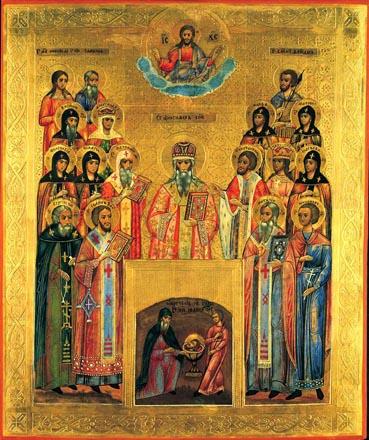
The stored image is a late-nineteenth-century Russian panel in which the Finding occupies the lower register beneath a Deesis and ranks of standing saints: within a dark cave-mouth, a monk in the black klobuk and a second figure in red together lift a footed vessel in which the Head lies, under the Slavonic inscription Обрѣтенїе главы Іѡанна Предтечи ("The Finding of the Head of John the Forerunner"). The subject is beyond doubt; the inscription, as is usual, does not number the Finding, and the identification of the scene as the Third rests on the description at the source. It is stored here as a witness to the subject-type, and a securely-identified Third Finding image remains desirable (source, public domain, pd-old-work).
Disputed questions
- The three-finding scheme itself. The Byzantine historians present a difficulty the synaxaria do not resolve. Socrates and Theodoret record that the head of the Forerunner was brought to Constantinople and enshrined at the Hebdomon in the reign of Theodosius the Great (c. 391) — that is, more than half a century before the Second Finding at Emesa in 452, and some four and a half centuries before the Third. The enumeration of "three findings" is a later liturgical harmonisation of relic-histories that were originally independent, and it is not possible to trace a single documented chain of custody from Herodias's burial to the court church of Michael III. The feasts canonise the Church's memory of three revelations, not a verified provenance.
- The date c. 850. The year is inferred from the first patriarchate of Ignatius (847–858) and is given as "about 850" in the synaxaria; no contemporary document dates the finding, and the notice is not corroborated in the ninth-century chronicles. Ignatius's own life is bound up with the Photian controversy, and it is worth noting that the tradition attaches the vision to him rather than to Photius.
- The relation to the fourth Forerunner relic-feast. Some usages count a further translation or veneration of the Head; the Byzantine calendar as received keeps three Findings only — two on February 24 and this one — within the Forerunner's cycle of six fixed commemorations.