
Innocent of Komel
Our Venerable Father Innocent of Komel and Vologda
Venerable · b. mid-15th century — d. 1521
Commemorated 19 March — Repose at his hermitage in the Komel forest
Innocent of Komel (mid-15th century – 1521) was a Russian monastic saint of the northern forests, a disciple of Nilus of Sora and one of the chief bearers of his teacher's austere skete tradition of non-acquisition and inner prayer. Descended from the princely Okhlyabinin line, a branch of the Rurikid house, he took monastic vows in the region of the Kirillo-Belozersky monastery and attached himself to Nilus, whom he accompanied on pilgrimage to the holy places of the Christian East. After Nilus's repose he withdrew north into the Komel forest of the Vologda land and, on the little river Nurma (Ediza), founded a hermitage under a written rule of his own that carried Nilus's skete discipline into the next generation. He reposed there on March 19, 1521, and is venerated as Innocent of Komel and of Vologda.

Origins and formation
Innocent belonged by birth to the princely family of the Okhlyabinins, a line descended from the princes of Rurikid stock in the Moscow lands; he laid aside that rank for the monastic life, taking vows in the north, in the orbit of the great Kirillo-Belozersky (Saint Cyril of White Lake) monastery, the mother-house of the Trans-Volga monasticism. There he came under the guidance of the elder who would shape his whole life, Nilus of Sora — the foremost Russian teacher of nestyazhanie, monastic non-possession, and of the hesychast prayer of the heart learned from Athos and the Greek fathers.
Innocent became one of Nilus's closest disciples, and the tradition holds that he travelled with his teacher to the Christian East — to Constantinople, to Mount Athos, and to the holy places of Palestine — in the years when Nilus was gathering the patristic and Athonite sources of his own reform. Returning, they settled in the skete Nilus founded on the river Sora, near White Lake, where a few monks lived apart in the sparse, self-effacing manner of the Egyptian and Athonite hermits rather than in a great cenobium.
The hermitage in the Komel forest
The tradition preserves a saying of Nilus to his disciple: that Innocent would go out and gather brethren into a community, while Nilus himself would remain in his desert; and so it fell out. After Nilus of Sora reposed (1508), Innocent went away northward into the Komel forest in the Vologda region, and on the banks of the small river Nurma (also called the Ediza) he built a cell, and then a church, and drew brethren about him, founding the hermitage that bore his name.
For his community he left a written monastic rule — a "testament" or ustav — modelled on the skete discipline of his master: poverty, manual labour, the guarding of the mind, and the prayer of the heart, with a warning against the acquisition of villages and wealth that Nilus had made the mark of his reform. In that document Innocent styled himself the least of monks and bound his successors to keep the founder's poverty. He governed the hermitage as its abbot until his death, and reposed on March 19, 1521, appointing that he be buried without honour within his own house.
Relics and veneration
Innocent was buried at his hermitage, and his memory was kept there and through the Vologda land as one of the company of Trans-Volga elders — the disciples of Nilus and Cyril and Cornelius who filled the northern forests with sketes. His hermitage endured as the Innocent (Innokentiev) monastery on the Nurma until the monastic suppressions of the modern period; his relics rested there under a covering. He is numbered among the Saints of Vologda and commemorated on the day of his repose, March 19.
Feast and commemoration
Innocent is kept on March 19 (church date; Old Calendar civil April 1), the day of his repose, as a Russian commemoration — proper to the Vologda diocese and the wider Russian calendar rather than to the universal menaion. His name does not stand in the Greek books of the day. Because the date falls within Great Lent, his memory is observed with the Lenten offices; no festal Liturgy readings are proper to him on the fast's weekdays.
Hymns
Troparion — Tone 8
In thee, O Father, was the divine image kept secure; for, taking up thy cross, thou didst follow Christ, and by thy deeds thou didst teach us to despise the flesh, for it passes away, but to care for the soul, a thing immortal. Therefore doth thy spirit, venerable Innocent, rejoice together with the Angels.
Original translation from the Greek
Iconography
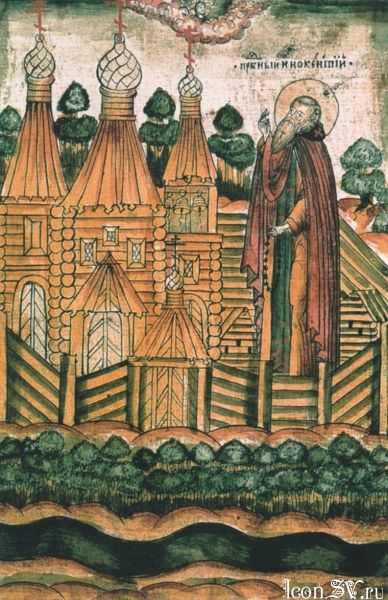
Innocent is depicted in the manner of the Russian venerable fathers of the north — an aged monk in the mantia and schema, long-bearded, his right hand raised in blessing or holding a scroll, sometimes with his hermitage shown behind him. The stored image is a 17th-century Russian icon of the saint (source, public domain, pd-old-work).