
Irene the Empress
The Holy and Right-believing Empress Irene, in the schema Xenia
Queen · Venerable · b. 1088, in the kingdom of Hungary — d. 13 August 1134, in Bithynia
Commemorated 13 August — Repose, having received the great schema with the name Xenia
Irene the Empress (1088 – 13 August 1134) was born Piroska, daughter of King Ladislaus I of Hungary, and came to Constantinople at sixteen as the bride of the future emperor John II Komnenos, taking the name Irene with her reception into the Orthodox Church. For thirty years she was empress of the Romans, and used the position as almost no other Byzantine empress did: her name stands with her husband's on the foundation of the monastery of Christ Pantokrator in Constantinople, whose typikon endowed a hospital of fifty beds in five wards, with salaried physicians and surgeons of both sexes, a dispensary, an almshouse and a leprosarium — one of the ancestors of the European hospital. She died on campaign in Bithynia on 13 August 1134, having received the great schema with the name Xenia, "the stranger", and was buried in her own foundation. She is the only Byzantine empress of the twelfth century to have been canonised, and her portrait in Hagia Sophia is the earliest surviving likeness of any member of the Árpád dynasty.

Piroska of Hungary
She was born in 1088, the daughter of King Ladislaus I of Hungary — the warrior-king and canonised legislator — and of Adelaide of Swabia, and was given the Hungarian name Piroska. She was orphaned early: her mother died about 1090 and her father in 1095, and she was brought up at the court of her cousin, King Coloman.
In 1104 the marriage was arranged that made her Byzantine — a dynastic alliance sought by Alexios I Komnenos to steady his northern frontier, and sealed by the marriage of the sixteen-year-old Hungarian princess to Alexios's eldest son and co-emperor, John. She was received into the Orthodox Church on her arrival at Constantinople and took the name Irene, "peace" — a name that the Byzantine writers afterwards found apt to her.
Empress
John succeeded his father in 1118, and Irene was Augusta beside him for sixteen years, sharing the first years of her marriage with her formidable mother-in-law Irene Doukaina. She bore eight children, of whom the eldest, Alexios, was crowned co-emperor and died before his father, and the youngest, Manuel, became Manuel I Komnenos; the others were Andronikos, Isaac, and the daughters Maria, Anna, Theodora and Eudokia.
The Byzantine sources are unanimous on her character, and unusually specific. She took no part in the palace politics that had made the reigns before hers dangerous; when in 1118 her sister-in-law Anna Komnene and the dowager empress schemed to set aside John in favour of Anna's husband, Irene stood aside from the whole business. What she did instead was to give money away — not by the conventional imperial largesse at festivals, but personally and continuously. The accounts say that she went into the houses of the poor herself, carrying money and speaking with them, and that she founded and endowed houses for the aged.
The Pantokrator
The great work of her life is the monastery of Christ Pantokrator in Constantinople — today the Zeyrek Mosque, and after Hagia Sophia the largest surviving Byzantine church of the city. It was begun on her initiative and substantially built in her lifetime, completed and endowed by John after her death, and its typikon, which survives, is one of the most remarkable documents of Byzantine social history.
The complex held three churches — the Pantokrator, the Theotokos Eleousa, and between them the funerary chapel of the Archangel Michael that became the burial church of the Komnenian and Palaiologan dynasties — and, attached to them, a hospital (xenon) of fifty beds in five wards, one of them for women, with a fixed establishment of physicians, surgeons, medical assistants and pharmacists, including women physicians for the women's ward; a monthly rotation of duty; a teaching function; an out-patient dispensary; a home for the aged of twenty-four places; and a leprosarium. Provision was made for the food, the bedding, the heating and the burial of the patients, and for the poor of the quarter. It is on the strength of this document that Irene's foundation is counted among the significant precursors of the hospital as Europe came to know it.
Death and the schema
In the summer of 1134 she accompanied John on campaign in Bithynia, and there fell ill and died on 13 August 1134, at the age of about forty-six. Before her death she was tonsured into the great schema, receiving the name Xenia (Greek Xenē, "the stranger", "the foreigner") — a name chosen, the tradition says, because she had been all her life a stranger in the city she ruled, and because the monastic life is a strangerhood to the world. She was brought back to Constantinople and buried in the Pantokrator, in the chapel she had built; John was laid beside her nine years later.
Her canonisation followed within a generation — it is usually placed about 1166, in the reign of her son Manuel — and her commemoration was fixed on the day of her death.
Feast and commemoration
Her feast is August 13, the day of her repose — civil August 13 on the New Calendar, civil August 26 on the Old. The day is the leavetaking of the Transfiguration and falls in the Dormition Fast (August 1–14), so that her commemoration is a synaxarion notice within the festal office rather than a sung service; no proper hymns are transmitted for her.
She is kept in Greek use as Ἁγία Εἰρήνη ἡ βασίλισσα and in Russian and OCA use as the "Holy Empress Irene, in schema Xenia". In Hungary she is honoured as Szent Piroska, the Hungarian princess who became a Byzantine saint, and her memory has been a point of contact between the Hungarian and the Orthodox churches in modern times. She is invoked as a patron of hospitals and of those who work in them, on the strength of the Pantokrator xenon.
Hymns
Troparion — Tone 8
Thou didst exchange a crown for the tonsure, and a throne for the cell, and the purple for the habit of a stranger; and having spent thy wealth upon the poor and the sick, thou didst depart to the Bridegroom with the name of a stranger upon thee. O righteous Irene, called Xenia, entreat Christ God that our souls be saved.
Original translation from the Greek
Kontakion — Tone 2
Thou wast a mother to the sick and to the aged, O blessed one, and didst build a house of healing for the poor of the city; wherefore, having laid aside the empire, thou wast received into the mansions that pass not away.
Original translation from the Greek
Iconography
Two quite different images of her exist, and both are worth distinguishing.
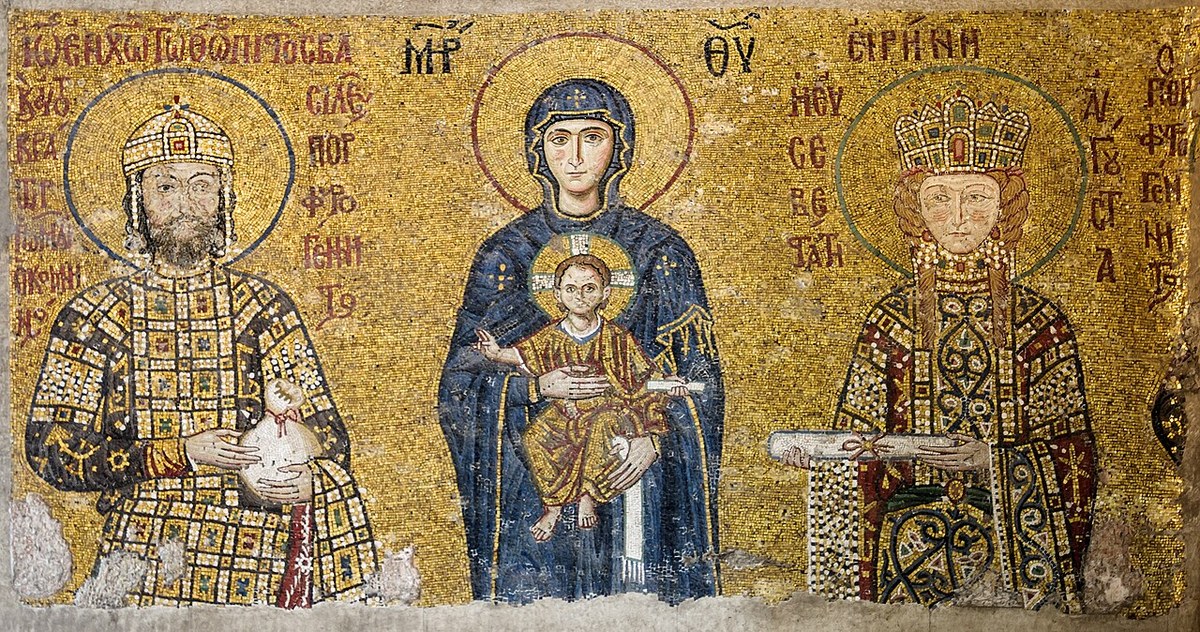
The first is not an icon at all in the strict sense but a contemporary imperial portrait: the Comnenus panel in the south gallery of Hagia Sophia, set up about 1118 to record the couple's benefaction to the Great Church. The Theotokos sits enthroned in the centre with the Child; John II stands at her right offering a purse of gold, and Irene at her left holding a scroll — the document of the donation. She is shown as the Byzantine court saw her and as the Hungarian she was: fair-haired, with long braids falling over her shoulders, high colour in the cheeks, wearing the loros stiff with pearls and gems and the imperial stemma, her name lettered beside her head in the mosaic itself, ЕΙΡΗΝΗ. It is the only surviving contemporary likeness of any member of the Árpád dynasty of Hungary, and the halo it gives her is the imperial nimbus rather than a mark of sanctity — the canonisation lay some fifty years in the future.
Hagia Sophia, south gallery, c. 1118. The empress at the right, inscribed ЕΙΡΗΝΗ.
The second is the hagiographical type, which is modern and Greek in origin and follows the synaxarion: she is shown as a nun in the great schema, in the dark analavos and koukoulion embroidered with crosses and the instruments of the Passion, but wearing or holding the imperial crown to declare what she laid down; sometimes she holds a model of the Pantokrator church. The name is written in both forms, Εἰρήνη and Ξένη. No pre-1900 example of this type has been located for this collection.
Disputed questions
The synaxarion life of the saint, which is what stands in the modern Greek and Russian calendars and is repeated in the OCA's notice for August 13, differs from the documented history at several points, and the difference should be stated plainly rather than smoothed over.
- The synaxarion has her outliving her husband, who is said to have died on a campaign in Syria, and then, after the death of two of her children, obtaining leave from her son Manuel to enter the Pantokrator and be tonsured there, living out her days in the monastery and dying in it. The documentary record is otherwise: Irene died in 1134, nine years before John, who was killed by an infected hunting wound in Cilicia in 1143; her tonsure was on her deathbed in Bithynia, not a retirement into her foundation.
- The synaxarion gives her four children; the historical record gives eight, four sons and four daughters.
- The saying attributed to her at the end — that "the empress Irene died long ago, and only the nun Xenia is left" — is a hagiographical formula of the kind used for several imperial monastics, and cannot be traced to a contemporary source; it is nonetheless a fair statement of what the change of name meant.
The likeliest explanation is that the synaxarion notice was composed late, after the Pantokrator had become firmly associated with her memory as its foundress and burial place, and that the association drew the tonsure and the last years into the monastery with it. The date of the commemoration, August 13, is in every version the date of her death, and is confirmed by the independent record; the identification of the saint is not in doubt.
A separate confusion should be excluded: this Irene is not Irene the Great Martyr of Magedon (May 5), nor the empress Irene the Athenian who restored the icons at the Seventh Ecumenical Council (August 7/9). She is also occasionally called Prisca in Western literature, a Latinisation of Piroska.