
Irene the Great Martyr
The Holy Great-Martyr Irene
Great Martyr · Virgin · d. c. 315 (traditional; other traditions place her in the 1st–2nd century)
Commemorated 5 May — The contest and repose of the Great-Martyr Irene
Irene is the great-martyr whose long passion — a cycle of tortures survived, deliverances and repeated returns to preaching — made her one of the most widely honoured women saints of the Byzantine world. Born Penelope, the only daughter of a petty pagan king named Licinius, she was shut up from childhood in a tower with thirteen companions, taught the faith in secret by her tutor Apellian, and baptised Irene ("peace") by Timothy, whom the tradition identifies as the disciple of the Apostle Paul. Her father's attempt to kill her ended in his own conversion and that of some three thousand souls; thereafter she passed from city to city under a succession of rulers — Sedekias, Sapor, Numerian, Babdonus — enduring the serpent-pit, the saw, the millwheel and three heated bronze oxen, converting whole populations, and at last reposing near Ephesus, where her sealed tomb was found empty. She is commemorated on May 5.
.jpg)
Penelope in the tower
The Acts of Irene, which present themselves as the work of her tutor Apellian, open in the small kingdom of Magedon, whose ruler Licinius and his wife Licinia had one daughter of extraordinary beauty, named Penelope. When the girl was six, her father — the account says, to guard her beauty and to keep her from the eyes of men — built a high tower outside the city, furnished it with gold and with idols, and shut her in it with thirteen maidens of her own age and an elderly tutor.
The tutor was Apellian, and he was secretly a Christian. Over the years of her seclusion he taught her letters and, with them, the Scriptures and the faith of Christ, so that the girl grew up a believer in a house full of idols. When she came of age her father began to speak of a marriage; and it was then, the Acts relate, that Penelope received the sign that decided her.
The three birds
Three creatures came in at the window of her chamber on three successive days: a dove bearing an olive branch, which laid them on the little table; an eagle carrying a garland of flowers; and a raven which dropped a serpent. Troubled, she asked Apellian what they meant. He read them as her whole life foretold: the dove was the meekness of her soul and the olive the grace of baptism; the eagle with its crown was the victory and reward of a martyr's contest; the raven with the serpent was the malice of the enemy and the sufferings that were to come. From that hour, the account says, she gave herself wholly to Christ.
A priest named Timothy — whom the Greek and Slavonic tradition identifies with Timothy the disciple of the Apostle Paul — came to the tower, catechised her, and baptised her, giving her in place of Penelope the name Irene, "peace." She then refused the marriage her father had arranged, and, going into the chamber where the household idols stood, she threw them down and broke them.
The conversion of Licinius
Licinius, told what his daughter had done and what she now confessed, commanded that she be bound and trampled by wild horses in the hippodrome outside the city. The horses stood still; one of them — in the fuller account, the very horse harnessed to drag her — turned, seized the king by the right arm and tore it away, and threw him down dead (or mortally hurt). The people cried out; Irene prayed, and her father was raised up and his arm restored to him.
The miracle broke him. Licinius confessed Christ with his wife, with his household, and — the Acts say — with about three thousand of the people; he laid down his kingdom, went up into the very tower he had built for his daughter, and lived out his life there in repentance. Irene remained with Apellian and began openly to teach.
The cycle of the tortures
What follows in the Acts is a chain of confrontations with a succession of rulers, each ending in Irene's deliverance and in the conversion of the onlookers. It is this extraordinary series — rather than any single execution — that earned her the title great-martyr.
- Sedekias, who succeeded to the government, summoned her, forbade her to preach and bade her sacrifice. She refused; she was thrown into a pit filled with vipers and serpents, and after ten days was drawn out unhurt. She was then bound to a saw, which would not cut her, and set upon a millwheel, whose water stood still.
- Sapor, son of Sedekias, took up the persecution and marched against her. Irene met him and prayed; his army was struck blind, and at her further prayer their sight was given back — but Sapor persisted, and the account says he was killed by a bolt of lightning. She returned to Magedon with Timothy and converted five thousand more.
- At Callinicum (called Callipolis in some Greek copies) she was taken before King Numerian, who had three bronze oxen heated white-hot and shut her in them one after another; the third split asunder and she came out unharmed, at which, the Acts say, many thousands believed. After Numerian's death his eparch Babdonus tortured her further, again without effect.
- At Constantina — a city set some forty miles north-east of Edessa — she was arrested by the Persian king Sapor, and there she was beheaded and buried. Raised again, she went on to Mesembria in Thrace, where the king of the place and his people received baptism at her hands.
Throughout, the Acts attribute to her not only endurance but an apostolic ministry: she preaches, disputes with priests and magistrates, heals, and leaves baptised congregations behind her. The synaxaria reckon her converts in tens of thousands, and it is on this ground that later Greek writers speak of her as an equal of the apostles in effect, though the calendars do not give her that title.
Repose at Ephesus
Irene came at last to Ephesus, where she worked many miracles and where, the account says, it was revealed to her that her end was near. Taking Apellian and a few companions — six in number — she went out of the city and found a new tomb hewn in the rock in which no one had been laid. Signing herself with the cross, she went in alone and charged her companions to close the entrance with a great stone and to leave it undisturbed for four days. Apellian, returning after two days, found the stone rolled away and the tomb empty. Her repose is conventionally placed about the year 315.
Veneration and later cultus
Irene's cult was early and very wide. Churches were dedicated to her at Constantinople from the fifth century; her name — Slavonic Irina — became one of the great baptismal names of Orthodox women, and it was to this Irene, not to any other of the name, that the Russian tsaritsa Irina Godunova and countless namesakes were entrusted. Fragments of relics are shown at the Kykkos monastery in Cyprus and at the church of St George of the Greeks in Venice; older reports variously place relics at Constantinople, Patras, Samos and Patmos, and none of these can be reconciled with the others or with the empty tomb of the Acts.
In the West she was received as Sant'Irene, and became the patroness of Lecce in Apulia, holding that place until 1656, when she was replaced by St Orontius; the great Theatine church of Sant'Irene at Lecce (1591–1639) remains hers, and she is patroness of Altamura. In modern Greece she is invoked for a good and speedy marriage and is honoured as patron of the police. Russian devotion counts her among the twelve virgin-martyrs seen in the vision granted to St Seraphim of Sarov and, in 1831, to the nun Eupraxia.
Feast and commemoration
May 5 (church date; New Calendar civil May 5; Old Calendar civil May 18). The commemoration is universal in the Byzantine rite and is carried by the Greek, Antiochian, Slavic and Romanian calendars alike; the Roman Martyrology keeps her on the same day. Her position in the year is not fixed relative to the movable cycle: May 5 falls within the Paschal season in most years, but in a year of very late Pascha it can fall in Great Lent or Holy Week, and the day's rank and hymnody are ordered accordingly.
In the Greek usage of May 5 she heads a day that also carries Ephraim of Nea Makri, Euthymius of Madytos, the martyrs Neophytus, Gaius and Gaianus, and the martyrs Irenaeus, Irene and Peregrinus; the Slavic calendars add the Russian commemorations of the day. Her service in the Menaion has the common apolytikion of a virgin-martyr with a proper kontakion, and in Greek parish practice her feast is kept with particular solemnity where she is a church's patron.
She is not to be confused with the Byzantine empress Irene, in the schema Xenia (August 13), the Hungarian-born wife of John II Komnenos and foundress of the Pantokrator.
Hymns
Troparion — Tone 4 (common of a virgin-martyr)
Thy lamb Irene crieth unto Thee with a great voice, O Jesus: Thee, my Bridegroom, do I love, and seeking Thee I endure the contest; I am crucified with Thee and buried with Thee in Thy baptism; I suffer for Thy sake that I may reign with Thee, and I die for Thee that I may live with Thee. Receive me as a spotless sacrifice, offered to Thee in love; and by her prayers, O merciful One, save our souls.
Original translation from the Greek
Kontakion — Tone 4
Adorned with the beauties of virginity, O maiden, thou wast made yet more comely by thy contest, O Irene, stained crimson with thine own outpoured blood; and thou didst cast down the delusion of godlessness. Wherefore thou hast received the honours of victory from the hand of thy Creator.
Original translation from the Greek
Iconography
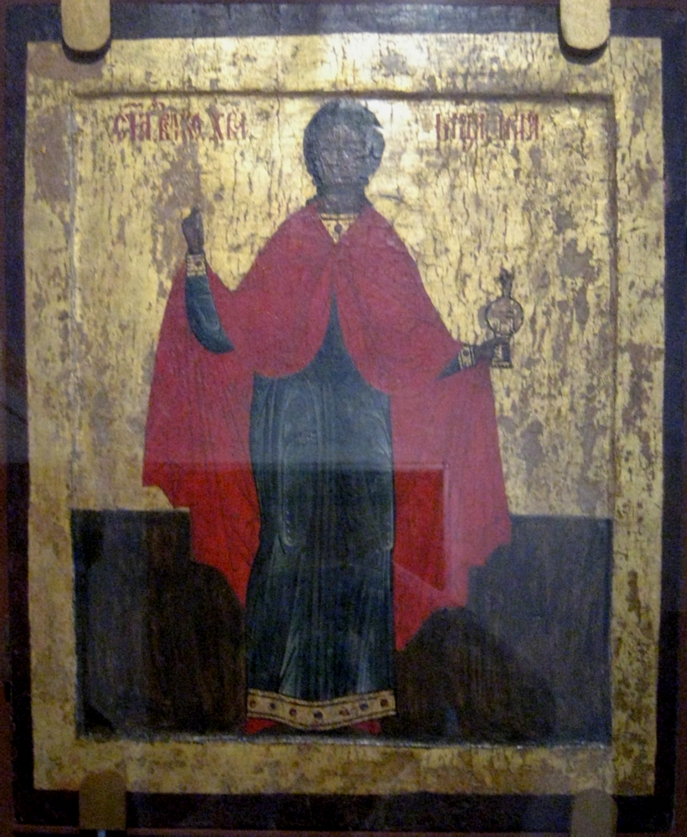
Irene is painted as a young woman of noble birth: bareheaded or veiled, in a long tunic with a red mantle fastened at the breast, holding the cross of witness, and often with a crown — sometimes worn, sometimes offered to her from above — in token of her royal descent and of her victory. Because her Acts make her a king's daughter, Russian and Balkan icons freely give her the korona and the jewelled hem of a princess, so that she can resemble St Barbara or St Catherine; the inscription is the only sure guide. Cycles of her passion, where they occur, show the three bronze oxen, the serpent-pit and the wild horse turning on her father. She appears in the May leaf of painted menaion icons and, in Greek churches, among the great women martyrs of the nave.
The stored image is a Russian icon of about 1595 from the iconostasis of the Church of the Transfiguration at the Kirillo-Belozersky Monastery: the saint standing full-length on a gold ground, in a crimson mantle over a dark green tunic with a jewelled border, her right hand raised in prayer and a cross in her left. The inscription is read СТАЯ ВЛКОМЧЦА ИРИНА — "Holy Great-Martyr Irene" — which fixes the identification on this saint and not on any of the other Irenes of the calendar.
Disputed questions
- The legendary character of the Acts. Irene's Passion is, in the judgement of every critical student of the hagiographic corpus, a hagiographic romance rather than a court record. It has no fixed chronology; its rulers cannot be arranged in any historical sequence (a "Numerian" of 283–284 stands beside a Persian Sapor — Shapur II reigned 309–379 — and beside a Timothy who belongs to the apostolic generation); its miracles are multiplied on a scale unlike the authentic Acts of, for example, Agape, Chionia and Irene or Irenaeus of Sirmium; and it includes a death, burial and resurrection followed by further preaching, a motif proper to the legendary passions. The earliest recoverable form of her story carries no names of time or place at all: the later retellings supply them, alter them, move her from city to city, and only at a late stage locate her in Persia. The Church's veneration of Irene is ancient and secure; what the Acts transmit is a cult, not a biography, and this entry reports their content as their content.
- Her homeland: Magedon in Persia, or Mygdonia in Macedonia? The Greek synaxarion places her in "Magedon, a city of Persia," and the OCA follows it. The Slavonic and Russian tradition reads the same name as Mygdonia, the district of Macedonia lying inland from Thessalonica, and therefore styles her Irene of Macedonia (Ирина Македонская) — from which comes the loose epithet "of Thessalonica" found in Greek and English popular usage. Neither reading can be verified, and they are not merely variant spellings but two different countries: the Persian setting agrees with the Sapor of the Acts, the Macedonian with her baptism by Timothy and with the Thracian and Ephesian stages of her journey. The Western tradition, for its own reasons, transferred her birth to Lecce in Italy. This repository uses the neutral title the Great Martyr precisely so that the slug does not decide the question.
- Her dating. The Greek synaxarion and the OCA put her in the fourth century and her repose about 315; the Russian calendar and the Prologue of Ohrid tradition place her in the second half of the first century, which is the only dating compatible with a baptism by Timothy the disciple of Paul; Western notices say "first or second century." The internal evidence of the Acts supports all three and none. The fourth-century reckoning is adopted here for indexing, following the Greek and Antiochian usage, with the disagreement recorded.
- Not to be confused with the virgin-martyr Irene of Thessalonica, one of the three sisters Agape, Chionia and Irene (April 16), who suffered at Thessalonica under Diocletian in 304 and whose Acts are genuine court records. This is the single most likely confusion in the calendar, because popular usage gives the great-martyr the same epithet "of Thessalonica" by way of Mygdonia in Macedonia. They are certainly distinct persons of distinct days.
- Not to be confused, further, with the Irene of the company of Irenaeus, Irene and Peregrinus, martyrs burned at Thessalonica, who are commemorated on the same day, May 5; with Sophia and Irene of Egypt (September 18); with Irene of Rome, who tended St Sebastian; with Irene of Cappadocia, abbess of Chrysovalantou (July 28); or with the empresses Irene of Athens and Irene of Hungary.