
Isaac the Recluse of the Kiev Caves
Our Venerable Father Isaac the Recluse of the Kiev Caves
Venerable · Fool for Christ · b. 11th century, at Toropets — d. c. 1090, at the Kiev Caves
Commemorated 14 February — Repose of Isaac the Recluse
Isaac (†c. 1090), born Chern, a wealthy merchant of Toropets in the Pskov land, gave away his goods and came to the Kiev Caves in the days of Saints Anthony and Theodosius, receiving the tonsure from Anthony's own hand. He shut himself in a tiny cave-cell, clothed in a raw goatskin, tasting a single prosphoron every other day, in an asceticism so extreme that it became his snare: demons appeared to him as angels of light and as Christ, and, when he bowed to them, seized him and drove him in a wild "game" of pipes and drums until he fell half-dead. Found near death and nursed for years back to strength — for two of them he lay speechless and helpless — Isaac rose from his fall a humbler man, took up menial labour in the monastery kitchen, embraced the way of the fool-for-Christ, and won at the last a true mastery over the demons that had once deceived him. He reposed about 1090 and rests in the Near Caves; he is kept on February 14.

From merchant to recluse
Isaac's story is told in the Kiev Caves Patericon and in the ancient Russian chronicle, among the most vivid and cautionary of all the tales of the Caves. Before his tonsure he was named Chern, and he was a rich merchant of the town of Toropets. Renouncing his wealth and his trade, he came to the Monastery of the Caves at Kiev and besought the tonsure of Saint Anthony, the founder, who received him. From the first Isaac sought not the common life of the brotherhood but the severest reclusion: he walled himself into a cave-cell so small he could not stretch out in it, wore next to his skin a fresh goatskin that dried hard upon his body, and ate only one small prosphoron every other day, with a little water, standing through the nights in prayer. For seven years, the Patericon says, he did not lie down, sleeping only as he sat.
The deception of the demons
It was upon this pinnacle of unshared and unguarded austerity that Isaac fell — and the Caves fathers preserved the tale precisely as a warning against ascetic pride and self-trust. One night a great light filled his cave, and there appeared to him two radiant youths, and then a figure of surpassing brightness who declared himself Christ come to receive His servant, bidding Isaac bow down. Isaac, not arming himself with the sign of the Cross nor testing the vision, bowed. At once the light became a mob of demons, who cried in triumph, "You are ours, Isaac!" and, seizing him, whirled him in a mad revel — with pipes, tambourines, and gusli — dancing and beating him until, worn utterly out, they left him at dawn lying scarcely alive on the floor of his cell.
The years of recovery, and the fool for Christ
In the morning Saint Theodosius, coming with bread to the recluse's window and receiving no answer, broke in and found Isaac as one dead. They carried him out; Saint Anthony himself tended him. For two years Isaac lay paralysed and speechless, unable to eat or move without help, and only slowly — nursed by the brethren through a third year — did he recover the use of his body and his tongue. When he had risen, he was a changed man. He gave up the proud solitude that had undone him and took the lowest place in the community, labouring in the kitchen, serving the brothers, enduring their jests. He put on the way of the fool-for-Christ, feigning simplicity, going barefoot in the frost, seeking mockery rather than honour, and so ground down every remnant of the self-reliance that the demons had exploited. In this humility he grew strong, and the same demons that had once deceived him now found him unassailable: when they came again in their old shapes he laughed at them, and they fled, powerless over the man who had learned to trust not himself but God. He reposed about the year 1090 and was buried in the Near (Anthony's) Caves, where his relics remain.
Feast and commemoration
Isaac is kept on February 14 (church date; Old Calendar civil February 27), a Russian and Kiev-Caves commemoration observed by the Russian Orthodox Church, the Ukrainian Church, and the Orthodox Church in America; it is not part of the universal Byzantine calendar. He is honoured also within the Synaxis of the Venerable Fathers of the Kiev Caves (of the Near Caves), and shares the common hymnody of those synaxes; no proper individual office is attested.
Hymns
Troparion — Tone 8
In thee, O Father, was the divine image kept secure; for taking up thy cross thou didst follow Christ, and by thy deeds thou didst teach us to despise the flesh, for it passeth away, but to care for the soul, a thing immortal. Therefore doth thy spirit, O venerable Isaac, rejoice together with the angels.
Original translation from the Greek
Iconography
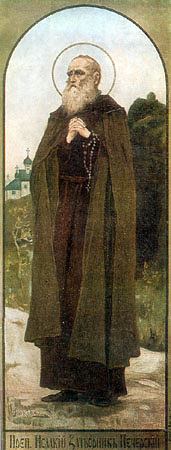
Isaac is depicted as a monk of the Caves — bearded, in the schema, often shown against the dark background of his cave-cell — and in the narrative tradition of the Patericon two scenes are proper to him: the demons' revel, in which he is whirled about by dancing devils with pipes and drums, and his burial by Anthony and the brethren. In the great cycles of the Caves Fathers he takes his place among the saints of the Near Caves.
The stored image is a figure of Saint Isaac of the Caves by Viktor Vasnetsov (late nineteenth century), from the artist's celebrated cycle of Russian saints (source, public domain, pd-old-work).
Disputed questions
- Not to be confused with the other saints of the name: Isaac the Syrian (Isaac of Nineveh, the ascetical writer), Isaac the martyr and Martin, or Isaac of Dalmatia (kept with the Dalmatus fathers). This Isaac is the eleventh-century recluse of the Kiev Caves, remembered for his fall and his recovery.