
Isaac the Syrian
Our Venerable Father Isaac the Syrian, Bishop of Nineveh
Venerable · Bishop · b. c. 613, in Beth Qatraye (eastern Arabia) — d. c. 700, at the monastery of Rabban Shabur
Commemorated 28 January — Commemoration; kept with Ephrem the Syrian
Isaac the Syrian (c. 613 – c. 700), also called Isaac of Nineveh, was an East-Syriac monk and bishop whose Ascetical Homilies became one of the most beloved and formative texts of Orthodox spiritual life. Born in the region of Beth Qatraye on the Persian Gulf, he embraced the monastic life, was consecrated bishop of Nineveh, and after only five months laid down the office to return to the solitude of the mountains, where he lived as a hermit and finally at the monastery of Rabban Shabur, reading and weeping until he lost his sight. His homilies — on repentance and tears, humility, stillness, the discernment of the passions, pure prayer, and above all the immeasurable love of God — were translated from Syriac into Greek at the Lavra of Saint Sabbas and passed thence into the whole Orthodox world, treasured by hesychasts, gathered into the Philokalia's tradition, and rendered into Slavonic and every Orthodox tongue. Though he belonged by birth to the Church of the East, the Orthodox Church has received him without reserve as a teacher and saint, and keeps his memory on January 28.

Origins and monastic beginnings
Isaac was born about the year 613 in Beth Qatraye, the Christian region along the western shore of the Persian Gulf (the coast of modern Qatar and eastern Arabia), then within the world of the Church of the East under the Catholicos of Seleucia-Ctesiphon. From this origin comes one of his by-names, "Isaac of Qatar." The sources for his life are few — a brief Syriac notice in the Book of Chastity of Ishoʿdnaḥ of Basra, an early Arabic life, and the internal witness of his own writings — but they agree on its shape. As a young man he entered the monastic life; one tradition places him, with a brother, at a monastery near Nineveh (the account the OCA follows names the monastery of Mar Matthew), and tells how, when the brother became its abbot and pressed him to return from his solitude, Isaac withdrew the further into the wilderness.
Bishop of Nineveh — and the return to solitude
His holiness and learning became known, and when the Catholicos George (Mar Gewargis I) visited the region, Isaac was consecrated bishop of Nineveh — the great city on the Tigris opposite Mosul — about the year 676, at the monastery of Beth Abhe. His episcopate lasted only five months. The tradition preserves a telling occasion for his resignation: two men of the city came before him in dispute over a debt, one demanding immediate payment by law, the other begging a little time; when the bishop counselled forbearance, appealing to the Gospel, the creditor retorted that the Gospel had no place here — at which Isaac reflected that if the Gospel found no room in the affairs of the city, he had no calling to govern it. Whether or not the anecdote is exact, it names truly the reason the tradition gives: Isaac was made for stillness, not administration, and he laid down the episcopate to return to the eremitical life he had left.
Hermit, blindness, and repose
He withdrew to the mountains of Beth Huzaye (Khuzistan, in south-western Persia), living as a solitary among the ascetics of the region, and at last entered the monastery of Rabban Shabur, where he gave himself to the study of Scripture and the writing of his homilies. He read and wept, the tradition says, until — like his forerunner in tears, Ephrem — he lost his eyesight from unceasing reading and weeping, and dictated his last teaching to his brethren. He reposed at Rabban Shabur about the year 700, at a great age, and was buried there. He left no foundation and sought no fame; what he left was his words.
The Ascetical Homilies
Isaac's writings — known in the Greek and Slavonic tradition as the Ascetical Homilies (or Mystic Treatises) — are a body of discourses, letters, and chapters on the inner life of the monk, and through the monk of every Christian soul. Their theme is the whole ascent of the soul to God: withdrawal and stillness (šelyā, the Syriac counterpart of Greek hēsychia); vigilance over the thoughts and the discernment of the passions; the labour of the body giving way to the labour of the heart; and above all repentance and the gift of tears, which Isaac makes the very threshold of the spiritual life — "the door of mercy," the baptism of the soul after baptism. He teaches humility as the garment of the Godhead, put on by the Word in the Incarnation and by every soul that would draw near; he distinguishes the degrees of prayer, up to the "prayer" that is no longer prayer but wonder and the stilling of the mind before God; and he writes of the love of God in words the whole Church has taken to heart — of the "merciful heart" that "burns for all creation, for men, for birds, for beasts, for the demons, and for every creature," that cannot bear to see or hear of any hurt or grief in the world, and prays even for the enemies of truth; and of divine love as a fire so strong that even those who are scourged in the age to come are "scourged by love," for there is no torment worse, and no sweetness greater, than to have wounded that Love. Dostoevsky's elder Zosima, and the whole modern Orthodox rediscovery of the "gladdening sorrow" of repentance, drink from this well.
Transmission and reception
The passage of Isaac's homilies into the wider Church is itself part of his sanctity. Toward the end of the eighth century two monks of the Lavra of Saint Sabbas near Jerusalem, Patrikios and Abramios, translated the First Part of his homilies from Syriac into Greek. Through this Greek version — copied, loved, and imitated across the Byzantine world — Isaac became one of the great masters of Orthodox ascetical and mystical theology, a constant authority for the hesychast fathers and a staple of the monasteries of Athos, Sinai, and Palestine. In the eighteenth century Paisius Velichkovsky and his circle translated him into Slavonic, and the Russian tradition — the Optina elders, Theophan the Recluse, Ignatius Brianchaninov — made him a household teacher of the interior life. Modern scholarship (notably the work of Sebastian Brock) has recovered a Second Part of his homilies in Syriac, deepening the picture of his thought. Across every division of language and even of communion, the Church has heard in Isaac the pure voice of the Gospel's inwardness.
Feast and commemoration
Isaac is kept on January 28 (church date; Old Calendar civil February 10), together with his elder countryman Ephrem the Syrian, so that the day gathers the two supreme ascetic teachers of the Syriac East. The Antiochian, Greek, and Slavic calendars all keep him. Devotion to Isaac has grown rather than waned: modern Greek monasticism has composed full services in his honour, and his commemoration is observed with special love on the Holy Mountain and in the Slavic Churches.
The Church-of-the-East origin
Isaac must be met with honesty on a point the tradition itself has weighed. He belonged, by birth, ordination, and episcopate, not to the Byzantine (Chalcedonian) Church but to the Church of the East — the ancient Church of Persia and Mesopotamia, which after the Council of Ephesus (431) and the christological disputes of the fifth century stood outside communion with the imperial Church, and which the Byzantines called by the polemical name "Nestorian." Isaac lived under its Catholicos and was consecrated by one of them. Yet the Orthodox Church has received him fully and without reserve as a saint and a father, reading his homilies in her monasteries and singing his praises in her services, and this reception is not an oversight but a judgement. Isaac's writings are innocent of the errors his Church was charged with; they breathe the undivided faith of the Fathers, and centre not on christological formulae but on repentance, humility, and the love of God, in which the whole Church recognises her own voice. His case is a witness that holiness and true theology can be found across the tragic frontiers of the divided East, and that the Church, in receiving him, honours the Spirit's work beyond the lines of institution. Where Isaac's inheritance touches the disputed questions of the Church of the East — the Second Part's hope for the ultimate mercy of God upon all — the tradition receives what accords with the mind of the Fathers and passes by what does not, as it has always read even its own doctors with discernment (see Disputed questions).
Hymns
Troparion — Tone 8
By the streams of thy tears thou didst make the wilderness to blossom, and by thy deep-drawn sighing thou didst bear fruit a hundredfold in thy labours; and thou becamest a beacon of stillness, enlightening the world with thy teaching. O Isaac our holy Father, intercede with Christ our God that our souls may be saved.
Original translation from the Greek
Kontakion — Tone 2
Illumined by stillness and taught by thine own tears, O Isaac, thou didst set down for the world the paths of repentance and the measures of prayer; wherefore, O Father, thou dost guide the faithful to the love of God.
Original translation from the Greek
Iconography
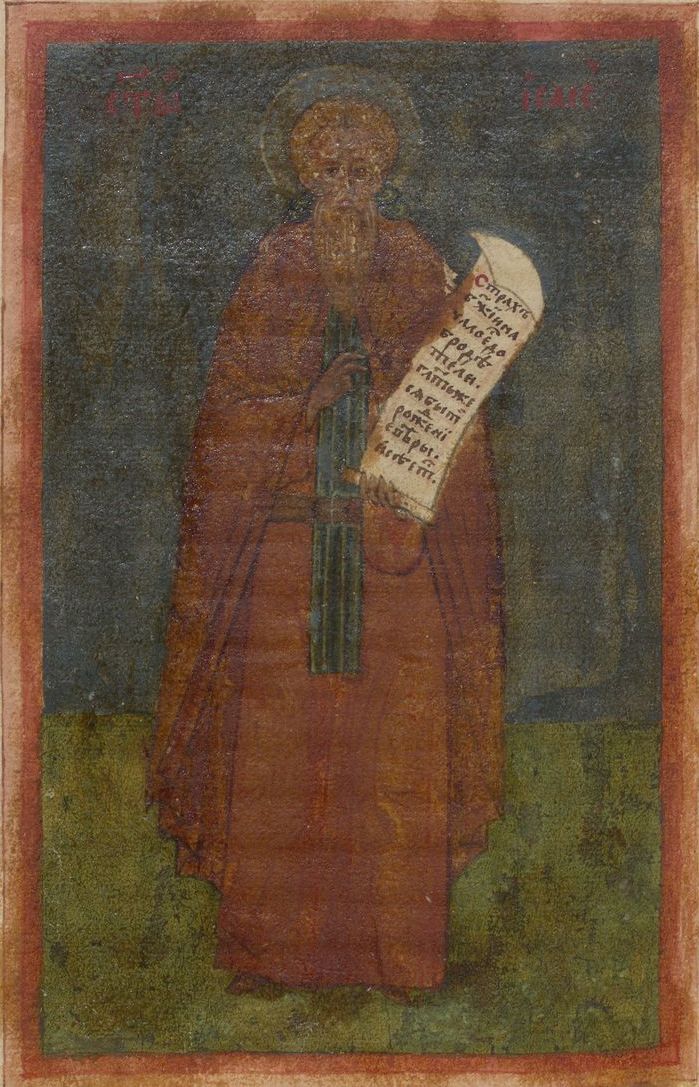
Isaac is depicted as a Syrian monk-bishop: an ascetic, thin and grave, with a long dark or greying beard, usually in the monastic habit and sometimes with the omophorion of his brief episcopate, holding a scroll or an open book — often inscribed with a sentence of his own on repentance or the love of God. Because his glory is that of a writer and hesychast, the book or scroll is his constant attribute, and he is frequently shown in the pose of a teacher of the interior life.
The stored image is a Russian manuscript miniature of 1518, from a copy of Isaac's Ascetical Homilies made by the monk-scribe Ioasaph Khokholek of the Kirillo-Belozersky Monastery: Isaac the Syrian shown as the author of the book his readers held in their hands (source, public domain, pd-old-work). The identification is secured by the manuscript's own contents — it is Isaac of Nineveh's homilies — distinguishing this figure from the other saints named Isaac (see Disputed questions).
Disputed questions
- The century of his life. Older calendars and lives — the OCA notice among them — place Isaac in the sixth century. The witness of the Syriac sources (the Book of Chastity of Ishoʿdnaḥ) and modern scholarship establish rather the seventh: consecrated bishop of Nineveh by the Catholicos George around 676 and reposing near the year 700. The entry follows the seventh-century dating and notes the older reckoning where it differs.
- The "Second Part" and the hope of universal mercy. The Syriac Second Part of the homilies, recovered in modern times, contains passages expressing a hope that the mercy of God will finally embrace even the damned — a strand of thought that runs, in the Church of the East, back to Theodore of Mopsuestia and, in the wider tradition, to the debated speculations associated with Origen and Gregory of Nyssa. The Orthodox Church has never adopted universal restoration as doctrine; it reads Isaac, as it reads every father, by the measure of the whole tradition, cherishing his overwhelming vision of the divine love while not making of his hope a dogma. The First Part, on which his universal reception rests, is free of the difficulty.
- Not to be confused with Isaac the Syrian, Abbot of Spoleto (†c. 550, kept April 11/12) — a different Syrian saint, a monk who fled Monophysite persecution in his homeland and lived some fifty years as a hermit at Monte Luco above Spoleto in Italy, known from the Dialogues of Gregory the Great; the shared epithet "the Syrian" has caused the two to be confounded, but they are distinct men of distinct centuries and lands. Nor with Isaac the Confessor of the Dalmatian Monastery at Constantinople (†c. 383, kept May 30 and August 3), who withstood the emperor Valens; nor with Isaac of Optina (Isaac Antimonov, †1894), abbot of Optina Monastery. "Of Nineveh" belongs to this Isaac alone.