
Januarius of Benevento
The Holy Hieromartyr Januarius, Bishop of Benevento, and his Companions
Hieromartyr · Bishop · Deacon · Martyr · d. c. 305
Commemorated 21 April — Martyrdom at Pozzuoli under Diocletian
Januarius, Bishop of Benevento in Campania, was beheaded near Pozzuoli about the year 305, in the persecution of Diocletian, together with a company of six: his own deacon Festus and his lector Desiderius, the deacons Sossius of Misenum and Proculus of Pozzuoli, and two laymen, Eutychius and Acutius. The Byzantine synaxaria keep the whole company on April 21; the West keeps Januarius on September 19. His relics were carried to Naples, of which he became the great patron; there, from the fourteenth century onward, the periodic liquefaction of a relic of his blood has made him one of the most famous martyrs of the Latin world — though the Orthodox Church honours him, then as now, simply as a hieromartyr who confessed Christ before a magistrate and died for it.
.jpg)
Origins and episcopate
Nothing certain survives of Januarius's family or early years. The surviving Acts are late and legendary — the two principal recensions are conventionally called the Acta Bononiensia (the Bologna acts, epitomised by St Bede in his martyrology about the year 733) and the Acta Vaticana — and they agree only on the outline. Later Campanian tradition makes him a native of Benevento or of Naples, born in the third century of a family of standing, and raised to the see of Benevento, the chief city of inland Campania, while still a young man. The office he held is the one point on which the whole tradition, Eastern and Western, is unanimous: he was a bishop, and it is as a bishop that the Greek books style him hieromartyr.
The arrest of the company
The persecution under Diocletian and Maximian reached Campania in the first years of the fourth century. According to the Acts, the chain of arrests began not with Januarius but with Sossius, deacon of the church of Misenum, seized and imprisoned at Puteoli (Pozzuoli). Januarius, hearing of it, came to visit and encourage the confessor — an act of pastoral courage that made him a marked man. With Sossius in prison, or arrested soon after, were Proculus, deacon of the church of Puteoli, and two laymen of that city, Eutychius and Acutius. Januarius was taken with the two clerics of his own household who had accompanied him: his deacon Festus and his lector Desiderius.
The transmitted roll therefore falls into two natural groups — the bishop of Benevento with his deacon and reader, and the Puteolan and Misenate confessors — and this is one reason critics have suspected that the Acts have fused what were originally distinct martyrdoms into a single company. Sossius and Proculus each kept an independent cultus in their own cities, and Sossius is honoured on his own day (September 23) in the Latin books. The Byzantine synaxaria transmit the group as a single company, with the members' names varying between manuscripts.
Trial and martyrdom
The Acts set the trial before the governor of Campania. The Bologna recension names him Timotheus, praeses of Campania; the recension followed by the Slavonic and Greek synaxaria and by the Russian Lives calls him Menignus — one of the many small divergences that mark the tradition as late.
The narrative that follows is built of the standard elements of the Diocletianic passions, and is best reported as the Church has received it rather than pressed as history. Januarius, refusing to sacrifice, was cast into a fiery furnace and came out untouched, his very garments unsinged. He was then scourged with iron rods until his bones showed. The Christians who had gathered and confessed Christ at the sight were arrested with him. The whole company was next exposed in the amphitheatre at Puteoli — the great Flavian amphitheatre whose ruins still stand — but the beasts loosed against them lay down at the martyrs' feet and would not touch them. The governor, declaring the wonder to be magic, was at that moment struck blind; Januarius prayed, and his sight was restored. The Breviary tradition adds that some five thousand of the onlookers believed. The judge was unmoved by his own healing, and ordered the company beheaded outside the walls — by Neapolitan tradition at the sulphurous volcanic field of the Solfatara, between Pozzuoli and Naples, where a shrine has stood since the Middle Ages. The year is given as about 305; some accounts place the martyrdom a year or two earlier, in 303 or 304, at the opening of the persecution.
Relics and translations
The faithful gathered the bodies of the martyrs and buried each company in its own city. The relics of Januarius were carried into Naples, and laid in the cemetery on the hill of Capodimonte which has borne his name ever since — the Catacombs of San Gennaro, whose galleries preserve some of the earliest surviving painted and mosaic portraits of a saint in the West. The translation is traditionally ascribed to John I, bishop of Naples, in the first half of the fifth century.
The relics travelled repeatedly thereafter. About 831 the Lombard prince Sico of Benevento, having raided the Neapolitan territory, carried the body off to Benevento — though the head was kept at Naples, and remains there. After Benevento was sacked in the twelfth century the relics were hidden in the Benedictine sanctuary of Montevergine, where they were lost sight of and rediscovered in 1480. In 1497 they were brought back to Naples at the instance of Cardinal Oliviero Carafa, who built beneath the high altar of the cathedral the crypt called the Succorpo (completed about 1506) to receive them, and so reunited body, head, and blood in one place.
The relic of the blood
Naples preserves, in a silver reliquary of two sealed glass ampoules, a dark substance venerated as the blood of the martyr, which a later legend attributes to a pious woman — named Eusebia in the developed form of the story — who is said to have gathered it at the place of beheading. At certain seasons the mass in the ampoules becomes liquid, and often bright, when the reliquary is exposed near the reliquary of the head.
The first securely dated record of a liquefaction is 1389; the earlier history of the relic is undocumented, and older claims that the phenomenon was first noticed in 1456 have been superseded. Naples now looks for it three times a year: on the Saturday before the first Sunday of May, keeping the translation of the relics into the city; on September 19, the Western feast of the martyrdom; and on December 16, kept since the eruption of Vesuvius in 1631 in thanksgiving for the city's deliverance. Failure of the liquefaction has long been read at Naples as an omen of calamity. Repeated attempts to account for the change physically — thixotropy of a gel, a low-melting compound, an iron-salt suspension — remain inconclusive, chiefly because the relic cannot be opened.
Orthodox usage should be clear on the point: the veneration of Januarius in the East is older than any record of the blood-wonder and does not rest on it. The Greek synaxaria commemorate a bishop martyred with his companions; the Neapolitan phenomenon belongs to the later Western history of his relics, and is reported here as part of the record rather than as an article of his cultus.
Patron of Naples against the mountain
Januarius's patronage of Naples was fixed above all by Vesuvius. The tradition attaches his first great intervention to a fifth-century eruption — the eruption of 472, or in the version received by the Slavonic and OCA Lives, about 431 — when the citizens processed and prayed and the lava is said to have halted short of the city. After the catastrophic eruption of 1631 he was proclaimed the city's chief protector by formal act, and the December commemoration was established. He is invoked to this day against volcanic eruption, and — from the relic of the blood — as patron of blood donors and of those who suffer haemorrhage.
Veneration in the East
The reception of a Campanian martyr into the Byzantine calendar is easily explained: Naples and its duchy were imperial territory under Constantinople from the sixth century until well into the eighth, with a Greek-speaking clerical and monastic presence, and the Italo-Greek monasteries of southern Italy carried Campanian and Sicilian saints into the Greek synaxaria. The Synaxarion of Constantinople commemorates "Januarius the hieromartyr and those with him" on April 21, and the Greek and Slavonic books have kept him there ever since; the day's canon in the printed Menaion is his. The Antiochian Archdiocese lists him on April 21 as "Januarius the Hieromartyr and those with him," together with the martyr Theodore of Perge and the patriarch Maximian.
Feast and commemoration
April 21 (church date; New Calendar civil April 21, Old Calendar civil May 4), in the Pentecostarion season or the closing days of Great Lent according to the year. The commemoration is universal in the Byzantine rite and is styled a commemoration of the hieromartyr with those who suffered with him, so that the deacons Festus, Sossius and Proculus, the lector Desiderius, and the laymen Eutychius and Acutius are named with him. The West keeps him on September 19 with the rank of a memorial, and at Naples with the solemnity of the city's patron; Naples adds the May translation and the December thanksgiving, and the Armenian Church commemorates him on the Monday after the second Sunday of Advent. On April 21 the Greek and Antiochian books commemorate him first, before Theodore of Perge and Maximian of Constantinople.
Hymns
Apolytikion
Sharing the manner of life of the Apostles and seated upon their thrones, thou didst find in the practice of virtue the ascent to divine vision, O inspired one; therefore, having rightly dispensed the word of truth, thou didst contend for the faith even unto blood, O hieromartyr Januarius. Intercede with Christ our God that our souls may be saved.
Troparion
Thy martyrs, O Lord, in their contest received from Thee, our God, the crowns of incorruption; for having Thy strength, they cast down their persecutors and broke the feeble arrogance of the demons. By their supplications, O Christ God, save our souls.
Original translation from the Greek
Kontakion — Tone 2
Thou didst tend the flock of Christ as a shepherd and didst lay down thy life for the sheep, O wise Januarius; and with thee the deacons and the faithful people were crowned, a sevenfold choir offered to the Trinity. Wherefore we cry to you: cease not to intercede for us who honour your memory.
Original translation from the Greek
Iconography
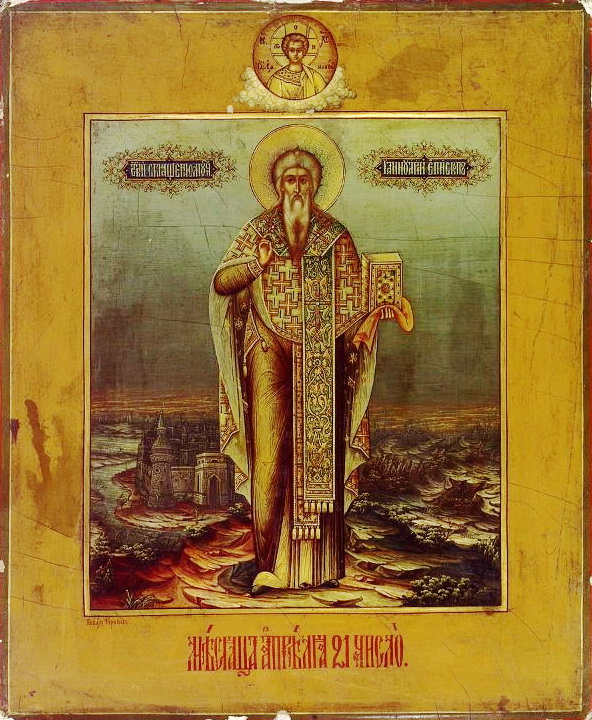
Januarius is written in the East as a hierarch-martyr: standing or bust-length, in phelonion and crossed omophorion, blessing with the right hand and holding the jewelled Gospel in the left, with the greying or white beard of an elder bishop. Where the company is shown, the deacons appear beside him in sticharion and orarion, the lector in a plain tunic with a book, the two laymen in tunic and mantle, all bearing crosses; the passion scene shows the beheading of the seven, and sometimes the beasts crouching at their feet in the amphitheatre or the furnace out of which the bishop steps unharmed.
Western art, by contrast, made him a Neapolitan spectacle: a mitred bishop in cope and pontificals, holding the two ampoules of blood, often with Vesuvius smoking behind him or with the volcano being quelled by his upraised hand — the type fixed in the Baroque painting of Naples and quite distinct from the Byzantine hierarch.
The stored image is a Russian menaion icon of about 1850 by Osip Semenovich Chirikov, one of a set of monthly panels painted for a palace chapel and now in the State Museum of the History of Religion at St Petersburg. It answers the Eastern type exactly: the saint stands in a jewelled sakkos and omophorion, blessing and holding the Gospel, with a walled city on the left; the inscription reads Св. священномученикъ Іаннуарій епископъ ("Holy Hieromartyr Januarius, bishop"), and the lower cartouche names the day — Мѣсяца апрѣля 21 число, "the month of April, the 21st day" — which confirms the identification against the other bishops of the name.
Disputed questions
- Bishop of Benevento or of Naples? The Beneventan tradition, followed by Bede, the Roman Martyrology, and the Byzantine synaxaria, makes him bishop of Benevento. A rival Neapolitan tradition — reflected in some reference works and in his cultus as San Gennaro of Naples — has him bishop of Naples, which is almost certainly a retrojection from the city that possessed his relics. Benevento remains the better-attested claim.
- Are the seven one company? The independent cults of Sossius at Misenum and Proculus at Pozzuoli, and the two-part shape of the roll, make it likely that the Acts gathered martyrs of neighbouring churches into a single passion. The Church commemorates them together, and this entry keeps them together while recording the doubt.
- The names. Manuscripts and calendars vary: Sossius / Sosius / Sosus, Eutyches / Eutychius, Acutius / Acution, and Festus is sometimes given as Faustus (as in the Russian Lives and hence in OCA usage). No definitive roll can be asserted.
- The governor. Timotheus in the Bologna acts, Menignus in the tradition behind the Slavonic synaxaria. Neither is otherwise attested as praeses of Campania.
- The date. c. 305 is the received date; 303–304 is defended on the ground that the Campanian arrests belong to the first edicts.
- Two feasts. The Eastern April 21 and the Western September 19 are the same martyr. The September date is Naples's own and is the older of the two in Latin martyrologies; the origin of the Byzantine April date is unexplained, and may go back to a dedication or a local translation rather than to the day of death.
- Not to be confused with the several other bishops named Januarius in the Latin martyrologies, nor with the Januarius numbered among the sons of St Felicitas of Rome.