
Maximian of Constantinople
Our Father among the Saints Maximian, Archbishop and Patriarch of Constantinople
Patriarch · Bishop · d. 434
Commemorated 21 April — Commemoration of the patriarch who reposed in peace in 434
Maximian, a Roman by birth who had lived as an ascetic and spent his own inheritance burying the bodies of holy men, was raised from the presbyterate to the throne of Constantinople on 25 October 431, four months after the Third Ecumenical Council at Ephesus deposed Nestorius. His two and a half years in the see were given almost wholly to peace: he cleared the capital and the neighbouring sees of Nestorian bishops, and he laboured — pressing even St Cyril of Alexandria to set his Twelve Anathemas aside for the sake of concord — for the reconciliation of Alexandria with John of Antioch and the Eastern bishops, which was achieved in the Formula of Reunion of 433. He reposed in peace, on Great and Holy Thursday of 434, and is commemorated on April 21.

Origins and ascetic beginnings
Maximian was born at Rome, of parents described as wealthy and devout. He had no taste for public life; the sources agree in presenting him as a man of retirement, learning, and unfeigned integrity, who embraced the monastic manner of life and gave himself to prayer. He came east and was numbered among the clergy of Constantinople, being ordained presbyter by the archbishop Sisinnius I (426–427).
The one concrete act attributed to him before his elevation is a striking one, and the church historian Socrates Scholasticus singles it out: at his own expense Maximian built tombs for the bodies of holy men, providing burial and honour for the relics of the saints. It was an act of piety with no political dividend, and it is what made his name in the city. He sought nothing further, and was, by every account, an unwilling candidate for the see.
Raised to the throne in the aftermath of Ephesus
The circumstances of his election were the most difficult imaginable. Nestorius, archbishop of Constantinople since 428, had been condemned and deposed at the Council of Ephesus in the summer of 431 for refusing the title Theotokos to the Virgin, and the city was divided: a party of the clergy and people held to the deposed archbishop, the Eastern bishops under John of Antioch had held a rival session at Ephesus and were in schism with Alexandria, and the imperial court under Theodosius II was anxious above all for quiet.
For some four months the see stood vacant. Then, on 25 October 431, the clergy, the people, and the emperor together settled on Maximian — precisely because he belonged to no faction. He was consecrated with the emperor's warm support, and, in the words of the historians, the city "was at rest." Pope Celestine I wrote to congratulate him in terms of high praise, and he afterwards corresponded with Celestine's successor Sixtus III; Cyril of Alexandria received him into communion at once.
The pacification of the churches
Maximian's brief episcopate was a work of peace-making pursued with unusual firmness in two directions at once.
Against the party of Nestorius he acted decisively. Four bishops who continued to teach and to communicate with the deposed archbishop — Helladius of Tarsus, Eutherius of Tyana, Himerius of Nicomedia, and Dorotheus of Marcianopolis — were deposed, with the concurrence of the emperor. Some of the Eastern bishops, John of Antioch among them, at first refused communion with Maximian on the ground that his consecration presupposed a deposition they had not accepted; the breach was real, and the new archbishop set himself to heal it rather than to win it.
Towards Alexandria he was equally direct, and here his significance for the Antiochian tradition is greatest. The chief obstacle to reunion was Cyril's Twelve Anathemas appended to his third letter to Nestorius, which the Antiochene bishops read as Apollinarian and refused to subscribe. Maximian pressed Cyril to let the anathemas fall as an impediment to peace, urging that the faith of Ephesus did not stand or fall with that document. Together with the imperial tribune Aristolaus and the mediation of Paul, bishop of Emesa, this pressure bore fruit: in 433 Cyril and John of Antioch subscribed the Formula of Reunion, an Antiochene-drafted confession that Cyril accepted with his famous letter Laetentur caeli — "let the heavens rejoice." The reconciliation of Antioch and Alexandria, which held (with strain) until the crisis of 448, is the achievement of Maximian's patriarchate as much as of the two great sees themselves.
Repose
Maximian died in office, having held the see about two years and five months. Socrates places his death on Thursday 12 April 434 — Great and Holy Thursday of that year, the consulate of Areobindus and Aspar. So urgent was the court that no second interregnum should open the question again that Proclus, long since chosen bishop of Cyzicus and twice passed over for Constantinople, was enthroned by the assembled bishops at the emperor's insistence before Maximian had been buried — an irregularity that the Church accepted for the sake of peace, and that gave Constantinople in Proclus one of its holiest archbishops. Maximian's body was laid in the church of the Holy Apostles among his predecessors.
Writings
Almost nothing survives. A single letter of Maximian to Cyril of Alexandria is preserved in the conciliar collections; his correspondence with Celestine and Sixtus of Rome, and whatever homilies he preached, are lost. He left no doctrinal treatise, and his memory in the Church is that of a peacemaker rather than a theologian — which is very nearly what the sources say of him in his own lifetime.
Feast and commemoration
April 21 (church date; New Calendar civil April 21, Old Calendar civil May 4). The commemoration is universal in the Byzantine rite, and is a simple memorial: the printed Menaion gives the propers of the day to the martyrs — the hieromartyr Januarius of Benevento and his companions and Theodore of Perge with his mother Philippa — and Maximian is served from the common of a hierarch. The Antiochian Archdiocese lists "Maximian, Patriarch of Constantinople" third among the day's commemorations, and there is good reason for Antiochian memory to keep him: the reunion of 433 that healed the breach between Antioch and Alexandria was his work as much as anyone's. He is also named in the diptychs and episcopal lists of Constantinople between Nestorius and Proclus, and it is chiefly through those lists that his name reached the calendars.
Hymns
Apolytikion — Tone 4 (common of a hierarch)
The truth of things hath shown thee forth to thy flock as a rule of faith, an image of meekness, and a teacher of temperance; therefore hast thou attained to lofty things by humility, and to riches by poverty. O father and hierarch Maximian, intercede with Christ our God that our souls may be saved.
Kontakion — Tone 2
Called from stillness to the shepherd's throne, thou didst seek not thine own but the peace of the Churches, O all-blessed Maximian; and having gathered the scattered into one confession of the Theotokos, thou didst pass over to the light unwaning. Wherefore we cry: rejoice, O reconciler of the divided.
Original translation from the Greek
Iconography
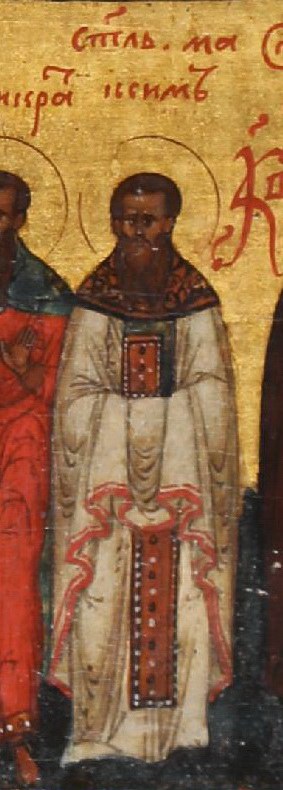
Maximian is written as a hierarch of the fifth century: standing or bust-length in phelonion and crossed omophorion — or, in later Russian panels, in the jewelled sakkos — blessing with the right hand and holding the Gospel in the left, the beard dark or greying and of moderate length, the head bare in the Byzantine manner rather than mitred. He carries no distinguishing attribute; his identification depends entirely on the inscription, and in practice he is met with only twice: in the monthly menaion icons for April, where he takes his place in the register for the twenty-first day, and in series of the archbishops of Constantinople, where he stands between Nestorius's vacant place and St Proclus. Where a composition alludes to his work, it does so through the Theotokos, whose title he defended by defending Ephesus.
No pre-1900 image of him has been identified for this collection. The Menologion of Basil II, the usual first resort for lesser-known saints of the fixed year, covers only September to February and does not reach April.
The stored image is his figure from a 17th-century Russian menaion icon for April (Central Andrey Rublev Museum), the patriarch named in the month's ranked row.
Disputed questions
- The date of his death, and why the feast is April 21. Socrates Scholasticus gives 12 April 434, specifying that it was the Thursday of Great Week; and this is coherent, since Pascha in 434 fell on 15 April, so that Great and Holy Thursday was indeed 12 April. The Synaxarion of Constantinople, however, commemorates him on 21 April, and some modern synaxaria (the OCA Lives among them) have harmonised the two by asserting that he died on April 21, "which was Great and Holy Thursday." That cannot be right: 21 April 434 was a Saturday. Either the synaxarion date marks something other than the day of death — a burial, a translation, or a displacement to avoid a crowded day — or it is simply a transmission error. This entry keeps the received feast of April 21 and the historical death-date of 12 April 434.
- Monk or not. That Maximian "led a monastic life" is stated by Socrates and repeated in the synaxaria, but he is not styled venerable (ὅσιος) in the Byzantine books, which commemorate him purely as a hierarch; his classification here follows that usage.
- The length of the vacancy. "About four months" between the deposition of Nestorius and the ordination of Maximian is the figure given by the historians; the precise legal moment of Nestorius's removal from the see was itself contested at the time, which makes the interval elastic.
- Not to be confused with the emperor Maximian (Maximianus Herculius, †310), the colleague of Diocletian and one of the great persecutors, who appears as the persecuting emperor in many martyr-acts in this corpus — including some on days near this one.