
Jeremiah the Prophet
The Holy Prophet Jeremiah
Prophet · b. c. 650 BC, at Anathoth in Benjamin — d. c. 570 BC, at Tahpanhes in Egypt
Commemorated 1 May — Memory of the prophet, stoned at Tahpanhes
Jeremiah is the second of the four Greater Prophets, the priest of Anathoth who was called as a boy in the thirteenth year of Josiah and prophesied for some forty years, through the reigns of five kings, until Jerusalem fell and the Temple burned. To him was given the bitterest of all prophetic commissions: to announce the ruin of his own city, to be hated for it by priests, princes and people, beaten, put in the stocks, imprisoned and let down into a miry cistern to die — and yet to promise, at the very bottom of the catastrophe, a new covenant written not on tablets but on the heart (Jeremiah 31:31–34), the text that gives the New Testament its name. Dragged into Egypt by the fleeing remnant against his own warning, he was stoned to death by his countrymen at Tahpanhes. The Church honours him on May 1 as prophet and martyr, reads him through Holy Week as the figure of the innocent Lamb led to slaughter, and ascribes to him the Book of Jeremiah and the Lamentations.
Origins and early life
Jeremiah — in Greek Ἰερεμίας, in Hebrew Yirmĕyahu, "the Lord exalts" or "the Lord looses" — was born about 650 BC at Anathoth, a priestly village some three miles north-east of Jerusalem in the territory of Benjamin. His father was Hilkiah (in the Greek, Helkias), "of the priests that were in Anathoth" (Jeremiah 1:1). Anathoth was the place to which Solomon had banished the priest Abiathar of the house of Eli, and it is often supposed that Jeremiah belonged to that displaced and disinherited priestly line — which would explain both his intimate knowledge of the sanctuary and his lifelong distance from the Jerusalem priesthood that persecuted him. He never served at the altar; his priesthood was of another kind.
He was called in the thirteenth year of Josiah (627/626 BC), and the call is recorded with unequalled intimacy: "Before I formed thee in the belly I knew thee; and before thou camest forth out of the womb I sanctified thee, and I ordained thee a prophet unto the nations" (Jeremiah 1:5). He resisted — "Ah, Lord God! behold, I cannot speak: for I am a child" — and was answered with the promise that afterwards became the pattern of every reluctant vocation in Scripture: "Say not, I am a child: for thou shalt go to all that I shall send thee… Be not afraid of their faces: for I am with thee to deliver thee." Then the Lord "put forth his hand and touched my mouth," saying, "Behold, I have put my words in thy mouth." The Greek synaxaria, reckoning from Josiah's regnal years, say the boy was about fifteen when this happened, and the Church's notices for May 1 repeat the figure. Two visions sealed the commission: the rod of an almond tree, watchful because the almond is the first tree to wake in spring, a sign that God watches over his word to perform it; and the seething cauldron tilted from the north, the empire that would boil over upon Judah.
The prophet in Jerusalem: the word against the city
Jeremiah's ministry spanned the reigns of Josiah, Jehoahaz (Shallum), Jehoiakim, Jehoiachin (Jeconiah) and Zedekiah, and continued under the governor Gedaliah after the fall — some forty years and more, from the last flare of Judah's independence to its extinction. He began in the years of Josiah's great reform, when the book of the Law was found in the Temple (622 BC) and the high places were thrown down; but his own message is never that of a court prophet celebrating reform. He saw that the cleansing of the shrines had not touched the heart, that the people were "a treacherous wife," that the reformed cult had become a new and more dangerous confidence: because the Temple stood, the city thought itself safe.
Against that confidence he was sent to preach in the Temple gate itself the sermon that almost cost him his life: "Trust ye not in lying words, saying, The temple of the Lord, the temple of the Lord, the temple of the Lord, are these" (Jeremiah 7:4). Shiloh, he reminded them, had also held the ark, and Shiloh was a ruin. For this the priests and the prophets seized him and said, "Thou shalt surely die"; he was saved when certain of the elders recalled that Micah of Moresheth had prophesied the same thing in Hezekiah's day and had not been put to death (Jeremiah 26). The prophet Uriah son of Shemaiah, who spoke as Jeremiah did, was less fortunate: he fled to Egypt, was extradited and killed by Jehoiakim — the measure of the danger Jeremiah lived in for forty years.
His preaching was constantly enacted as well as spoken, in the manner of the older prophets. He hid a linen girdle in a cleft of the rock by the river until it rotted, and showed it as the image of a people spoiled of all usefulness (13). He went down to the potter's house and watched the marred vessel remade, and learned that a nation is clay in the hand of God (18); and then he took an earthen flask to the valley of the son of Hinnom, where children had been burnt to Moloch, and broke it before the elders: "Even so will I break this people and this city, as a man breaketh a potter's vessel, that cannot be made whole again" (19). He wore a wooden yoke through the streets to signify submission to Babylon; when the false prophet Hananiah broke it in the Temple and promised that the exile would end in two years, Jeremiah was sent back with a yoke of iron (27–28). He was forbidden by God to marry or to father children, and forbidden to enter a house of mourning or of feasting: his celibate and solitary life was itself a sign that the ordinary human future was about to be cut off (16). He set the wine-cup before the Rechabites, who refused it for their father's commandment's sake, and made their obedience a reproach to Judah's (35). And when Jerusalem was already under siege he bought a field at Anathoth from his cousin Hanamel and had the deeds sealed and stored in an earthen jar — the most stubborn act of hope in the Old Testament, "for thus saith the Lord of hosts: Houses and fields and vineyards shall be possessed again in this land" (32).
To the exiles already carried off with Jehoiachin in 597 he wrote the letter that turned captivity into vocation: build houses, plant gardens, marry, "and seek the peace of the city whither I have caused you to be carried away captive, and pray unto the Lord for it: for in the peace thereof shall ye have peace" (29:5–7). Against the comfortable oracles of Hananiah and Shemaiah he set the plain word that the exile would last seventy years, and that only after them would God visit his people.
The burning of the scroll
In the fourth and fifth years of Jehoiakim Jeremiah was barred from the Temple, and so he dictated to his disciple and secretary Baruch son of Neriah all the words he had spoken from the beginning, and sent Baruch to read the roll in the house of the Lord on a fast day. Read a second time before the princes, it was carried to the king. Jehoiakim sat in his winter house with a brazier burning before him, and as Jehudi read three or four columns the king cut them off with a penknife and threw them in the fire, "until all the roll was consumed" — and, the text notes with contempt, neither he nor his servants rent their garments (Jeremiah 36). Jeremiah and Baruch, hidden by the Lord, then wrote the whole book again, "and there were added besides unto them many like words." The episode is the single clearest window in Scripture on how a prophetic book came to be a book, and it is why Baruch, who is himself commemorated by the Church (Baruch the Prophet, September 28), is inseparable from Jeremiah's memory.
The cistern and the fall of Jerusalem
Under Zedekiah, the last king, the pressure became lethal. Jeremiah counselled surrender to Babylon as the only way to save the city and the Temple, and was therefore held to be a traitor. Leaving Jerusalem during a lull in the siege to see to his family property, he was arrested at the gate of Benjamin by the captain Irijah on a charge of deserting to the Chaldeans, beaten and shut up in a dungeon (37). Brought out at the king's secret request, he repeated the same word, and was left in the court of the guard. Then the princes demanded his death, and — because Zedekiah, weak and frightened of his own nobles, would not resist them — they let him down with cords into the cistern of Malchiah the king's son: "and in the dungeon there was no water, but mire: so Jeremiah sunk in the mire" (38:6). The synaxarion tradition, following the Greek accounts, adds that the pit was foul with vermin, and that he lay there in the filth expecting to die.
He was saved by a foreigner. Ebed-melech the Ethiopian, a eunuch of the palace, went to the king in the gate of Benjamin and said plainly that the men had done evil, and that the prophet would die of hunger where he was. Zedekiah gave him thirty men; they took old rags and worn-out garments to pad the ropes against the prophet's armpits, and drew him up. For that act of mercy Ebed-melech received his own oracle of deliverance (39:15–18), and the Fathers made him the type of the nations who would receive what Israel cast away. Jeremiah remained in the court of the guard until the city fell.
In the eleventh year of Zedekiah (587/586 BC) the wall was breached, the king was blinded at Riblah after seeing his sons killed, and Nebuchadnezzar's captain Nebuzaradan burned the Temple, the palace and the houses of Jerusalem and broke down the walls. He had orders concerning Jeremiah alone of all the city: to do him no harm and let him choose freely whether to go to Babylon in honour or to remain. Jeremiah chose to remain with the poorest of the land, under the governor Gedaliah son of Ahikam at Mizpah.
The forced flight into Egypt, and the death at Tahpanhes
Within months Gedaliah was murdered by Ishmael of the royal seed, and the terrified remnant, led by Johanan son of Kareah, resolved to escape into Egypt. They came to Jeremiah and swore to do whatever the Lord should answer; he waited ten days, and answered that they must stay in the land and not fear the king of Babylon, "for I am with you to save you." They called him a liar, accused Baruch of putting him up to it, and carried the old prophet and his secretary down into Egypt against their will (Jeremiah 42–43). At Tahpanhes (Greek Τάφνας, the Daphnae of the Delta) he hid stones in the clay of the pavement at the entry of Pharaoh's house and prophesied that Nebuchadnezzar would set his throne upon them; there he uttered his last oracles against Egypt and against the Judean colony that had resumed burning incense to the queen of heaven (44).
The manner of his death is not in Scripture. The unanimous tradition of the Church — carried by the ancient Lives of the Prophets, by the Greek synaxaria, and by the notices of every Orthodox calendar for May 1 — is that his own people stoned him to death at Tahpanhes, enraged by his prophecy that they and Egypt would perish together; and that the prophecy was fulfilled in that same year, when Nebuchadnezzar came down upon Egypt. Because of this the Church calls him not only prophet but martyr, and the epithet passes into his hymns. The same ancient tradition adds that the Egyptians honoured his grave, for at his prayer the serpents and crocodiles that infested the district were driven off, so that the dust of his tomb was long used as a remedy against the bite of asps; and that Alexander the Great, learning of the wonder, had his relics translated to Alexandria and laid in a circuit about the new city for its protection.
The hiding of the Ark
To Jeremiah the tradition also ascribes the last act of the first Temple's history. The second Book of Maccabees records that "it was also contained in the same writing, that the prophet, being warned of God, commanded the tabernacle and the ark to go with him, as he went forth into the mountain, where Moses climbed up and saw the heritage of God. And when Jeremiah came thither, he found a hollow cave, wherein he laid the tabernacle, and the ark, and the altar of incense, and so stopped the door" — rebuking those who sought the place, and saying that it should remain unknown "until the time that God gather his people again together, and receive them unto mercy" (2 Maccabees 2:4–8). The mountain is Nebo, the mountain of Moses' vision, and the synaxarion notices for May 1 regularly repeat the story, sometimes adding that Jeremiah hid the ark with the tablets of the Law before the Babylonians entered the sanctuary. The Church reads it not as a treasure-legend but as the assurance that the glory of the old covenant was withdrawn, not destroyed, until it should be gathered up into the new.
The New Covenant, and Jeremiah in the New Testament
The centre of Jeremiah's book, and the reason his name stands at the head of the Christian Scriptures' very title, is the oracle of the new covenant: "Behold, the days come, saith the Lord, that I will make a new covenant with the house of Israel and with the house of Judah: not according to the covenant that I made with their fathers… I will put my law in their inward parts, and write it in their hearts… and I will remember their sin no more" (Jeremiah 31:31–34). The Epistle to the Hebrews quotes the passage entire — the longest single Old Testament citation in the New Testament — to show that the first covenant was by God's own word provisional (Hebrews 8:8–12), and the Fathers read it as the charter of the Church, fulfilled in the Cup of the Mystical Supper: "this is my blood of the new covenant."
Other threads of his book run into the Gospel. "A voice was heard in Ramah, lamentation and bitter weeping; Rachel weeping for her children, and would not be comforted, because they are not" (31:15) is applied by Saint Matthew to the slaughter of the Holy Innocents at Bethlehem (Matthew 2:17–18). Jeremiah's cry, "But I was like a gentle lamb that is led to the slaughter; and I knew not that they had devised devices against me" (11:19), made him for the Fathers the clearest prophetic figure of the Passion, and it is on this account that the Church reads him in Holy Week. And when the Lord asked his disciples whom men said that he was, one of the answers was "Jeremias" (Matthew 16:14) — the popular memory of the suffering, rejected, weeping prophet of Jerusalem being the nearest thing the people had to a category for Christ.
Lamentations, and the writings
The Greek and Latin tradition alike ascribe to Jeremiah the Lamentations — five poems over the ruined city, four of them alphabetic acrostics — and in the Septuagint they follow his book directly, with Baruch and the Epistle of Jeremiah after them. Modern criticism generally treats Lamentations as anonymous and Baruch as later, and the question is left open here; the Church's liturgical books, however, name Jeremiah as their author, and the whole of the Byzantine tradition receives him as the poet of Jerusalem's grief. His book itself survives in two substantially different forms — the Hebrew (Masoretic) text and the shorter, differently ordered Septuagint version that the Church reads — and it is the Greek that underlies the liturgical citations of Jeremiah throughout the Orthodox services.
Feast and commemoration
May 1 (church date; New Calendar civil May 1, Old Calendar civil May 14). The commemoration is universal to the Byzantine rite and is kept by the Antiochian Archdiocese, the Greek Churches, the Slavic Churches and the Georgian Church alike; the Roman Martyrology also keeps him on May 1. Because May 1 can fall anywhere from Great Week to the fifth week of Pascha, the propers of the prophet are commonly abridged or transferred in practice, and in Great Week they yield entirely to the services of the day.
Beyond his own feast Jeremiah is present throughout the year in the Church's readings. He is commemorated with the other prophets on the Sunday of the Holy Forefathers and the Sunday before the Nativity, and stands with them in the prophet-row of the iconostasis. At the Royal Hours of Great Friday the reading of the Third Hour is Jeremiah 11:18–12:5, 9–11, 14–15 — "I was like an innocent lamb led to the slaughter" — which is why the Passion services carry his voice. In the Byzantine Prophetologion the passage Baruch 3:36–4:4 is read at the Vespers of the Nativity and of Theophany under the title "the reading from Jeremiah the prophet," so that his name is pronounced over the two greatest feasts of the Incarnation; and his oracle of the new covenant is read wherever the Church expounds the Mystical Supper.
Hymns
Troparion — Tone 2
As we celebrate the memory of thy prophet Jeremiah, O Lord, through him we entreat thee: save our souls.
Original translation from the Greek
Kontakion — Tone 3
Thy heart being cleansed by the Spirit, O glorious prophet and martyr Jeremiah, thou didst become a great vessel of prophecy, beholding things far off as though they were present. Therefore, being stoned by thy own people, thou dost never cease to intercede for the world, O adornment of the prophets.
Original translation from the Greek
Iconography
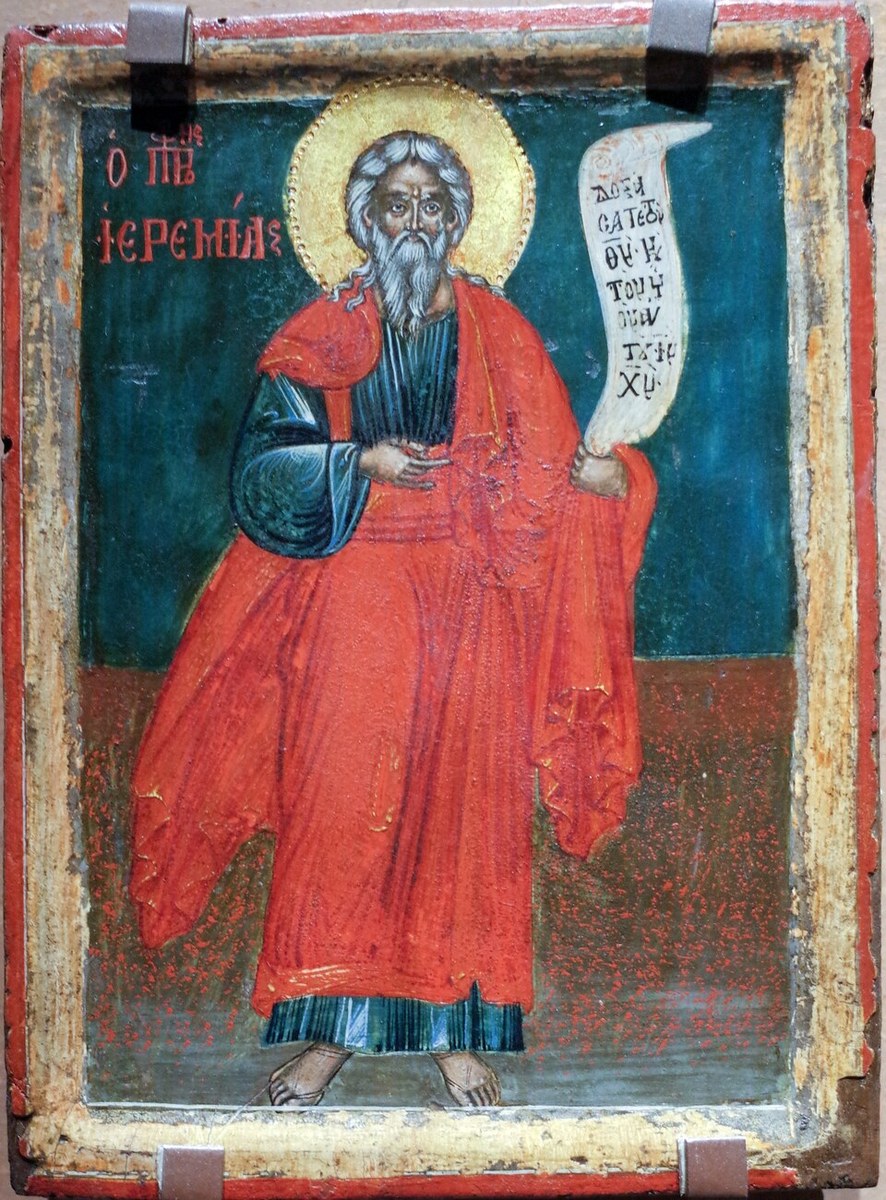
Jeremiah is painted as a man of middle years or older, with a full dark or greying beard, sometimes bareheaded and sometimes veiled, in tunic and mantle, holding an unrolled scroll — his usual inscription being the opening of the new-covenant oracle ("Behold, the days come, saith the Lord") or the lament "Who will give water to my head, and a fountain of tears to mine eyes?" In the prophet-row of the iconostasis he stands with the other Greater Prophets flanking the Deesis; in the great fresco cycles he appears in the dome or drum among the prophets who foretold the Incarnation. Narrative scenes are less common than for Daniel or Habakkuk, but the cistern — the prophet sunk to the waist in mire while Ebed-melech and his men let down the ropes and rags — is met in illustrated Bibles and menologia, as is the stoning, and, in Russian iconography of the sixteenth and seventeenth centuries, the hiding of the ark on Nebo. Because Lamentations is read as his, he is also the figure behind the Western "weeping prophet" type, which Orthodox painting deliberately avoids in favour of the calm frontal hierophant.
The stored image is an eighteenth-century Greek icon now in the Museum of Byzantine Culture at Thessalonica, inscribed Ὁ ΠΡ(ΟΦΗΤΗΣ) ΙΕΡΕΜΙΑΣ: the prophet stands barefoot on a green ground in a great scarlet himation over a blue-green tunic, white-haired and white-bearded, his left hand holding an open scroll and his right drawn to his breast.
Disputed questions
- The thirty pieces of silver. Saint Matthew introduces the purchase of the potter's field with "Then was fulfilled that which was spoken by Jeremy the prophet" (Matthew 27:9), but the words quoted are substantially those of Zechariah 11:12–13. Ancient and modern explanations differ: that Matthew cites a lost saying of Jeremiah; that he names the first prophet of a collected scroll; that the potter's-field imagery of Jeremiah 18–19 and 32 is fused with Zechariah's thirty shekels; or that an early copyist's slip has been preserved. The Church has never resolved it, and the discrepancy is recorded here rather than harmonised.
- The date of his death. No source dates it. The traditional reckoning — repose about 570 BC, a decade or more after the fall of Jerusalem, in extreme old age — rests on the chronology of the Egyptian oracles and on the tradition that his prophecy against Egypt was fulfilled in the year of his martyrdom.
- Authorship of Lamentations and of Baruch. See above; the liturgical and the critical judgments are both stated, neither imposed.
- The Lamentations of Great Friday. The Egkomia or "Lamentations at the Tomb" sung at the Matins of Holy Saturday are a Byzantine hymnographic composition on Psalm 118 and have nothing to do with the biblical book of Lamentations, though the two are frequently confused in English. The biblical Lamentations are read at the Royal Hours of Great Friday.
- Not to be confused with the several later Jeremiahs of the calendar — among them the wonderworker of the Kiev Caves and the patriarchs of Constantinople of that name — nor with his contemporary and namesake in the priestly lists.