
John Kalyvites
Our Venerable Father John Kalyvites, the Hut-dweller, the Poor Man for Christ
Venerable · b. early 5th century, at Constantinople — d. c. 450, at Constantinople
Commemorated 15 January — Repose at Constantinople, at his hut by his parents' gate
John Kalyvites — "the Hut-dweller" (c. 450) — was the only son of a wealthy senatorial family of Constantinople who, seized in boyhood by the longing for God, secretly left his parents' house to become a monk in the "Sleepless" (Akoimetoi) monastery. After years of ascetic struggle he returned, unrecognised, to his own family's gate, and lived there as a nameless beggar in a little hut, enduring the contempt of his parents' servants and the daily sight of the home and the mother he had renounced, keeping always with him a precious Gospel-book his parents had once given him. Only on his deathbed did he make himself known, sending word by that book, so that his mother and father knew at last that the beggar at their door was their lost son. He reposed about the year 450, still a young man, and a church was raised over the hut. He is kept on January 15, together with Paul of Thebes.
_-_John_Kalyvites.jpg)
The life of John the Hut-dweller is preserved in a Greek Life of the sixth or seventh century, from which the synaxaria and the Menaion draw, and it is among the most tenderly told of the ascetic stories: a drama not of the desert but of the great city, and of a hidden holiness practised within sight of the very household it renounced.
A senator's son of Constantinople
John was born at Constantinople in the early fifth century, in the reign (the tradition says) of the emperor Leo I, the only and much-loved son of a rich and noble family — his father, Eutropius, a man of senatorial rank, his mother Theodora a woman of great piety and wealth. He was given the best education the capital could offer, but the boy's heart was turned early to God, and he read the lives of the monks with a growing resolve to imitate them.
The turning-point, in the received account, was a meeting with a monk of the "Sleepless" monastery (the Akoimetoi, the "Unsleeping Ones," whose brethren kept the divine praises in unbroken relays day and night). John begged to be taken with him; and, knowing his parents would never consent to lose their only heir, he asked of them one gift — a richly bound copy of the Holy Gospels, which they had made for him at great cost, adorned with gold. With this one treasure of his old life he slipped away by night, took ship, and came to the monastery of the Sleepless, where he received the habit and gave himself to the ascetic life with such fervour that he outstripped monks long grey in the struggle.
The return, and the hut by the gate
After some years — six, the tradition commonly says — the memory of his parents, and perhaps the assaults of the enemy upon a young monk, pressed hard on him; he was tempted with longing for home, or, in the deeper reading of the Life, was granted to see how he might crucify that longing utterly. He asked and received his abbot's blessing to return to Constantinople, but not to be known. He came back to his own city in the rags of a beggar, and took up his place at the gate of his father's own house, among the poor who were fed there in alms — so that he lived out his days within a few steps of the home he had left, saw daily the mother who had borne him and did not know him, and bore the scorn and the blows of the household servants, who despised the ragged stranger squatting at their masters' door. His parents, in their charity, allowed the beggar a little hut (kalybē) to be built for him against the wall — and from this he has his name, Kalyvites, "the Hut-dweller." There he continued in secret prayer and fasting, his only companion the golden Gospel-book of his childhood, which he never let go.
Repose and recognition
So he lived, the account says, some three years, until sickness and his austerity brought him near death. Then he sent to his mother, or made himself known to a servant, asking that his parents come to him; and he gave them the Gospel-book — the very book they had made for their son — telling them to read in it the comfort of God. By that unmistakable token, and by his own last words, they knew the dying beggar at their gate to be their lost and only son. The grief and wonder of the recognition, the parents' late understanding of the holiness that had lived unseen beside them, and John's own peaceful death form the close of the Life. He reposed about the year 450, still young. His parents buried him on the spot of his hut, and there raised a church in his honour, which became a place of his veneration in the city; his relics were later, the tradition holds, translated to Rome.
The force of the story is in its paradox, and the hymnography seizes on it: a man who "loved a poverty in imitation of Christ" and "forsook the wealth of his parents," who dwelt in a hut "as though in Paradise," and who, choosing to be a stranger at his own door, "slew the man-slaying dragon" of self-love by the one weapon of hiddenness. His feast joins him, fittingly, to Paul of Thebes: the desert father who fled all men, and the city youth who hid himself in the midst of them, are two forms of the one renunciation.
Feast and commemoration
John is kept universally on January 15 (church date; Old Calendar civil January 28), together with Paul of Thebes, in the days after the Leavetaking of the Theophany. The Byzantine calendars — Greek, Slavic, and Antiochian — agree on the day; the Menaion appoints a full office of the two ascetics jointly.
Hymns
Troparion — Tone 4
From infancy thou didst fervently long for the Lord, and thou didst forsake the world and the delights that are in the world, and thou didst struggle excellently; thou didst set up thy hut before the gates of thy parents, and thou didst shatter the snares of the demons, O all-blessed one. Wherefore, O John, Christ hath worthily glorified thee.
Original translation from the Greek
Kontakion — Tone 2
Longing, O wise one, for a poverty in imitation of Christ, thou didst forsake the wealth of thy parents; and holding the Gospel in thy hands, thou didst follow after Christ our God, O John, interceding without ceasing for us all.
Original translation from the Greek
Sticheron
Having renounced the world and the things that are in the world, O righteous one, and having taken up the Gospel, thou didst follow after it in the manner of the Gospel; and dwelling in thy hut as mystically in Paradise, by the utmost hardness of thy flesh thou didst slay the man-slaying dragon. Therefore, making thy dwelling in the heavens, O blessed John, ask for us the great mercy.
Original translation from the Greek
Appointed readings
Epistle — Galatians 5:22–6:2
22But the fruit of the Spirit is love, joy, peace, longsuffering, gentleness, goodness, faith, 23Meekness, temperance: against such there is no law. 24And they that are Christ’s have crucified the flesh with the affections and lusts. 25If we live in the Spirit, let us also walk in the Spirit. 26Let us not be desirous of vain glory, provoking one another, envying one another. 1Brethren, if a man be overtaken in a fault, ye which are spiritual, restore such an one in the spirit of meekness; considering thyself, lest thou also be tempted. 2Bear ye one another’s burdens, and so fulfil the law of Christ.
Gospel — Matthew 11:27–30
27All things are delivered unto me of my Father: and no man knoweth the Son, but the Father; neither knoweth any man the Father, save the Son, and he to whomsoever the Son will reveal him. 28Come unto me, all ye that labour and are heavy laden, and I will give you rest. 29Take my yoke upon you, and learn of me; for I am meek and lowly in heart: and ye shall find rest unto your souls. 30For my yoke is easy, and my burden is light.
Iconography
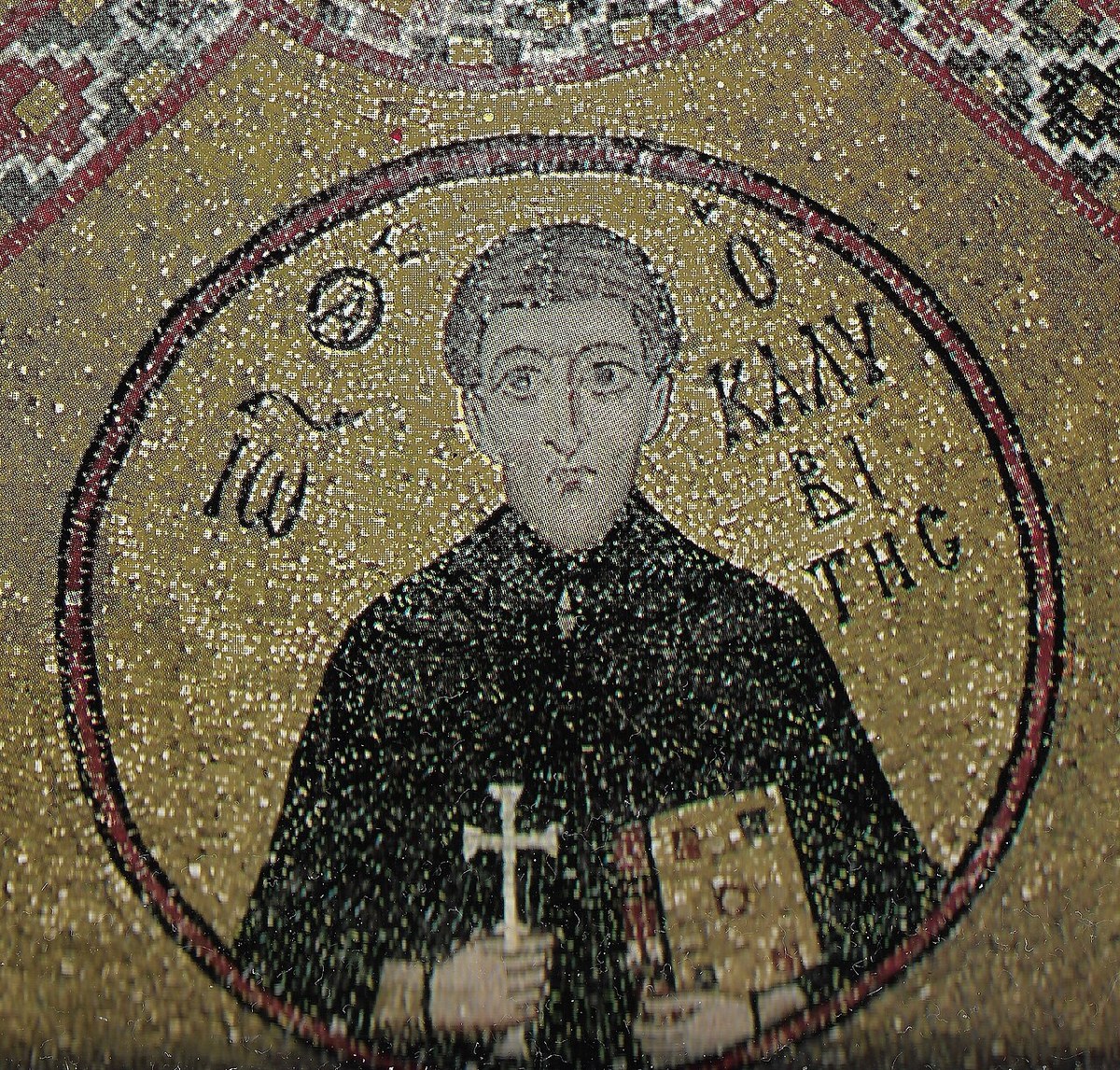
John Kalyvites is depicted as a young monk — beardless or with the first down of a beard, in contrast to the aged desert fathers among whom he is often ranked — clad in the monastic schema, and holding his distinctive attribute, the Gospel-book, the token of his renunciation and of his recognition. In narrative scenes he is shown as the ragged beggar at the gate, or on his deathbed giving the golden Gospels to his grieving parents. His youthful face and the book distinguish him at once from the grey-bearded hermits of the winter calendar.
The stored image is the eleventh-century mosaic of John Kalyvites in the katholikon of the Monastery of Hosios Loukas in Boeotia, Greece — one of the finest surviving cycles of Middle Byzantine mosaic — showing the young saint named by its inscription (source, public domain, pd-old-work).
Disputed questions
- Not to be confused with the many other saints named John, and in particular not with the great monastic teachers of the neighbouring days — John Climacus of the Ladder, or John the Chozebite — with whom "the Hut-dweller" shares only the name. His epithet Kalyvites, "of the little hut," belongs to this fifth-century Constantinopolitan alone; the details of his parents' names and the reign are given variously in the manuscripts and are transmitted with the Life rather than independently attested.