
Paul of Thebes
Our Venerable Father Paul of Thebes, the First Hermit
Venerable · b. c. 227/228, in the Thebaid of Egypt — d. c. 341, in the Theban desert, aged about 113
Commemorated 15 January — Repose in the Theban desert; burial by Anthony the Great
Paul of Thebes (c. 227 – c. 341), called the First Hermit, is honoured by the Church as the father and archetype of Christian solitude. A wealthy and educated young Egyptian of the Thebaid, orphaned early and threatened with betrayal by a covetous brother-in-law during the persecution of the emperor Decius, he fled into the desert about the age of twenty-three and found a hidden cave beside a spring and a single palm tree. There he remained for some ninety years, clothed in woven palm-leaves and fed — the tradition holds — by a raven that brought him half a loaf of bread each day, unknown to the world and known only to God. Near the end of his life he was sought out and found by Anthony the Great, to whom God revealed that a monk more perfect than himself dwelt deeper in the wilderness; the two aged fathers conversed, and Anthony was present at Paul's death and buried him — the grave, the account says, dug by two lions that came from the desert. Paul reposed about the year 341, aged some one hundred and thirteen. He is kept on January 15.

The single source for the life of Paul is the Vita S. Pauli primi eremitae — the Life of Paul the First Hermit — written by Jerome (Hieronymus) about the year 375, in the years he himself spent as a hermit in the desert of Chalcis in Syria. Jerome wrote, he says, to correct the widespread belief that Anthony the Great had been the first of the monks, and to set before the Church a solitary older still, whose memory had reached him through the disciples of Anthony — chiefly Amathas and Macarius, who had buried their master and preserved his testimony. Everything the tradition holds of Paul descends from this short and deliberately artful Life, and its character must be kept in view: it is a work of edification, weaving into a core of received memory some frankly symbolic and legendary scenes. What the whole of the East and West has drawn from it, and never doubted, is the figure of the first hermit himself.
Origins and flight into the desert
Paul was born in the Lower Thebaid of Egypt about the year 227 or 228, of wealthy parents, and was well educated in both Greek and Egyptian letters. He was orphaned in his youth — about the age of fifteen — and left, with a married sister, the heir to a considerable estate. His life fell across the persecution of the emperor Decius (249–251), which in Egypt was pressed with particular cruelty: Jerome recalls the refinements of torment devised to break the confessors, and Paul, still a young man, withdrew for safety to a country house on the edge of the desert while the storm raged.
There the danger came not from the magistrate but from his own household. His brother-in-law, coveting the inheritance and unmoved by ties of blood, resolved to denounce Paul as a Christian to the persecutors, so that his death should leave the estate to his sister and her husband. Warned of the plot, Paul understood that the desert he had fled to was safer than the house he had fled from, and he went out into the wilderness — at first, Jerome says, meaning only to wait out the persecution, but led by God, "step by step and again and again," ever deeper into the mountains, until he came upon a hidden place: a cave whose mouth had once, in the days of Antony and Cleopatra, been a secret mint for counterfeit coin, and within it a great palm tree and a clear spring. In that spot, Jerome writes, "as though it were given him by God," he settled; and what he had begun of necessity he came to love for its own sake, so that he never left it again to the end of his days.
Ninety years in the wilderness
The palm gave him everything: its leaves he wove into a rough garment, its fruit was his food. So he lived, the account says, for the greater part of a century — in prayer, in silence, unseen by any human face. To the bare economy of the palm tree the tradition adds its most beloved detail: that from a certain point a raven came each day, bringing in its beak half a loaf of bread, and so fed the hermit as the ravens once fed the prophet Elijah at the brook Cherith (1 Kings 17:6) — the parallel the hymnography of his feast draws out, hailing Paul as one who "imitated Elijah the zealot" and was "nourished through a bird as though he were an angel." How long the raven had come, Paul himself did not know until his last day; for the greater part of those ninety years he had simply lived, hidden, "citizen of the desert and fellow of the angels," until the God who had concealed him willed at the last that he should not be wholly unknown to men.
The coming of Anthony the Great
The most famous scene of the Life is the meeting of the two fathers, and its lesson is set at the outset. Anthony the Great, then about ninety years old and long the acknowledged summit of Egyptian monasticism, was visited in the night by a thought — that no monk had settled in the desert more perfectly than he. In answer, it was revealed to him in a dream that another lay deeper in the wilderness, far better than himself, and that he must set out to find him. At dawn the old man took his staff and went, not knowing the way, into the trackless interior.
Here Jerome's narrative passes deliberately into the marvellous. Anthony was met first by a hippocentaur — a creature half man, half horse — who, questioned, pointed with its hand toward the region where Paul dwelt and fled away; and then by a satyr, a little man with horns and goat's feet, who brought him palm-dates and confessed that he and his kind were mortal creatures of the desert who begged the servant of God to intercede for them with their common Lord. The scenes are palpably symbolic — the very monsters of the pagan imagination doing homage to the God of the Christians, the whole creation acknowledging its Maker through the passing of the saint — and Jerome half-anticipates the reader's doubt, appealing to the witness of Alexandria, where (he says) such a creature had once been brought alive to the emperor. The Church has always received these episodes as the poetry of the Life, not as its substance; the substance is what follows.
Guided onward, Anthony came at last to the cave. Paul, long unused to any human approach, at first barred the door; but Anthony, weeping, entreated him until the old hermit opened and embraced him, greeting him by name though they had never met. They sat and spoke of the world they had both left — Anthony asking whether men still built cities, and who now ruled the earth, and whether any still worshipped the idols — and as they talked the raven came, and set down a whole loaf of bread before them. "See," said Paul, "the Lord has sent us our dinner. For sixty years I have received half a loaf each day; but at thy coming Christ has doubled the ration of his soldiers." Then followed the courteous contest the tradition loves: each, out of reverence, pressed the other to break the bread, Anthony pleading Paul's age and Anthony's own guest-right, Paul pleading Anthony's dignity; until they agreed to take it each by one end and pull, and so shared it, and drank of the spring, and gave thanks.
Repose, and the burial by the lions
Paul then told Anthony that the hour of his own death was near — that this was why God had sent Anthony to him: to bury his body and return it to the earth. He asked Anthony to go back and fetch the cloak that Athanasius, bishop of Alexandria, had given him, and to wrap his corpse in it. This request — that he be shrouded in a garment blessed by the great confessor of Nicaea — Anthony understood as Paul's gentle way of sparing him the sight of his death; and he hastened the long journey back to his own cell. On the road, or as he neared it, he saw in a vision the soul of Paul borne up to heaven amid choirs of angels, prophets, and apostles, shining white. Understanding, he pressed back to the cave without pausing, and found the old man kneeling, his head raised and his hands lifted up as in prayer — dead, but in the very posture of one still praising God, so that at first Anthony thought him living and prayed beside him.
Anthony wrapped the body in the bishop's cloak and carried it out to bury it, but he had no spade and no strength to dig the grave, and stood at a loss. Then, the Life says, two lions came running from the depth of the desert, their manes streaming, and lay down at the dead man's feet, fawning and mourning with a kind of roar; and with their paws they dug a pit large enough to receive the body, and when they had finished came to Anthony, bowing their heads and licking his hands as if begging his blessing, and he blessed them and sent them away. So the first hermit was laid in the earth by the beasts of the wilderness he had made his home. Anthony took for himself the dead man's tunic woven of palm-leaves, which he kept as a treasure and wore afterward, the tradition says, only on the greatest feasts, at Pascha and Pentecost. Paul had lived, by Jerome's reckoning, about one hundred and thirteen years, some ninety of them in the desert; his repose is placed about the year 341.
Relics and later veneration
The cave of Paul became, in time, one of the great monastic sites of Egypt: the Monastery of Saint Paul the Anchorite (Deir Anba Bula), in the Eastern Desert near the Red Sea, grew up around the place of his cell and spring and is kept to this day by the Coptic Orthodox Church, the living memorial of the first hermit on the very ground of his struggle. His relics had a long later history: carried (the Byzantine tradition holds) to Constantinople in the twelfth century, they were taken west after the Latin conquests and became, in the later Middle Ages, the treasure of the Order of Saint Paul the First Hermit — the "Pauline Fathers," founded in Hungary in the thirteenth century on the model of his solitary life — who translated them to Buda in 1381; after the Ottoman advance they were removed again, and are venerated in Central Europe still. In both East and West, the memory of Paul is inseparable from that of Anthony: the two are the twin fathers of the eremitic life, and the art of both traditions loves to set them together at the sharing of the raven's bread.
Feast and commemoration
Paul is kept universally on January 15 (church date; Old Calendar civil January 28), a day the Byzantine calendar joins to the memory of another solitary, John Kalyvites the Hut-dweller, so that the father of the desert hermits and the young hidden ascetic of the city are honoured together. The feast falls in the days after the Leavetaking of the Theophany (January 14), as the Church turns from the Jordan back to the desert into which the Spirit had driven the Lord — a fitting frame for the first of those who followed Christ into the wilderness. The Coptic Orthodox Church, guardian of his monastery, keeps his memory as well (on Amshir 2 / the corresponding day); the Roman calendar long commemorated him on January 15, and the Pauline Fathers of his Order keep him as their patron.
Hymns
Troparion — Tone 8
With the streams of thy tears thou didst cultivate the barrenness of the desert, and with sighs from the depths thou didst bear fruit a hundredfold in labours; and thou becamest a beacon to the whole world, shining forth with miracles, O Paul our righteous father. Intercede with Christ our God, that our souls may be saved.
Original translation from the Greek
Sticheron — Tone 2
A stranger's way of life upon the earth didst thou pursue, O Paul, and thou didst dwell together with the wild beasts, ministered to by a bird, O righteous one, at the biddings of God; and when the great Anthony beheld this, when he had found thee, he was filled with wonder at all these things, and ceaselessly magnified as God the Provider and Master of all.
Original translation from the Greek
Appointed readings
Epistle — Galatians 5:22–6:2
22But the fruit of the Spirit is love, joy, peace, longsuffering, gentleness, goodness, faith, 23Meekness, temperance: against such there is no law. 24And they that are Christ’s have crucified the flesh with the affections and lusts. 25If we live in the Spirit, let us also walk in the Spirit. 26Let us not be desirous of vain glory, provoking one another, envying one another. 1Brethren, if a man be overtaken in a fault, ye which are spiritual, restore such an one in the spirit of meekness; considering thyself, lest thou also be tempted. 2Bear ye one another’s burdens, and so fulfil the law of Christ.
Gospel — Matthew 11:27–30
27All things are delivered unto me of my Father: and no man knoweth the Son, but the Father; neither knoweth any man the Father, save the Son, and he to whomsoever the Son will reveal him. 28Come unto me, all ye that labour and are heavy laden, and I will give you rest. 29Take my yoke upon you, and learn of me; for I am meek and lowly in heart: and ye shall find rest unto your souls. 30For my yoke is easy, and my burden is light.
Iconography
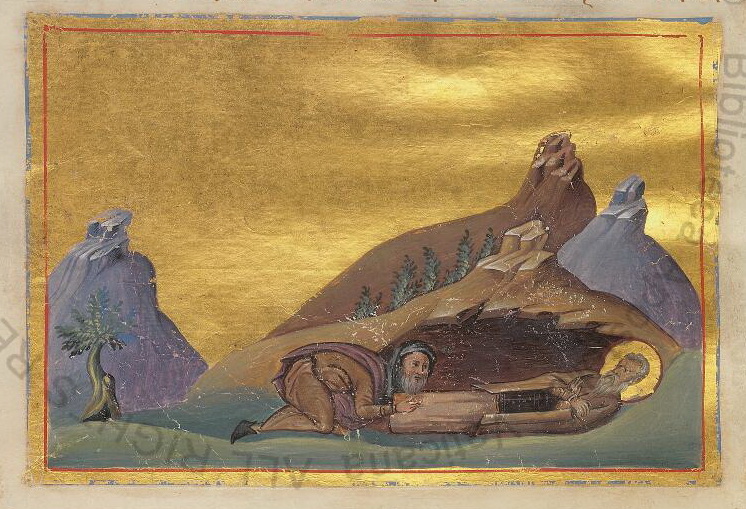
Paul of Thebes is depicted as a very old man, gaunt with a lifetime of fasting, his hair and beard long and white, clothed not in the monastic habit but in a tunic woven of palm-leaves — the plaited garment that is his unmistakable attribute, marking him as the man who had nothing of the world's making. Two scenes carry his story. The first is the meeting with Anthony: the two aged fathers seated together before the cave, the raven descending with a loaf in its beak between them — the most beloved and most frequently painted image of the first hermit, kept alike by Byzantine iconographers and by Western masters. The second is the burial: Anthony wrapping the body in Athanasius's cloak, or the two lions digging the grave with their paws while the old abbot looks on — the scene of the January 15 miniature.
The stored image is the miniature for January 15 from the Menologion of Basil II (Constantinople, c. 985; Vatican, Vat. gr. 1613), depicting Anthony the Great at the body of Paul of Thebes: the dead hermit laid within his cave in the desert mountains, and the aged Anthony bowed in grief beside him — the visual form of the Life's closing scene (source, public domain, pd-old-work).
Disputed questions
- The historicity of Paul. Because the whole of Paul's memory hangs on a single, consciously literary Life, and because that Life contains the centaur, the satyr, the raven, and the burying lions, the reality of Paul was doubted in antiquity and has been questioned since. Some of Jerome's own contemporaries suspected he had invented the hermit to eclipse Anthony; modern critics have read the Vita Pauli as an edifying romance. Against this stands the fact that Jerome, writing within a generation of Paul's death, appeals to a living chain of witnesses — the disciples of Anthony, who claimed to have received the story and the palm-leaf tunic from their master's own mouth — and that the cultus of Paul is older and wider than Jerome's Latin book, being kept independently in the Coptic and Greek East. The mainstream of both scholarship and tradition holds that a real solitary of the Thebaid named Paul lies behind the Life, however freely Jerome adorned the telling. The Church keeps the man, and reads the marvels as the Life's own poetry — the desert, and even its imagined monsters, bowing before the God its hermit served.
- Not to be confused with the many other Pauls of the calendar — among them Paul the Simple, the guileless peasant who became a disciple of Anthony the Great in the same Egyptian desert two generations later (kept October 4 and March 7), and Paul the Confessor, Archbishop of Constantinople. "The Theban," "the First Hermit," and "the Anchorite" belong to this Paul alone.