
John Koukouzelis
Our Venerable Father John Koukouzelis the Maistor, of the Great Lavra on Athos
Venerable · b. c. 1280 — d. 14th century
Commemorated 1 October — Repose at the Great Lavra on Athos
John Koukouzelis (13th–14th century) was the greatest singer and composer of the Byzantine world after the age of the ancient hymnographers: a boy from Dyrrachium who became the star of the imperial music school at Constantinople, fled fame and an arranged marriage to hide as a goatherd at the Great Lavra on Mount Athos, and there, discovered and left in peace, spent his life singing. The tradition calls him "angel-voiced" and the maistor — master — of music: he was the leading figure of the kalophonic style, codifier of chant and notation whose teaching pieces were copied for centuries. The Theotokos herself, the Life relates, appeared to him with the words "Sing, and I will not forsake thee." He is commemorated on October 1, with Romanus the Melodist, as a patron of church singers.

Origins and the imperial school
John was born at Dyrrachium on the Adriatic (the modern Durrës in Albania), in the later thirteenth century by the reckoning most scholarship now accepts; his father died while he was a child, and his pious mother, whom the Life remembers tenderly, raised him alone. Sent to Constantinople, the gifted boy entered the imperial school of music in the days of the emperor conventionally identified in the Life's horizon with Andronikos II Palaiologos (1282–1328). His famous surname was a schoolboys' joke that history kept: asked what he had eaten, the boy — whose first tongue was not Greek — answered "κουκιὰ καὶ ζέλια," broad beans and greens, and "Koukouzelis" he remained. His voice carried him to the head of the school and the favour of the emperor: he became the first singer of the court, admired, rewarded, and — the Life says — miserable, for his heart was elsewhere. When a marriage was arranged for him at the court's pleasure, the conflict came to a head.
Flight to Athos
Meeting a party of Athonite monks in the capital, John learned of the Holy Mountain and resolved on flight. He came to the Great Lavra of Athanasius on Athos in a poor man's clothes, gave no hint of who he was, and asked for the humblest of obediences; the monastery set him to herd its goats. In the wilderness, alone with the flock, he allowed himself at last to sing — and the Life gives Athos one of its loveliest scenes: a hermit, drawn by a sweetness of song that seemed more than human, found the goatherd singing with the animals standing still around him. Pressed, John confessed himself the vanished singer of the imperial court, and begged that his secret be kept; but it reached the abbot, and in time the emperor himself, who — the tradition says — grieved to lose him and consented to leave him to God. Freed from concealment, John lived thereafter in a kellion dedicated to the Archangels, keeping his goats no longer but the rule of an ascetic, and on Sundays and feasts he took his place in the right choir of the Lavra's church and sang.
The vision of the Theotokos
Once, after he had stood the vigil of the Akathist and sung the hymn before the icon of the Mother of God, John dozed in his stall, and the Theotokos appeared to him: "Rejoice, John, my child," she said. "Sing, and I will not forsake thee." And she placed in his hand a gold coin. He woke with the nomisma in his palm; it was hung upon her icon, and icon and coin alike became a wonder-working treasure of the Lavra — the icon is venerated there to this day under the name Koukouzelissa. The Life adds a second visitation: when long standing at vigil had rotted the flesh of his leg, the Mother of God appeared again and healed him with the words "Be whole henceforth." He foresaw his death, took leave of the brethren, and was buried, as he had asked, in the church of the Archangels that he had built; the day of his memory is October 1. A fellow singer of the Lavra, Gregory the Domestikos, who kept the same feast and of whom a like gift of a gold coin from the Theotokos is recorded, is commemorated with him.
The maistor of music
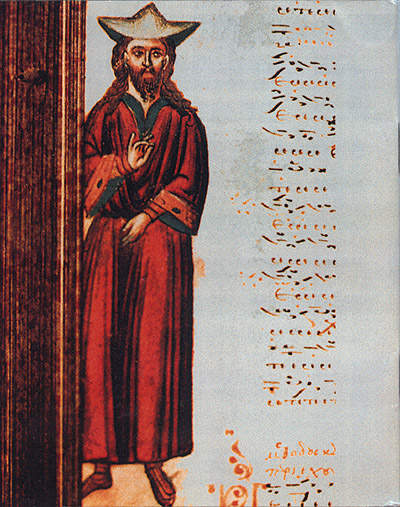
In the history of Byzantine chant John Koukouzelis stands second only to John of Damascus, and the tradition made the comparison itself, calling him a second beginning of church song. He was the great master — maistor, μαΐστωρ, the title the manuscripts give him — of the kalophonic ("beautified") style that crowned the last Byzantine centuries: the florid, melismatic elaboration of the chant in which a single verse of a psalm may blossom for many minutes, with inserted teretismata (syllables of pure melody) and anagrammatismoi (rewoven texts). He revised and ordered the chant repertory and its notation; his didactic composition the Mega Ison, setting the names of the notational signs to their own melodies, remained the singer's primer for centuries, and the mnemonic diagram of the modes transmitted with his method — the "wheel" (trochos) of Koukouzelis — passed into every corner of the Orthodox musical world. His settings and teaching pieces fill the Athonite musical codices from the fourteenth century onward; one fifteenth-century codex of the Great Lavra carries his portrait, and copies of his diagrams were still being made at Iviron in 1670. Through the psaltic art the whole Orthodox world — Greek, Slavic, Romanian, Albanian — claims a share in him, and with Romanus the Melodist, whose feast he shares, he is honoured as a patron of church singers.
Feast and commemoration
October 1 (church date; Old Calendar civil October 14), with Romanus the Melodist and, in the Athonite tradition, with Gregory the Domestikos of the Great Lavra; the day is kept as the feast of church singers. His commemoration appears in the Athonite recension of the Greek synaxarion for the day ("John Koukouzelis the sweet-singing, who lived in ascesis in the bounds of the Great Lavra on Athos, is perfected in peace") and in the Slavic calendars; on Athos his memory is also kept with the veneration of the Koukouzelissa icon.
Hymns
Troparion — Tone 8
In thee, O Father, that which is according to the image was preserved exactly: for taking up the cross, thou didst follow Christ, and by thy deeds didst teach us to despise the flesh, for it passeth away, but to care for the soul, a thing immortal. Wherefore thy spirit, O venerable John, rejoiceth with the angels.
Original translation from the Greek
Iconography
John is painted as a middle-aged monk with a short beard, but his most distinctive image is not monastic at all: the fifteenth-century miniature in a musical codex of the Great Lavra — the stored image — shows him standing beside a column of Byzantine musical notation in the red robe and curious brimmed hat of an imperial singer, his right hand raised in the chironomic gesture of the choir-master: the maistor teaching his art. Later Athonite and Balkan frescoes and icons show him as a monk with a scroll of notation, sometimes together with the other masters of song.
Disputed questions
- Dates. Older literature placed Koukouzelis in the twelfth century under the Komnenoi; the manuscript evidence of his repertory has settled scholarship on the late thirteenth and fourteenth centuries (conventionally c. 1280–c. 1360, under the first Palaiologoi). No exact year of death is transmitted.
- Origins. Dyrrachium is constant in the tradition; his non-Greek mother tongue is implied by the surname story, and Bulgarian, Slavic, and Albanian descent have all been claimed for him. The sources do not settle it.
- The Life. The transmitted Life is late and edifying in character, and its court chronology is loose; the outline (imperial school, flight, the Lavra, the visions) is given here as the tradition gives it.