
Romanus the Melodist
Our Venerable Father Romanus the Melodist, Poet of the Kontakia
Venerable · b. c. 490 — d. c. 556
Commemorated 1 October — Repose at Constantinople
Romanus the Melodist (c. 490–c. 556) is the greatest of Orthodox hymnographers: a Syrian from Emesa who served as deacon in Beirut and then at Constantinople, where — unlettered in music and mocked for it — he received in a Christmas Eve vision a scroll from the Theotokos, swallowed it at her command, and mounted the ambo to sing "Today the Virgin gives birth to him who is above all being," the kontakion of the Nativity. He perfected the kontakion, the great sung verse-sermon of the Byzantine rite; about sixty of his works survive, signed in acrostic "of the humble Romanos." The Church calls him simply the Sweet-Singer, and church singers keep him as their patron; his feast is October 1.
_detail_02.jpg)
Origins and early life
Romanus was born about 490 at Emesa (the modern Homs) on the Orontes — Syrian territory of the Patriarchate of Antioch — and his art never lost the stamp of that origin: his verse-homilies stand in the direct line of the Syriac sung homily, the madrasha and memra of Ephrem the Syrian, as much as of Greek rhetoric, and it was precisely this Semitic inheritance, carried into Greek, that made the kontakion possible. Some modern scholars have argued from hints in the hymns that his family was Jewish and that he was baptised in boyhood; the evidence is thin and the question remains open. He became a deacon of the church of the Resurrection at Berytus (Beirut), and during the reign of the emperor Anastasius I (491–518) came to Constantinople, where he attached himself to the clergy of the church of the Theotokos in the quarter of Kyros (ta Kyrou), living in ascetic simplicity and spending his nights at vigil, often at the great shrine of the Theotokos at Blachernae.
The vision of the scroll
The tradition, carried by the Synaxarion, is candid about his beginnings: Romanus was devout but unskilled, neither a reader nor a singer of any account, and the polished clergy made him feel it — the accounts tell of his being pushed forward to sing at a vigil in the emperor's presence and humiliated by his failure. That night — the paramone of the Nativity — he prayed long before the icon of the Theotokos and fell asleep in grief, and the Mother of God appeared to him in his sleep, holding a scroll of paper, and said: "Take this and eat it." He opened his mouth and swallowed the scroll; and waking on the feast, he ascended the ambo and sang, of his own composing and to everyone's astonishment, the hymn that is sung to this day as the kontakion of Christmas: "Today the Virgin gives birth to him who is above all being, and the earth offers a cave to him whom no man can approach… for unto us is born a young Child, the pre-eternal God." From that night the gift never left him: the Synaxarion credits him with about a thousand kontakia, for feasts and saints through the whole year, and the Greek service book remembers him by the exact and unadorned title "Poet of the Kontakia."
The kontakion
What Romanus perfected — he had Syriac and Greek predecessors, but the form is his the way the fugue is Bach's — is a long sung verse-sermon: a short prelude (prooimion or koukoulion) in one metre, followed by a chain of eighteen to twenty-four stanzas (oikoi) in another, every stanza closing in the same refrain sung by the people, the whole bound together by an acrostic running down the initials of the stanzas — most often his signature, "τοῦ ταπεινοῦ Ῥωμανοῦ," of the humble Romanos. The metre is not the old quantitative verse of the schools but accentual rhythm, syllable counted against syllable and stress against stress, made for singing; the manner is dramatic, built on dialogue and imagined speech — Mary reasoning with Gabriel, Hades arguing with Satan, the Virgin pleading with her Son at the Cross — theology preached as theatre for the ear. Among the masterpieces that survive are the kontakia on the Nativity, on the Entry into Jerusalem, on Judas, on Peter's denial, the lament of the Mother of God at the Cross, on the Victory of the Cross, on the Resurrection, on the Second Coming, on the Ten Virgins, and on the earthquakes and fires — this last a court-preacher's reading of the Nika revolt and the rebuilding of Hagia Sophia, and a chief anchor for his dates. About eighty-five kontakia are transmitted under his name, of which some sixty are accepted as genuine.
His Nativity kontakion had a public career unmatched by any hymn of the age: it is recorded that down to the twelfth century it was sung each year at the imperial Christmas banquet by the combined choirs of Hagia Sophia and of the Holy Apostles. And though the kontakion as a form was displaced in the service books from the eighth century by the canon, it never wholly died: the short hymns still called "kontakia" that follow the sixth ode at Matins — recorded in this collection for every saint and feast — are the surviving prooimia and first stanzas of the old form, the visible debris of the genre Romanus perfected. The kontakion of the Nativity of the Theotokos, "Joachim and Anna were freed from the reproach of childlessness," is itself transmitted under his name, and the kontakion of the Protection of the Theotokos — the feast that shares his day — is patterned on his "Today the Virgin."
Repose and veneration
Romanus died in peace at Constantinople about 556 — after 555, on the evidence of his latest datable hymns — and was buried in the church of the Theotokos in the Kyros quarter where he had served, and where his memory was afterwards kept. The synaxarion verses for October 1 give him the only epitaph he needs: "Even before, Romanus hymned God the Word; he hymns him still — but now with the angels." The Slavs, whose church received his feast with the rest of the calendar, translated his epithet as Sladkopevets, the Sweet-Singer, and by a happy providence his day coincides in Slavic usage with the feast of the Protection: on Pokrov icons of the Suzdal and later recensions Romanus stands on the ambo at the centre of the composition, scroll in hand, singing beneath the outspread veil of the Theotokos whose gift his art was. October 1 is kept by church singers, choirs, and chanters as their patronal feast — Romanus their patron, joined in the calendar of the day by the much later master of Byzantine song, John Koukouzelis.
Feast and commemoration
October 1 (church date; Old Calendar civil October 14), kept universally in the Byzantine rite. The Greek Menaion joins his service with that of the Apostle Ananias; in the Slavic books both are sung under the feast of the Protection of the Theotokos, which governs the day in Russian usage. His feast is kept by church singers as their patronal day.
Hymns
Troparion — Tone 8
In thee, O Father, that which is according to the image was preserved exactly: for taking up the cross, thou didst follow Christ, and by thy deeds didst teach us to despise the flesh, for it passeth away, but to care for the soul, a thing immortal. Wherefore thy spirit, O venerable Romanus, rejoiceth with the angels.
Original translation from the Greek
Troparion — Tone 3 (Slavic use)
From thy youth emulating the life of the angels, thou didst acquire faith, humility of mind, and patience, O venerable Romanus the Sweet-Singer; thou wast a dwelling of the Holy Spirit, and wast shown to be a chosen one of the Mother of God, and from her wast mercifully counted worthy of the gift of glorifying God. Wherefore pray for us, thine unworthy disciples, that with thee we may sweetly sing the glory of the pre-eternal God, who for our sake took flesh.
Original translation from the Greek
Kontakion — Tone 8
Adorned from childhood with the divine virtues of the Spirit, O most-wise Romanus, thou wast a most precious adornment of the Church of Christ, for thou didst adorn her with beautiful song, O blessed one. Wherefore we entreat thee: grant thy divine gift to them that desire it, that we may cry unto thee: Rejoice, O all-blessed father, beauty of the Church.
Original translation from the Slavonic
Iconography
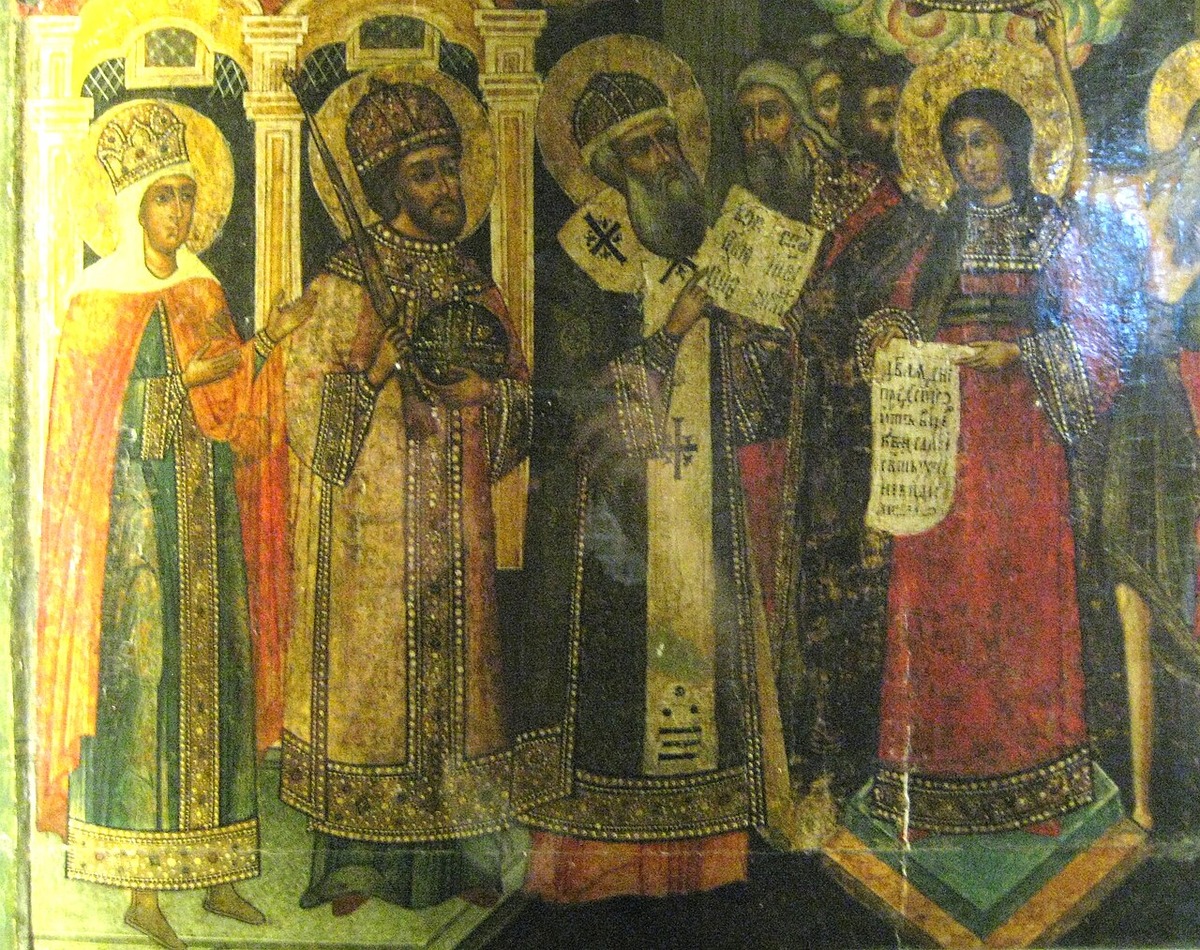
Romanus is painted as a young deacon, beardless, with dark curling hair, vested in the sticharion and orarion of his order, holding a censer or an unrolled scroll; his most famous setting is not his own festal icon but the icon of the Protection, where from the Suzdal recension onward he stands on the ambo at the centre of the composition, singing beneath the veil of the Theotokos. The stored image is exactly such a witness: a detail of the great Protection icon of 1642 in the cathedral of the Protection on the Moat (St. Basil's) in Moscow, showing Romanus in his dark-red vesture among the emperor, empress, and hierarchs of the Blachernae congregation, holding an unrolled scroll on which the opening of the Protection kontakion — "Today the Virgin stands in the church…" — is legibly written; the identification is thereby secured by the inscription itself.
Disputed questions
- Dates. The reign of "Anastasius" in the Life was long disputed between Anastasius I (491–518) and Anastasius II (713–715); the internal evidence of the hymns — the Nika revolt, the rebuilding of Hagia Sophia, events to c. 555 — settles the sixth century, and c. 490–c. 556 is the scholarly convention.
- Jewish origin. Asserted by some modern scholars from hints in the hymns; not transmitted by the synaxaria; unresolved.
- The canon of his works. Ascriptions in the manuscripts run to eighty-five and more; critical scholarship accepts roughly sixty. Individual cases remain argued.
- The Akathist. Part of the manuscript tradition and many modern scholars have ascribed to Romanus the greatest of all Marian hymns, the Akathist to the Theotokos; other candidates include Patriarch Sergius (under whom it was sung at the deliverance of 626), George of Pisidia, and Patriarch Germanus. The question is recorded here, not resolved: the Akathist's author is not certainly known.