
John Mark of the Seventy
The Holy Apostle Mark of the Seventy, also called John, Bishop of Byblos
Apostle of the Seventy · Apostle · Bishop
Commemorated 4 January — Synaxis of the Seventy Apostles, 27 September — With the apostles Aristarchus and Zenas
The apostle Mark of the Seventy, "also called John" — the John Mark of the Acts of the Apostles — was a Jerusalem Christian of the first generation, in whose mother Mary's house the Church gathered, and an early companion of Barnabas and Paul on their missionary journeys. The Byzantine tradition numbers him among the Seventy and makes him bishop of Byblos in Phoenicia, where such grace attended him that, like Peter's, his very shadow healed the sick. He is commemorated on September 27 with the apostles Aristarchus and Zenas, and with all the Seventy on January 4. The synaxaria distinguish him from Mark the Evangelist and from Mark the cousin of Barnabas, though the three are tangled in both tradition and scholarship.
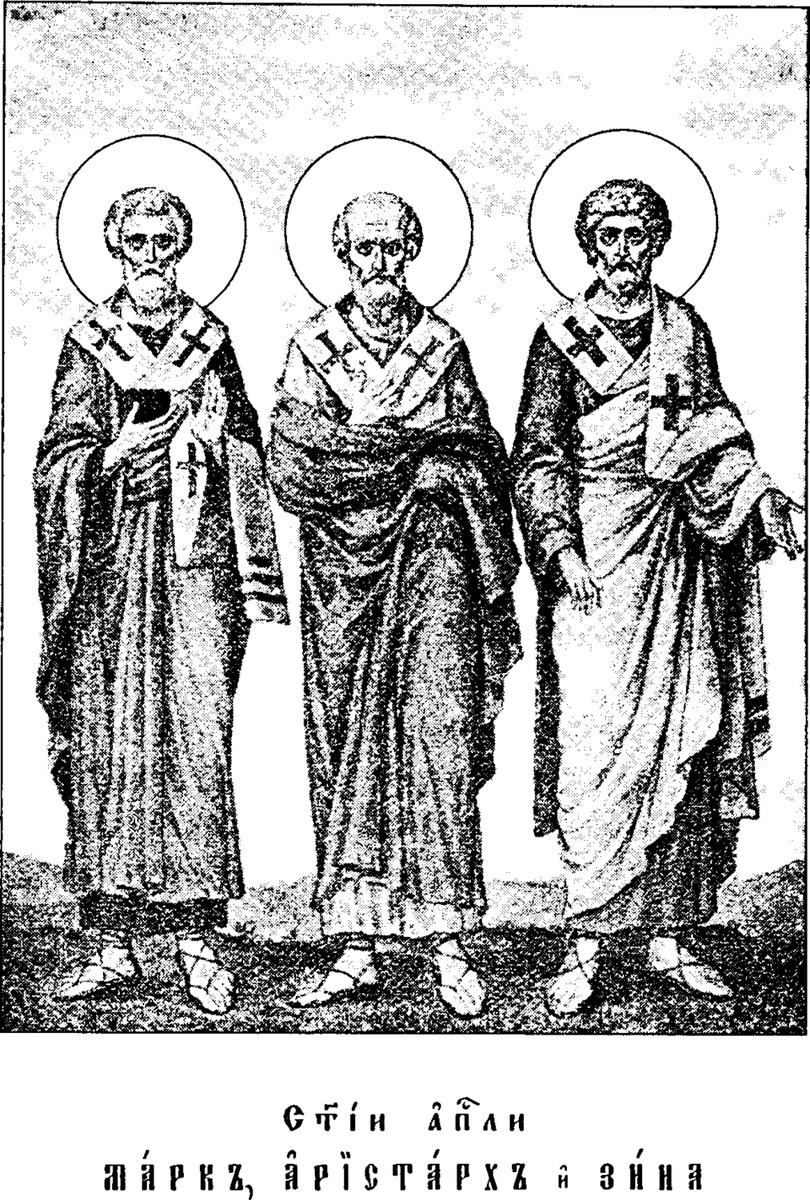
_-_икона_01273_Марк,_Аристарх_и_Зина.png)
The house of Mary and the journeys with Barnabas and Saul
John Mark first appears in the Acts of the Apostles as the son of Mary of Jerusalem, to whose house Peter came when the angel led him out of Herod's prison — a house evidently serving as a gathering place of the first community (Acts 12:12). Barnabas and Saul, returning from their relief mission to Jerusalem, "took with them John, whose surname was Mark" (Acts 12:25); he served them as assistant on the first missionary journey as far as Perga in Pamphylia, where he left them and returned to Jerusalem (Acts 13:5, 13). When Paul declined to take him on the second journey because of that departure, "the contention became so sharp" that Paul and Barnabas parted — Barnabas sailing with Mark to Cyprus (Acts 15:37–39). The later epistles show the breach healed: a Mark appears among Paul's fellow workers, greeted from Rome and desired by the apostle as "useful to me for ministry" (Colossians 4:10; Philemon 24; 2 Timothy 4:11) — verses the traditions divide, not always consistently, among the Marks of the apostolic company.
Bishop of Byblos
The Byzantine tradition, followed by the OCA's Life, counts this Mark among the Seventy sent out by the Lord (Luke 10:1) and records that, after preaching the word with Paul and Barnabas, he was made bishop of Byblos, the ancient Phoenician coastal city north of Beirut. There, the tradition says, he attained such boldness before God that his shadow, falling on the sick, healed them — the grace the Acts records of Peter (Acts 5:15) attending his one-time companion's disciple. Nothing further of his episcopate or of the manner of his death is transmitted; the calendars do not style him a martyr.
Feast and commemoration
September 27 (church date; Old Calendar civil October 10), jointly with the apostles Aristarchus and Zenas of the Seventy — the three are listed together in the synaxarion of the received Greek Menaion (which, in its printed text, gives the third name as "Zenon"). The day's sanctoral service belongs to the martyr Callistratus, the apostles receiving synaxarion notice; the OCA presents each apostle separately. Mark is commemorated again with all the Seventy at their synaxis on January 4.
Hymns
Troparion — Tone 3
Holy Apostles, intercede with the merciful God, that he may grant our souls forgiveness of offences.
Original translation from the Greek
Iconography
Mark is painted as an apostle of the Seventy: a bearded man in tunic and himation holding the scroll or book of his preaching, often vested as a bishop in later images. The stored image, an illustration from the Russian synodal Lives of the Saints (1903–1911), shows the three apostles of the day — Mark, Aristarchus and Zenas — standing together with books and blessing hands.
Disputed questions
- Which Mark? The three-Marks question. The Byzantine synaxaria distinguish three apostles of this name among the Seventy: Mark the Evangelist, disciple of Peter and first bishop of Alexandria (April 25); this Mark "also called John," bishop of Byblos (September 27); and Mark the cousin (ἀνεψιός) of Barnabas, bishop of Apollonias (October 30). The scheme is not cleanly separable from the New Testament data: Colossians 4:10 — cited by the OCA's Life for this John Mark — actually names "Mark the cousin of Barnabas," the verse on which the October 30 Mark rests, and much modern scholarship identifies John Mark of Acts, the cousin of Barnabas, and the Evangelist as one man. The Church's calendar keeps them distinct, and this corpus follows the calendar while recording the question. The Evangelist's commemoration of April 25 is now authored as a separate entry, Mark the Evangelist, which narrates his life from these same verses of Acts and states the identity question from the other side; readers who follow the modern identification should treat the present September 27 commemoration as a second feast of the Evangelist. The October 30 Mark of Apollonias is likewise authored, with the full three-Marks disambiguation and a note that the OCA's October 30 notice attaches the "John Mark" biography (the name John, the house of Mary, the cousinship to Barnabas) to that commemoration as well as to this one — the received calendars thus splitting one scriptural John Mark across two feast days.
- The OCA's "also April 15." The OCA's Life closes by referring this Mark also to January 4 (the Synaxis of the Seventy) and to April 15 — the day of the apostles Aristarchus, Pudens and Trophimus, on which the Greek tradition does not list a Mark. The reference appears to belong to the entangled Mark traditions and is recorded here without adoption.
- Not to be confused with the martyr Mark the Shepherd of Pisidian Antioch, commemorated the next day (September 28) among the martyrs Alexander, Alphius, Zosimas and their companions.