
Mark the Evangelist
The Holy, Glorious and All-laudable Apostle and Evangelist Mark, First Bishop of Alexandria
Apostle · Evangelist · Apostle of the Seventy · Hieromartyr · Bishop · b. early 1st century, at Jerusalem (Cyrenean family, by the Alexandrian tradition) — d. c. 68 (traditions range from 62 to 68)
Commemorated 4 January — Synaxis of the Seventy Apostles, 25 April — Martyrdom at Alexandria, dragged through the streets of Boukolia
Mark the Evangelist — the John Mark of the Acts of the Apostles, son of that Mary of Jerusalem in whose house the first community gathered and kinsman of the apostle Barnabas — is the writer of the Second Gospel and, by the unanimous witness of antiquity, Peter's interpreter, who set down in writing what the chief apostle preached at Rome. Carried from Jerusalem to Antioch by Barnabas and Saul, he served them on the first missionary journey, turned back at Perga and became the occasion of their parting, and was afterwards reconciled — Paul calls him profitable for the ministry, and Peter calls him "my son." The tradition then sends him to Egypt, where he founded the Church of Alexandria and became its first bishop, and where, about the year 68, on the day the city kept the feast of its idol Serapis, he was dragged by a rope through the streets until he died. His relics were carried off to Venice in 828 and a portion of them returned to Alexandria in 1968. He is the evangelist of the lion, and every patriarch of Alexandria to this day is styled the successor of his throne.

John Mark of Jerusalem and the house of his mother Mary
The New Testament introduces him not by his own achievement but by his mother's house. When the angel had led Peter out of Herod's prison, the apostle "came to the house of Mary the mother of John, whose surname was Mark, where many were gathered together praying" (Acts 12:12) — a house that Peter evidently knew, large enough for the assembly, with an outer gate and a servant-girl to keep it. Everything about the notice suggests a family of substance in the Jerusalem church, and the ancient tradition has always read that house as the cradle of the Church herself: the hyperōon, the upper room of the Mystical Supper and of the appearances of the risen Lord, the room in which the Eleven with the Mother of God awaited the Spirit and where Pentecost came upon them (Acts 1:13–14; 2:1–4). If that identification is right — the Church of Sion venerated one site for all of it — then the first Christian church building in the world was the house of Mark's mother, and the boy who grew up in it saw the whole beginning.
He bore two names, as many Hellenized Jews of the diaspora and of cosmopolitan Jerusalem did: the Hebrew John (Yohanan) and the Latin Marcus, the second in time becoming the only one the Church used. The Alexandrian tradition, transmitted in the Coptic Life, makes his family Jewish colonists of the Pentapolis of Cyrenaica in North Africa, driven to Palestine by raids — which, if received, would make Mark by origin an African Jew of the very region to which he later carried the Gospel, and would set him among such Cyrenean names as the Simon of the Cross and the men of Cyprus and Cyrene who first preached to Greeks at Antioch (Mark 15:21; Acts 11:20).
He was, second, kinsman of Barnabas: Paul calls him plainly "Mark, the anepsios of Barnabas" (Colossians 4:10) — the Greek means cousin, though the older English versions and the Slavonic-derived Lives render it "nephew." Barnabas was a Levite of Cyprus who had sold his field and laid the money at the apostles' feet (Acts 4:36–37), and it is through this generous kinsman that Mark enters the apostolic mission. Barnabas's own entry is filed at his feast of June 11, and it records that it was Mark who recovered his body at Salamis and buried it with the Gospel of Matthew upon his breast.
The Gospels themselves are silent about him — with two possible exceptions that the tradition has long cherished. At the arrest in Gethsemane, Mark's own Gospel alone records that "a certain young man followed him, having a linen cloth cast about his naked body; and they laid hold on him, and he left the linen cloth and fled from them naked" (Mark 14:51–52): a detail so gratuitous, so useless to the narrative, that readers from antiquity onward have taken it for the evangelist's veiled signature — the more so as the house of his mother, by the tradition, adjoined the garden. On the same reasoning the unnamed "man bearing a pitcher of water" who leads the disciples to the upper room (Mark 14:13) has been thought to be Mark himself or his father. The identifications cannot be proved and the Church has never required them; they are, as the Fathers would say, said reverently and not defined.
Antioch, Cyprus, and the parting of Paul and Barnabas
Mark's public history begins at Antioch. When Barnabas and Saul had discharged the famine-relief the Antiochene Christians sent up to Judea, they "returned from Jerusalem, having fulfilled their ministry, and took with them John, whose surname was Mark" (Acts 12:25). He is thus enrolled in the church of Antioch — the church where the disciples were first called Christians, and the base from which the whole Gentile mission was launched — and when the Holy Spirit said "Separate me Barnabas and Saul for the work whereunto I have called them" (Acts 13:2), Mark went with them from Seleucia as their hypēretēs, their attendant or assistant (Acts 13:5). The word is the same the evangelist Luke uses for the "ministers of the word" (Luke 1:2) and, in the papyri, for a subordinate who serves a superior's work; the Fathers understood it of one who baptized, catechized, carried the books, and served the apostles' daily needs.
So Mark saw Cyprus — Barnabas's own island — from Salamis to Paphos, and stood by when the sorcerer Bar-Jesus Elymas was struck blind and the proconsul Sergius Paulus believed (Acts 13:6–12). Then, when the party sailed north to Perga in Pamphylia, "John departing from them returned to Jerusalem" (Acts 13:13). Luke gives no reason, and the guesses of interpreters — the hardships of the Taurus roads, homesickness, alarm at the turn to the Gentiles and at the leadership passing from his kinsman Barnabas to Paul — remain guesses. What is certain is that Paul held it against him. When, some years later, the two apostles planned to revisit the churches, "Barnabas determined to take with them John, whose surname was Mark. But Paul thought not good to take him with them, who departed from them from Pamphylia... And the contention was so sharp between them, that they departed asunder one from the other: and so Barnabas took Mark, and sailed unto Cyprus" (Acts 15:37–39).
This quarrel — the sharpest recorded between two saints in the New Testament, and it happened at Antioch — the Fathers treated with a delicate honesty that later ages have sometimes lacked. John Chrysostom, preaching on Acts in that same city, refuses to make either apostle a villain: the disagreement was over a man, not over the faith; each acted from a genuine good, Paul from strictness for the work and Barnabas from mercy toward his kinsman; and the providence of God turned one mission into two, so that the churches gained by the separation what they might have lost by the concord. That Mark was the occasion of it, and afterwards the friend of both, is part of what the Church loves in him. Nothing in Scripture is said of his years in Cyprus with Barnabas; the Cypriot tradition keeps his memory with his kinsman's, and the account of Barnabas's martyrdom at Salamis has Mark bury him secretly with a copy of the Gospel of Matthew upon his breast and then flee to Egypt.
Reconciled: with Paul and with Peter at Rome
The last notices of Mark in the New Testament are luminous with a reconciliation. From his Roman captivity Paul writes to the Colossians: "Aristarchus my fellow-prisoner saluteth you, and Mark, the cousin of Barnabas, touching whom ye received commandments: if he come unto you, receive him" (Colossians 4:10) — the apostle who once would not travel with him now commends him to a church with his own authority. Philemon receives the same greeting (Philemon 24). And in the last letter of all, awaiting execution and abandoned by others, Paul asks Timothy: "Take Mark, and bring him with thee: for he is profitable to me for the ministry" (2 Timothy 4:11) — the man rejected in Acts 15 has become useful, the one Paul now sends for. The Church has read these verses for two thousand years as the vindication of the young deserter and the proof that a beginning badly made is not a life.
At Rome he is also, and above all, Peter's. The first epistle of Peter closes: "The church that is at Babylon, elected together with you, saluteth you; and so doth Marcus my son" (1 Peter 5:13) — Babylon read since Papias and Eusebius as Rome, and "my son" as the language of spiritual fatherhood, whether or not Peter had baptized him in his mother's house years before. The two great apostles, in their last days in the capital, both had Mark beside them.
Peter's interpreter and the writing of the Second Gospel
The oldest tradition about any Gospel is the tradition about Mark's, and it is remarkably early. Papias, bishop of Hierapolis, writing about A.D. 110–130, reported what he had learned from "the Elder" — John the presbyter of the apostolic generation — and Eusebius preserved his words: Mark, having become the interpreter (ἑρμηνευτής) of Peter, wrote down accurately, though not in order, all that he remembered of the things said and done by the Lord; for he had neither heard the Lord nor followed him, but afterwards followed Peter, who taught according to the need of the moment and not as one composing an ordered account of the Lord's sayings. Mark therefore did no wrong in writing down single points as he remembered them, for his one care was to omit nothing that he had heard and to state nothing falsely. Every element of the later tradition is already there: Mark not an eyewitness, Mark the interpreter, Mark's material Peter's preaching, Mark's order not chronological, Mark's honesty absolute.
Irenaeus (c. 180) adds the setting: "After their departure, Mark, the disciple and interpreter of Peter, himself handed down to us in writing the things preached by Peter." Clement of Alexandria, whose testimony matters especially since he taught in Mark's own city, tells how it happened: Peter having preached publicly at Rome, his hearers — many of them, in one form of the story, knights of the imperial household — begged Mark, who had long followed him, to leave them a written memorial of the teaching; and when it was done and Peter learned of it, he "neither actively hindered nor encouraged" the work, while another Alexandrian line of the tradition has him ratify it outright for reading in the churches. Jerome repeats the whole: Mark, disciple and interpreter of Peter, wrote a short Gospel at the request of the brethren at Rome, "and Peter, hearing it, approved and authorised it to be read in the churches." The anti-Marcionite prologue to the Gospel and the Muratorian fragment agree in substance, and no ancient voice dissents.
That Peter's own memory stands behind the book is something a reader can still test. The Second Gospel opens the story of the ministry in Peter's house at Capernaum, is frankest of all four about Peter's failures — the rebuke "Get thee behind me, Satan," the sleep in Gethsemane, the threefold denial told at length and unsoftened — and records with an eyewitness's superfluity what only a man in the room would keep: that the Lord slept "on a pillow" in the stern, that he "looked round about on them with anger," that he took the children "in his arms," that the grass at the feeding was green, that the crowds sat down "in ranks like garden-beds," and the Aramaic words themselves as they were spoken — Talitha koum, Ephphatha, Abba, Boanerges, Korban, Eloi Eloi lama sabachthani — each carefully translated for readers who had no Aramaic. To an Antiochene eye there is something fitting in this: the two greatest sees of the East both trace their founding to Peter, Antioch by his own presence and Alexandria through his interpreter Mark, and it was of these three thrones — Antioch, Alexandria and Rome — that Gregory the Great could write that they are in truth "the one see of Peter."
The Gospel according to Mark
The book Mark left is the shortest of the four, sixteen chapters of headlong Greek in which nearly everything happens "immediately" (εὐθύς, more than forty times) and the narrative drives without preface or genealogy from the Jordan to the empty tomb. Its Greek is plain, Latinate in vocabulary and paratactic in syntax — the speech of the Roman street rather than the schools — and it explains Jewish customs and translates Aramaic for readers who need it, which is the internal evidence of its Roman and Gentile destination. It opens with a title rather than a story: "The beginning of the Gospel of Jesus Christ, the Son of God" — the words the lion of the icon holds open on his book — and it uses the word euangelion for a written account in the way that gave the four books their name. Its date the ancients set in the sixties: Irenaeus after the deaths of Peter and Paul, Clement in Peter's lifetime, and the Lives which the Slavic and Russian synaxaria transmit about the year 62 or 63. Its two halves turn on Peter's confession at Caesarea Philippi; its Christology is a secret disclosed by stages, from the demons who know him, through the disciples who do not, to the centurion at the Cross who says at last, "Truly this man was the Son of God" — and the Fathers observed that the Gospel which begins in the wilderness with the voice of a herald ends with the confession of a Roman soldier.
Since antiquity the Church has read the Second Gospel liturgically through much of the year, and its resurrection endings stand among the eleven Gospels of Sunday Matins. Augustine's judgement that Mark was Matthew's abbreviator (breviator) held the West for a millennium; nearly all modern scholarship reverses it, taking Mark for the earliest of the Gospels and a source of the other two. Neither view touches what the Church confesses about the book, and both are recorded below.
The founding of the Church of Alexandria
"They say," writes Eusebius, "that this Mark was the first to be sent to Egypt to preach the Gospel which he had also composed in writing, and the first to establish churches in Alexandria itself." The notice — repeated by Jerome, by the whole Byzantine synaxarion tradition, and by the Copts as the foundation charter of their Church — is the beginning of Christianity in Africa. Eusebius adds a second notice that fixes the chronology as antiquity understood it: "In the eighth year of the reign of Nero, Annianus was the first after Mark the evangelist to receive the ministry of the churches of Alexandria" — that is, about the year 62.
The Alexandrian Acts of Mark tell the story that the Coptic and Byzantine Lives alike transmit. Coming into the great city by the eastern gate, the apostle's sandal-strap broke, and he gave it to a cobbler to mend; the awl pierced the man's hand, and he cried out in his pain, "Heis Theos! — God is one!" Mark took the words as the sign he had been sent for: he made clay with his spittle, anointed the wound and healed it, and then preached to the astonished craftsman the one God who had come in the flesh. The cobbler Anianus brought him home, believed with all his household, and became the first fruits of Egypt and, when Mark ordained him, the second bishop of Alexandria. Around that first house-church the apostle gathered a multitude "of every rank," and the Acts record that he consecrated for the city a bishop, three presbyters and seven deacons — a hierarchy complete in the apostolic pattern — before going west for some two years to the Pentapolis of Cyrenaica, and returning to find the church grown so numerous that it had built itself a place of assembly by the sea at the Boukolia, the cattle-pastures east of the city.
From that seed came what the Church of Alexandria became: the catechetical school whose masters were Pantaenus, Clement, Origen, Dionysius and Didymus, the greatest theological institution of the ancient world; the Egyptian monasticism of Antony and Pachomius; the throne of Athanasius and Cyril, and their fathers' definitions of the Trinity and the Incarnation; the ascetic community whose austerity Philo had described and which Eusebius, reading him, believed to be Mark's own converts. The apostle is credited too with the Liturgy of Saint Mark, the ancient eucharistic rite of Egypt, which survives in Greek in medieval rolls and, in its Coptic recension, as the Liturgy of Saint Cyril; the extant text is manifestly of later centuries in its developed form, but the Alexandrian Church has always held that the shape of its worship came from its founder. And the see itself keeps his name in its titles: both the Coptic Pope of Alexandria and the Greek Orthodox Patriarch of Alexandria and All Africa are styled successors of the throne of the holy Evangelist Mark.
Martyrdom in the streets of Boukolia
The Alexandrian passion is circumstantial and terrible. The growth of the Church had enraged the servants of the city's own god Serapis, and they sought the apostle, calling him a magician. In the year of his death the great festival of Serapis fell on the same days as the Christian Pascha, and while Mark was serving the Liturgy in the church at the Boukolia the pagan crowd broke in, seized him, and put a rope about his neck. Crying to one another, "Drag the ox to the ox-stalls!" — the mockery of a sacrificial beast led to slaughter — they hauled him through the stony streets of the city so that his flesh was torn away and the stones were wet with his blood, and at evening threw him into prison.
There, the Acts relate, an angel appeared to strengthen him, and then the Lord himself stood by him and said, "Peace be to thee, Mark, mine evangelist" — words that the Church of Venice would one day take for her own motto, Pax tibi Marce evangelista meus. In the morning the mob returned and dragged him again through the same streets, until, giving thanks and praying for the Church he had founded, he yielded up his spirit with the words of the Lord upon the Cross: "Into thy hands, O Lord, I commend my spirit." The synaxarion of Constantinople sets his death in a distich of two lines that says the whole of it: Dragging Mark along the ground, the murderers knew not that they were sending him to heaven.
The pagans built a fire in a place called the Angels to burn the body, but a sudden darkness came on, with hail and thunder and — the Acts say — an earthquake, and they fled crying that Serapis was avenging his own. The Christians took up the relics unburnt, wrapped and anointed them, and buried them in a tomb hewn in the rock beneath the sanctuary of the church at the Boukolia, and there kept the memory of their father year by year. Of the year the traditions differ, as they do of nearly every apostolic date: Eusebius's succession-notice implies a departure by about 62, the Slavic and Russian Lives print 63, and the Coptic reckoning gives 68, on the strength of which the Copts kept the nineteen-hundredth anniversary of the martyrdom in 1968. The OCA's notice adds a further oddity, dating the burial to "April 4, 63" — a day the calendars do not keep for Mark, and evidently a variant carried in the Slavic Lives rather than a rival feast. All the traditions agree on the day — the twenty-fifth of April in the Julian calendar, the thirtieth of Baramoudah in the Coptic — and on the manner: the first bishop of Africa dragged to death behind a rope.
Relics, translations, and the lion of Venice
The tomb at the Boukolia became the mother-shrine of Egyptian Christianity. A church was raised over it — the tradition dates the rebuilding to about 310 — and it survived the Persian and the Arab conquests, the relics being venerated there for nearly eight centuries.
In the year 828, under Muslim rule and with the shrine reportedly threatened by the stripping of its marbles for a mosque, two Venetian merchants — Buono of Malamocco and Rustico of Torcello — with the connivance of the Greek monk Staurakios and the priest Theodore who kept the church, took the body, left another in its place, and smuggled it aboard their ship, concealing it (so the Venetian translatio delights to tell) beneath layers of pork and cabbage leaves, at which the Muslim inspectors recoiled crying "kanzir, pig!" The relics reached Venice on 31 January 828 and were received by the doge Giustiniano Participazio, who willed the building of a church beside his palace to hold them; the great basilica of San Marco grew up over them, and the evangelist displaced the Greek St Theodore as the patron of the Republic. When the relics were lost during the rebuilding after the fire of 976 and rediscovered — so the Venetians say — in a pillar in 1094 at the consecration of the new church, that apparitio was added to the city's feasts (25 June). The winged lion of the evangelist, with the book open at Pax tibi Marce evangelista meus, became the ensign of Venice and of her empire, and remains the emblem of the city, of the Veneto, and of her old possessions from Dalmatia to the Aegean.
Alexandria never ceased to claim her founder. In June 1968, at the consecration of the new patriarchal cathedral of Saint Mark at Abbasiya in Cairo — and in what the Copts reckoned the nineteen-hundredth year since the martyrdom — Pope Paul VI of Rome gave a portion of the relics to a delegation of the Coptic Orthodox Church, and they were received in Egypt by Pope Cyril VI amid immense rejoicing and enshrined in the new cathedral of the see that Mark founded. The head of the apostle is said by Alexandrian tradition to have remained in Egypt through all the centuries of the Venetian possession.
Feast and commemoration
April 25 (church date; New Calendar civil April 25, Old Calendar civil May 8) is the feast of the Evangelist in every Byzantine calendar — Antiochian, Greek, Slavic, Romanian and Georgian alike — and, in one of the rare complete agreements of East and West, in the Latin calendar also, where April 25 has borne his name since at least the eighth century. The Coptic Orthodox Church, which honours him as its founder and first patriarch, keeps the martyrdom on 30 Baramoudah, the same day in its own reckoning (civil May 8, Julian April 25); the Copts commemorate besides the appearance of his head at Alexandria and the return of his relics in 1968. Venice keeps the Latin feasts of the translation (31 January) and the apparitio (25 June), which the Orthodox calendars do not observe.
Because the Orthodox Pascha may fall as early as April 4 and as late as May 8, the feast of Mark may come either before Pascha — in the last weeks of Great Lent or even in Holy Week — or after it, in the Pentecostarion; the Typikon accordingly provides for both, the service being sung with the paschal propers or, when it is caught in Holy Week, transferred. The rank is that of a great apostle with a proper service in the Menaion, without vigil in most usages; Alexandria and Venice keep it as a patronal solemnity.
The same day carries three further Byzantine commemorations of ancient standing, given in the synaxarion after Mark's own notice: the dedication of the Apostoleion of Saint Peter at Constantinople; Macedonius, Patriarch of Constantinople (†c. 516), who was deposed and exiled by the emperor Anastasius for refusing to condemn the Council of Chalcedon; the martyr Nike; and eight holy ascetics. The Slavic calendars add the venerable Sylvester of Obnora (†1379), a disciple of Sergius of Radonezh; the Romanian, the elder Basil of Poiana Mărului (†1767); and the Russian, the Constantinople Icon of the Mother of God. These are deferred to the enrichment pass.
On the classification used here: the calendars style Mark simply Apostle and Evangelist, and the Greek synaxarion does not call him hieromartyr. This entry adds hieromartyr and bishop on the same principle applied to James the Brother of the Lord — a bishop of an apostolic see who died a martyr's death — while noting that the liturgical books lead with the apostolate. He is not styled patriarch, the see of Alexandria not yet being one in his lifetime, though all his successors are.
Hymns
Apolytikion — Tone 3
O holy Apostle and Evangelist Mark, intercede with the merciful God, that he may grant unto our souls forgiveness of offences.
Kontakion — Tone 2
Receiving from on high the grace of the Spirit, thou didst unravel the woven snares of the rhetoricians, O Apostle; and having taken all the nations in thy net, O Mark all-praised, thou didst bring them to the Master, preaching the divine Gospel.
Original translation from the Greek
Synaxarion
Dragging Mark along the ground, the murderers knew not that they were sending him to the heavens. On the twenty-fifth, the senseless dragged Mark upon the earth.
Appointed readings
Epistle — 1 Peter 5:6–14
6Humble yourselves therefore under the mighty hand of God, that he may exalt you in due time: 7Casting all your care upon him; for he careth for you. 8Be sober, be vigilant; because your adversary the devil, as a roaring lion, walketh about, seeking whom he may devour: 9Whom resist stedfast in the faith, knowing that the same afflictions are accomplished in your brethren that are in the world. 10But the God of all grace, who hath called us unto his eternal glory by Christ Jesus, after that ye have suffered a while, make you perfect, stablish, strengthen, settle you. 11To him be glory and dominion for ever and ever. Amen. 12By Silvanus, a faithful brother unto you, as I suppose, I have written briefly, exhorting, and testifying that this is the true grace of God wherein ye stand. 13The church that is at Babylon, elected together with you, saluteth you; and so doth Marcus my son. 14Greet ye one another with a kiss of charity. Peace be with you all that are in Christ Jesus. Amen.
Gospel — Mark 6:7–13
7And he called unto him the twelve, and began to send them forth by two and two; and gave them power over unclean spirits; 8And commanded them that they should take nothing for their journey, save a staff only; no scrip, no bread, no money in their purse: 9But be shod with sandals; and not put on two coats. 10And he said unto them, In what place soever ye enter into an house, there abide till ye depart from that place. 11And whosoever shall not receive you, nor hear you, when ye depart thence, shake off the dust under your feet for a testimony against them. Verily I say unto you, It shall be more tolerable for Sodom and Gomorrha in the day of judgment, than for that city. 12And they went out, and preached that men should repent. 13And they cast out many devils, and anointed with oil many that were sick, and healed them.
Iconography
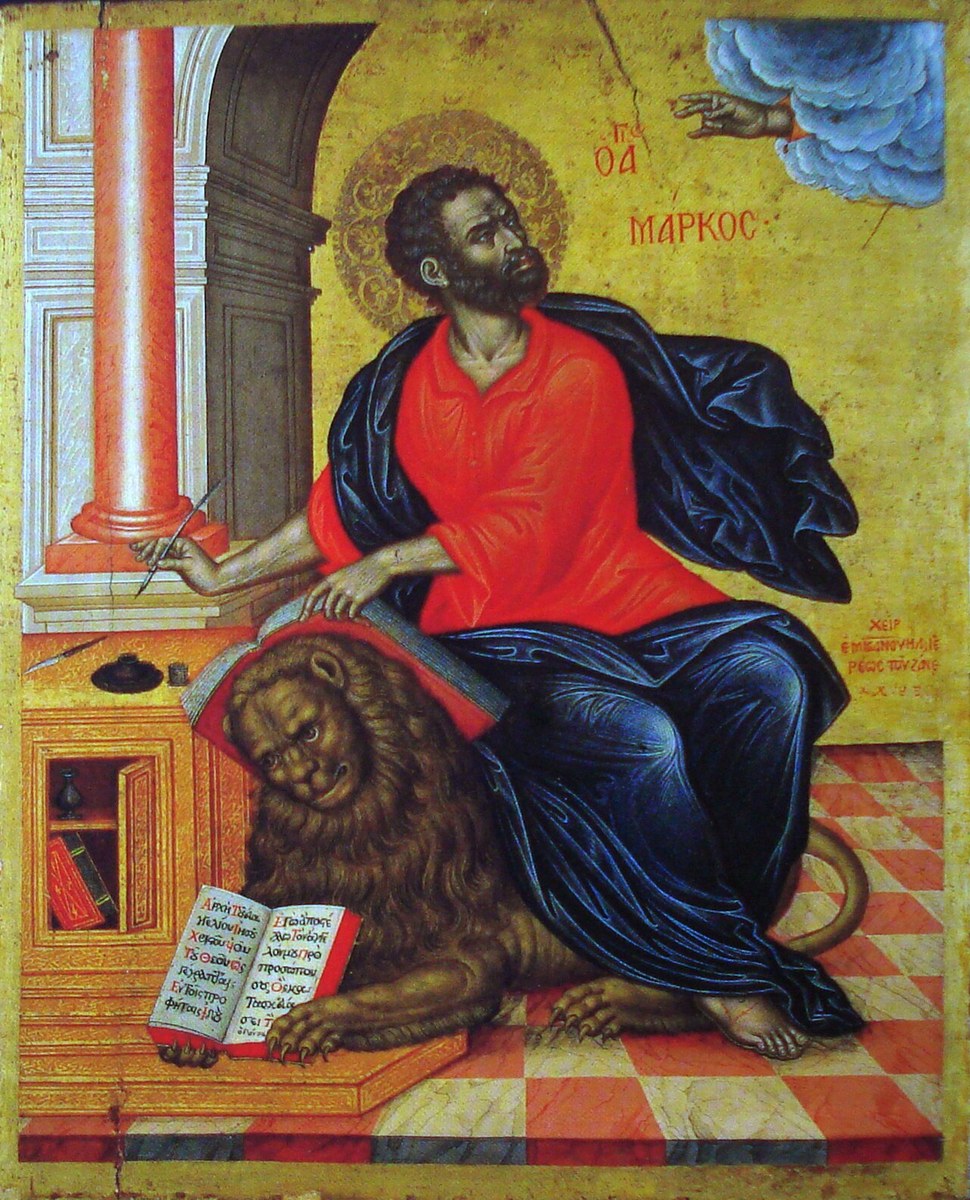
Mark is painted in two chief types. As apostle he stands or is shown bust-length, a man of middle age with dark curling hair and a short rounded beard, in tunic and himation, holding the closed Gospel-book against his breast — in the great programmes he takes his place with Matthew, Luke and John on the pendentives beneath the dome, where the four evangelists carry the four corners of the church as their books carry the four corners of the earth. As evangelist at work — the type inherited from the author-portraits of late-antique books and multiplied in every Byzantine and Slavic Gospel-manuscript — he is seated in a scholar's exedra before a lectern and writing-desk with pen, inkwell, penknife and scroll-case, bent over the codex or lifting his eyes to the ray of divine light or the blessing hand of God from the cloud, from which his inspiration descends. His inscription is Ο ΑΓΙΟΣ ΜΑΡΚΟΣ, and the words on his open book are the first words of his Gospel: ΑΡΧΗ ΤΟΥ ΕΥΑΓΓΕΛΙΟΥ ΙΗΣΟΥ ΧΡΙΣΤΟΥ. Where he is painted as first bishop of Alexandria he wears the omophorion and blesses; the scene of his martyrdom shows the rope about his neck and the crowd hauling him over the stones, and Egyptian and Venetian cycles add the healing of Anianus's hand, the vision in the prison, and the theft and voyage of the relics.
His symbol is the lion, third of the living creatures of Ezekiel's vision and of the Apocalypse (Ezekiel 1:10; Revelation 4:7). The assignment is Jerome's and became universal: the lion because Mark opens in the desert with the voice of one crying, a roar in the wilderness; because the lion is the royal beast and the Second Gospel proclaims the might and kingship of the Son of God; and because the ancients believed the lion's whelp to be born dead and roused to life on the third day by its father's breath, an image of the Resurrection. Earlier schemes differed — Irenaeus gave the lion to John and the eagle to Mark, and Augustine gave Mark the man — and Byzantine tetramorphs are not always consistent; but the lion has been Mark's throughout the Christian world for fifteen centuries, and in the West it is often winged and haloed, couched at his feet or holding the book.
The image stored here is a Cretan-school icon of 1657, signed at the right in red — ΧΕΙΡ ΕΜΜΑΝΟΥΗΛ ΙΕΡΕΩΣ ΤΟΥ ΤΖΑΝΕ, "by the hand of Emmanuel the priest, Tzanes" — by Emmanuel Tzanes (c. 1610–1690), the Rethymnon-born painter and priest who worked at Corfu and Venice, and it is a perfect example of the mature evangelist type: the saint, inscribed Ο ΑΓ(ΙΟΣ) ΜΑΡΚΟΣ, sits in a scarlet tunic and deep blue mantle before a column and a cupboard of books, pen in hand and eyes lifted to the blessing hand of God in a cloud, while the great lion couches at his feet on a marble pavement with the opened Gospel beneath its paws, showing in Greek the first verses of Mark: The beginning of the Gospel of Jesus Christ... as it is written in the prophets: Behold, I send my messenger before thy face.
Disputed questions
- The three Marks. This is the principal difficulty of the entry, and the Byzantine calendar itself creates it. The synaxaria distinguish three apostles of the Seventy named Mark: this Mark the Evangelist, disciple of Peter and first bishop of Alexandria (April 25); Mark "also called John," bishop of Byblos, commemorated on September 27 with Aristarchus and Zenas; and Mark the cousin of Barnabas, bishop of Apollonias (October 30). The scheme does not divide along the New Testament data, for the scriptural John Mark of Acts 12:12 is the cousin of Barnabas of Colossians 4:10, so that the September 27 and October 30 commemorations rest on one and the same man; and the great majority of modern scholarship, together with the received Lives of every jurisdiction — the OCA's April 25 notice opens by identifying the Evangelist as "John Mark (Acts 12:12), nephew of Barnabas" — further identifies both with the Evangelist, as this entry has done in narrating his life from the Acts. The Church's calendar nonetheless keeps three distinct commemorations, and this corpus follows the calendar while recording the question: the three files exist, each cross-referring to the others, and no attempt is made to abolish a commemoration the Church has kept for a thousand years. Practically, the reader should know that the biography given above and the biography given under September 27 are drawn from the same verses of Acts, and that the see of Byblos and the see of Apollonias belong to the calendar tradition, not to Scripture.
- September 27 and the companions Aristarchus and Zenas. Because the September 27 Mark is kept in this corpus as John Mark of the Seventy, no September feast is entered in this entry's frontmatter; readers who follow the modern identification should treat the September 27 commemoration with Aristarchus and Zenas as a second feast of the Evangelist. January 4 raises no such difficulty: the received roll of the Seventy names the Evangelist Mark second, after James the Brother of the Lord, and he is commemorated with them at their synaxis.
- The naked young man and the water-carrier. The identification of Mark with the young man who fled naked from Gethsemane (Mark 14:51–52) and of his family with the house of the upper room is a pious and ancient inference from the Gospel's own gratuitous detail, not a datum of the tradition; the same is true of the guess that the water-carrier of Mark 14:13 was Mark or his father. They are recorded here as the interpreters offer them.
- Kolobodaktylos, "the stump-fingered." The anti-Marcionite prologue and Hippolytus give Mark the strange epithet κολοβοδάκτυλος. The explanations offered are: that he had lost or mutilated a thumb or finger — the Coptic tradition says he cut it off to make himself unfit for the priesthood, and God restored him to it notwithstanding; that his fingers were naturally short; or that the word describes his book, the Gospel "docked" of a birth-narrative and an ending. No explanation is certain and the epithet itself may be very old.
- Was he a martyr, and when? Neither Eusebius nor Jerome speaks of a martyrdom; Jerome says only that Mark died and was buried at Alexandria, Annianus succeeding him. The passion narrative — the Acts of Mark — is a later composition (fourth or fifth century) though it draws on Alexandrian local memory, and it is from this that the whole Church, Greek, Coptic and Latin alike, has received the martyrdom. The year is variously 62, 63 or 68 (see above); the received Greek Menaion and the Copts agree on the day.
- The ending of the Gospel. The last twelve verses of Mark (16:9–20) are absent from the two oldest great uncial manuscripts and the textual history of the ending has been debated since Eusebius and Jerome noticed the variance. The Orthodox Church receives them: they are read as resurrection Gospels at Sunday Matins and were commented on by the Fathers. The question is one of textual transmission, not of canonicity.
- The "Secret Gospel of Mark." A letter attributed to Clement of Alexandria, reporting a longer mystical version of Mark's Gospel made at Alexandria, was announced in 1958 as found at the monastery of Mar Saba. The manuscript has since disappeared, and the scholarly judgement has moved decisively toward regarding it as a modern forgery. It has no place in the tradition of the Church and is noted here only because it is frequently met with in writing about Mark.
- Not to be confused with the several other saints named Mark in this corpus: Mark the Ascetic (March 5), Mark the Athenian (April 5), Mark of Arethusa (March 29), Mark of Ephesus (January 19), and the two apostolic Marks named above.