
John of Suzdal
Saint John the Wonderworker, Bishop of Suzdal and Nizhny Novgorod
Bishop · Wonderworker · d. 1373
Commemorated 15 October — Repose at Bogolyubovo
John (†1373) was the first bishop of the restored see of Suzdal and Nizhny Novgorod, consecrated about 1350, and is remembered as a hierarch of the poor: he pleaded with the princes to lighten the taxes of the destitute, built almshouses and hospices, and laboured to bring the pagan Mordvins of the Volga lands to Christ. The tradition tells that Prince Boris of Suzdal saw an angel serving with him at the Divine Liturgy, and that slanderers struck blind received their sight again by his prayer. When his diocese was joined to the metropolitan's jurisdiction he took the schema and withdrew to the Bogolyubovo monastery, where he died in peace; his relics rest in Suzdal, and miracles at his grave sealed his veneration as a wonderworker.

Episcopate
John entered one of the monasteries of the Suzdal country in his youth, and for the virtue and humility of his monastic life was raised, about the year 1350, to the newly restored episcopal see of Suzdal and Nizhny Novgorod — the tradition counts him the first bishop of the joined diocese, erected in the days when the princes of Suzdal and Nizhny Novgorod stood at the height of their power as rivals of Moscow. The chronology of his episcopate is imprecisely transmitted (see below), but the character of it is not. The sources dwell on his mercy: he was a father to the destitute and the sick, interceded with the princes to lighten the taxes laid on the poor, and built almshouses and hospices at his own charge. Beyond the Volga lay the heathen Mordvins, and the enlightenment of that people with the faith was among his cares — an early chapter in the long mission history of the middle Volga.
Of his sanctity the tradition preserves two signs above the rest. At the Divine Liturgy, Prince Boris Konstantinovich of Suzdal beheld an angel of God ministering with the saint at the altar. And when certain ill-intentioned churchmen slandered him, they were struck blind — and received their sight again at the saint's own prayer, who first bound and then blessed them, as the day's second troparion sings, likening him in this to Leontius, the hierarch-enlightener of Rostov.
Repose
When Suzdal's independent standing was ended and the diocese passed under the jurisdiction of the metropolitan's see, John laid aside his omophorion, took the great schema, and withdrew to the monastery of Bogolyubovo, the ancient princely foundation near Vladimir. There he lived in seclusion, and there he died in peace; the received date of his repose is October 15, 1373. His body was returned to Suzdal, and his relics rest in the cathedral of the Nativity of the Theotokos. Numerous miracles at his grave established his cultus, and Suzdal has honoured him since as one of its two great sainted hierarchs, with Theodore its first bishop.
Feast and commemoration
October 15 (church date; Old Calendar civil October 28), the day of his repose, kept in the Russian calendars and by the OCA; the commemoration is not part of the Greek tradition of the day. He is also honoured in the Russian tradition among the Suzdal saints.
Hymns
Troparion — Tone 8
Instructor of Orthodoxy, teacher of piety and purity, most radiant lamp of Suzdal, God-inspired adornment of hierarchs, O wise John: by thy teaching thou didst enlighten thy flock; O blessed hierarch, pray to Christ God that our souls may be saved.
Original translation from the Slavonic
Kontakion — Tone 8
By God-wise teaching and holy living thou didst shine as a lamp in the Church of God; wherefore thou wast counted worthy of divine protection, when the eyes of the evil-minded slanderers were darkened, and by thy prayer thou madest them to see again, and didst return to thy city and well shepherd the flock of reason-endowed sheep: help us also, their children, by thy prayers, O John, hierarch of Christ.
Original translation from the Slavonic
Iconography
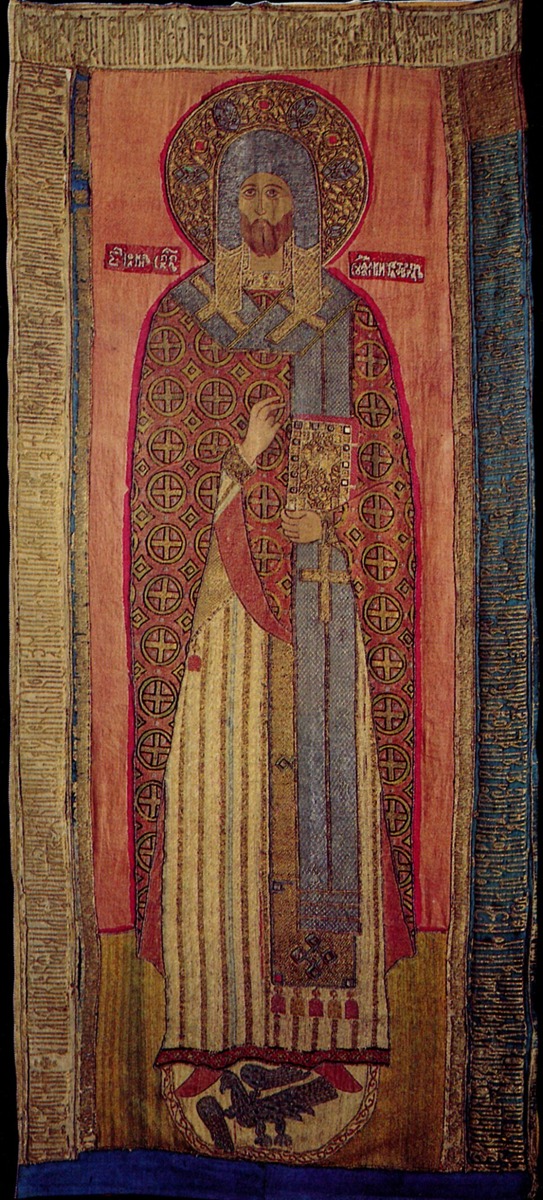
John is depicted as a Russian hierarch of the fourteenth century — in sakkos or polystavrion with omophorion, white-clobuked or bare-headed, his hand raised in blessing or holding the Gospel — often paired with Theodore, the first bishop of Suzdal, over the city they share. The stored image is among the earliest and finest witnesses to his cultus: the embroidered tomb-cover (pokrov) of the saint worked in 1578, within two centuries of his repose, showing the full-length figure of the bishop in cross-patterned vestments with omophorion and Gospel, framed by an embroidered troparion border; the inscriptions beside the halo name him "Saint John, Bishop of Suzdal, wonderworker."
Disputed questions
- Chronology. The dates of John's accession, retirement, and death are transmitted variously in the Russian sources; the received account — consecration c. 1350, withdrawal after the diocese's subordination, repose October 15, 1373 — is followed here, with the imprecision recorded.