
John the Chozebite
Our Venerable Father John the Chozebite, Bishop of Caesarea in Palestine
Venerable · Bishop · Wonderworker · d. c. 520–530 (so the scholarly dating; the calendars say 6th century — see Disputed questions)
Commemorated 3 October, 28 October — Commemoration in part of the synaxarion tradition (so the Menologion of Basil II; the OCA calendar repeats him on this day)
John the Chozebite (6th century) was an Egyptian of Thebes who became a hermit of the wild gorge of Choziba in the Judaean desert, between Jerusalem and Jericho, where he reorganized the hermit settlement into the community later famous as the monastery of Choziba. Renowned for healings, exorcisms and discernment, he was made bishop of Caesarea in Palestine against his will, soon laid down the see, and returned to the desert, where he reposed in old age. A defender of the Council of Chalcedon, he is remembered above all through the stories of the Spiritual Meadow of John Moschus, including the celebrated episode of the loaves consecrated on the road.
.jpg)
Origins and early life
John was born at Thebes in Upper Egypt, of a notable family, and was formed in the ascetic life from his youth in the Thebaid — the synaxarion says under his grandfather, a monk; the received Russian Life says under his uncle (the sources vary; see Disputed questions). The tradition preserves a telling episode of his Egyptian years: sharing for a time the hesitation of much of Egypt over the Council of Chalcedon, he separated from the communion of the catholic Church, until he was corrected by a vision in which he was taught that those out of communion with the catholic Church are not worthy to venerate the Cross of the Lord. He returned to the Church's communion and remained thereafter a firm opponent of the Monophysite (in the received Life's language, "Eutychian") party — a stance that would mark his public life in Palestine, where the struggle over Chalcedon dominated the age.
The hermit of Choziba
Leaving Egypt, John came to Palestine and settled in the ravine of Choziba (Wadi Qelt), the deep, precipitous gorge that the old road from Jerusalem descends toward Jericho — a landscape of cliff-caves that tradition already associated with the prophet Elijah's sojourn by the brook Cherith. He found an inaccessible cave and lived at first on the green shoots of the plants of the place. Around the older nucleus of hermits there — the tradition of the house remembered five Syrian fathers as its first founders — John gathered and ordered a community: the Life of George of Choziba, written in the seventh century by Antony, a monk of the house, names John of Thebes as the one who made the scattered lavra into an organized koinobion. Under his government the community by the brook grew into the monastery of the Theotokos of Choziba, clinging to the north cliff of the gorge, which remains inhabited to this day (now called after his later successor George the Chozebite, the abbot of about 625, a distinct saint kept January 8 — not to be confused with this John, the sixth-century organizer of the house and bishop of Caesarea).
Bishop of Caesarea
John's reputation for holiness — the tradition records exorcisms, healings of the incurable, water brought from the rock and rain called down by his prayer — reached the ears of authority, and he was taken from the desert and consecrated bishop of Caesarea, the metropolis of Palestine, against his will. The burden of the see and the loss of stillness proved intolerable to him: after a short tenure he abandoned the cathedra and returned to the gorge of Choziba, where he lived out his days as before, an old man of the cliffs sought out by pilgrims on the Jericho road. He reposed in peace at a great age.
The miracle of the loaves
The best-loved story of John belongs to his years as priest at Choziba, before his episcopate, and is told by John Moschus in the Spiritual Meadow (ch. 25). A brother of the community, sent to fetch the offering-loaves, had learned the words of the anaphora by heart and recited them over the loaves as he carried them back, "as though reciting verses." At the Liturgy, John, offering the gifts, was distressed that he did not perceive the descent of the Holy Spirit in the accustomed manner, and wondered what fault of his own had hindered it — until it was revealed to him that the gifts had already been hallowed by the brother's recitation on the road. The community thereafter ruled that the words of the offering be said by none but the ordained, and at the altar only. The story — a rare window into sixth-century eucharistic practice and its reverence for the spoken anaphora — made "Abba John the Chozebite, who became bishop of Caesarea in Palestine" a fixture of the spiritual literature. The adjacent chapter of the Meadow preserves the memory of an elder of the Cells of Choziba who carried bread and water up and down the Jericho road to refresh exhausted travellers — the charitable face of the same desert.
The synaxarion adds among his wonders that the hermit Marcianus was borne by an angel through the air to John's cave — a story linking him with the ascetic legends of the Palestinian desert.
Veneration
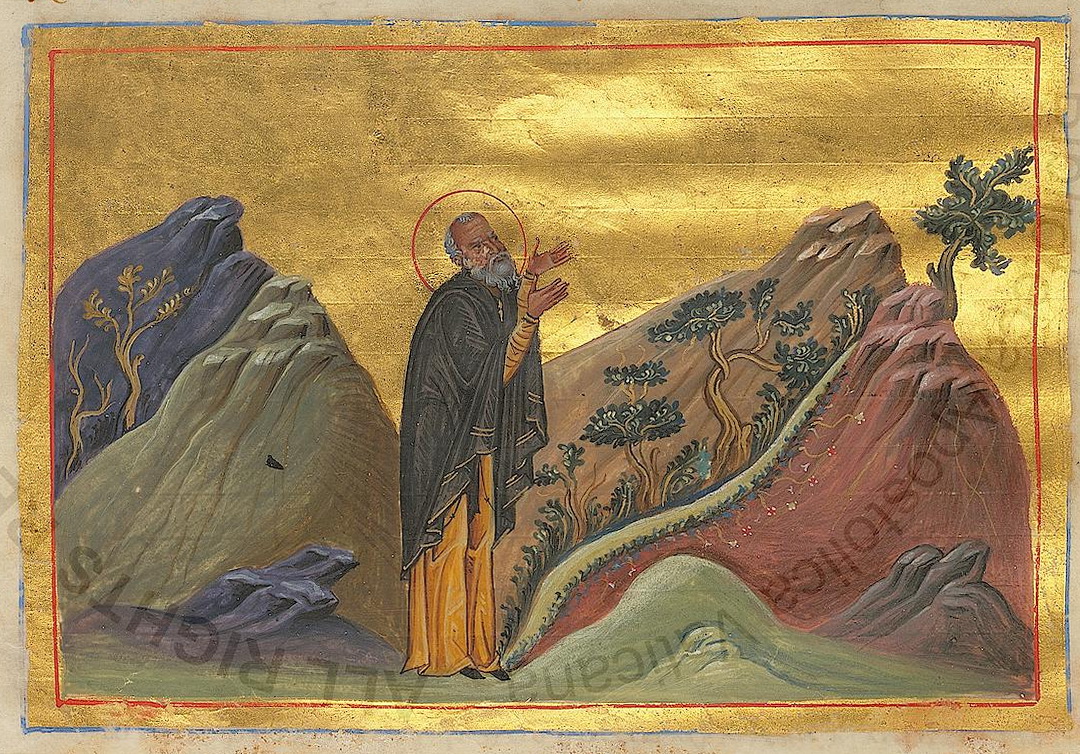
John's memory was kept above all in his own gorge: the monastery of Choziba commemorated its second founder, and the Menologion of Basil II (c. 985) includes his portrait miniature. With George the Chozebite (January 8) and the later John Jacob the New Chozebite (20th century), he stands at the head of the small company of saints surnamed "the Chozebite" from that one ravine.
Feast and commemoration
October 3 (church date; Old Calendar civil October 16), listed in the synaxaria after the hieromartyr Dionysius and his companions; kept universally, though without a proper service in the Greek Menaion. A secondary commemoration on October 28 survives in part of the tradition (see above). The monastery of Choziba keeps his memory with especial solemnity.
Hymns
Troparion — Tone 8
With the streams of thy tears thou didst till the barren desert, and with sighings from the depths thou madest thy labours bear fruit an hundredfold; and thou becamest a beacon to the whole world, shining with wonders: O John our venerable father, intercede with Christ God that our souls may be saved.
Original translation from the Greek
Iconography
John is shown as an aged desert monk — and, in fuller programmes, as a monk-bishop, the omophorion over the monastic habit, in token of the see he held and laid down. The stored image is his portrait miniature from the Menologion of Basil II (c. 985, Vat. gr. 1613): the saint stands at prayer in monastic dress against the gold ground, the rocky landscape of his gorge behind him. Modern icons of the Chozebite monastery follow the same monk-bishop type.
Disputed questions
- Dating. The calendars place John simply in the sixth century. The scholarly reconstruction, resting on the Life of George of Choziba and the prosopography of the see of Caesarea, puts his birth c. 440–450, his abandonment of the anti-Chalcedonian communion c. 480, his elevation to Caesarea about 516 — under the emperor Anastasius, whose Monophysite sympathies the Chalcedonian monks of Palestine famously resisted — and his death between about 520 and 530. The Life published by the OCA instead dates his episcopate 587–596; that late dating is hard to reconcile with the witness of Moschus and of the Choziba tradition, and may rest on confusion with the era of George of Choziba, who lived into the Persian sack of 614. The disagreement is recorded here and not resolved.
- Grandfather or uncle. The Greek synaxarion makes his first teacher his grandfather; the Slavic-Russian Life, his uncle. A small variance of transmission, noted as such.
- Two commemorations. Beside the universal October 3, part of the synaxarion tradition — including the Menologion of Basil II — commemorates him toward the end of October, and the OCA calendar carries a duplicate entry ("Venerable John the Chozebite") on October 28 with the same Life. One saint is meant; both days are recorded in the entry's record.
- Not to be confused with George the Chozebite (†early 7th c., January 8), the later hegumen after whom the monastery is now named; nor with John Jacob the New Chozebite (Romanian, †1960, commemorated August 5), the modern ascetic of the same gorge glorified in 1992, whose incorrupt relics lie in the monastery of St George there.