
John the New of Suceava
The Holy and Glorious Great Martyr John the New of Suceava, who suffered at Belgorod
Great Martyr · New Martyr · b. c. 1300, at Trebizond — d. c. 1330–1332, at Cetatea Albă (Asprokastron / Akkerman / Belgorod on the Dniester)
Commemorated 2 June — Martyrdom at Cetatea Albă, 24 June — Bringing of his relics to Suceava under Alexander the Good (Romanian usage)
John the New (c. 1300 – c. 1330/1332) was a Greek merchant of Trebizond who was tortured to death at Cetatea Albă — the Asprokastron of the Greeks, the Akkerman of the Turks, the Belgorod of the Slavs, at the mouth of the Dniester — for refusing to abandon Christ for the religion of its Tatar governor. Denounced out of commercial envy by the Western shipmaster who had carried him there, he was beaten with rods until his flesh came away, dragged through the streets tied to a wild horse, and beheaded in the open street; and the pillar of light that stood over his body that night is the first of the wonders reported of him. Some seventy years later Alexander the Good, Voivode of Moldavia, brought his relics to Suceava, where they remain — and where they made a foreign merchant-martyr into the heavenly patron of Moldavia and of Bukovina, "the protector of all the Moldavian land." He is honoured on June 2 for his martyrdom and, in Romanian usage, on June 24 for the bringing of his relics.
.jpg)
Origins and early life
John was born about the year 1300 at Trebizond on the southern shore of the Black Sea — a Greek city and, in his lifetime, the capital of the Grand Komnenoi, an outpost of Byzantine civilisation at the head of the caravan routes out of Persia and Armenia. His parents were Christians of the Greek rite, and he was raised in the faith and in the family calling: he became a merchant, sailing and trading the coasts of the Black Sea in the age when Genoese and Venetian factories were strung around it and every port held Greeks, Latins, Armenians, Tatars and Jews together.
What his passion emphasises about those years is not his commerce but the manner of it. He is described as devout, exact in the fasts and prayers of the Church, generous in almsgiving to the poor, and — this is the note that will cost him his life — entirely unembarrassed about his Orthodoxy in mixed company. Where merchants of every religion argued over cargo and creed alike, John spoke for the faith of the Greek Church, and would not be silent for the sake of a bargain.
The voyage and the denunciation
On one voyage he sailed in a ship whose master was not of his confession — a Western ("Latin") merchant and shipowner, whom the Romanian tradition names Reitz. The two fell into a dispute about religion during the passage. John, better read and better armed with the Scriptures and the fathers, had the better of the argument, and the shipmaster, publicly bested, nursed the injury.
The ship put in at Cetatea Albă ("the White Fortress"): the Greeks called it Asprokastron, the Turks later Akkerman, the Slavs Belgorod — the port at the Dniester liman that is Bilhorod-Dnistrovskyi in Ukraine today. It was then a Genoese trading station under the overlordship of the Nogai Tatars of the Golden Horde, and its governor — the eparch of the passion — was a pagan, a worshipper of fire and of the sun, whom the Slavonic text styles a man "of the Persian faith."
To this governor the shipmaster went with a lie shaped exactly to trap a devout man: a Greek merchant aboard his vessel, he said, had grown weary of Christianity and wished to be received into the religion of the fire and the sun, but was ashamed to ask for himself and must be summoned and honoured publicly. The governor was delighted. A great crowd was assembled to witness the conversion.
Martyrdom or repose
John was fetched with honour and set before the assembly, and there discovered what had been prepared for him. Invited to renounce Christ and to sacrifice to the fire and the sun, he answered — the passion gives the substance — that he could not deny the Christ who is the light of the world for the sake of creatures that give a borrowed light; that the sun and the fire are the works of God's hands and not gods; and that he had come to trade, not to apostatise. The passion notes that he did not prepare a speech but recalled the Lord's promise for such an hour: "when they shall lead you… take no thought beforehand what ye shall speak… for it is not ye that speak, but the Holy Ghost" (Mark 13:11).
The governor, humiliated before the crowd he had gathered, turned to force. John was stretched out and beaten with rods until, in the words of the passion, the flesh came away from him in pieces and the rods themselves were broken; he was thrown into prison bleeding, and gave thanks through the night. In the morning he was brought out and beaten a second time, so cruelly that his ribs were laid bare. When it was clear that he would not be moved, the governor ordered a wild horse brought, had the martyr bound by the feet to its tail, and had him dragged through the streets of the town — through the Jewish quarter, the passion specifies, where the crowd pelted and mocked him. There, while he was still alive and still confessing, one of the bystanders ran out with a sword and struck off his head, ending the torment; the Slavonic passion identifies him as a Jew of the town, and modern retellings often soften this to "one of the executioners." The body and the severed head were left lying in the street where they fell.
The date is given by the Romanian and Slavonic tradition as 2 June, in the year 1330 or 1332 (see Disputed questions).
Miracles and traditions
That night the wonder happened for which the whole town remembered him. Over the abandoned body there appeared a pillar of light reaching up to heaven, and three lighted lamps burning in the air, and three shining men — understood as angels — who stood by the body censing it and chanting psalms. A Jewish archer on the town wall, taking them for Christians come by night to steal the relics, drew his bow to shoot; and his hands were fixed to the bow and the arrow to the string, so that he could not loose it, and he stood so until morning. When the town came out at dawn and found him thus, he confessed what he had seen, and was released.
The governor, shaken, gave the Christians leave to take the body, and it was buried with honour beside — by some accounts within — the church of Cetatea Albă. Healings were reported at the grave, and the fame of the martyr spread up the Dniester and into Moldavia and Poland.
Relics and translations
The relics rested at Cetatea Albă for some seventy years. Then Alexander the Good (Alexandru cel Bun, Voivode of Moldavia 1400–1432) — a prince building a Church as well as a state, and seeking from the Ecumenical Patriarchate the recognition of a Moldavian metropolitan see — sent to the governor of the White Fortress and obtained the body of the martyr for his capital. It was carried up through Moldavia in procession and laid in the church of Mirăuți at Suceava, then the metropolitan cathedral. Romanian usage keeps that arrival on 24 June; the year is given as 1402 by the received tradition and by most Romanian accounts, while a body of modern historians argues for 1415. A tradition of the city of Iași attaches to the journey: the church called Nicoriță is said to mark the place where the relics halted on their way north.
In 1589 the Voivode Peter the Lame (Petru Șchiopul) translated them from Mirăuți to the newer princely church of Saint George at Suceava, built by Bogdan III and Stephen the Younger between 1514 and 1522 — which is why that church is known today as the Monastery of Saint John the New, and why the martyr's shrine and the metropolitan throne of Bukovina stand together there.
Thereafter the relics travelled with the misfortunes of the country. In 1686 the Polish king John III Sobieski, withdrawing from a failed Moldavian campaign, carried them off — together with the Metropolitan Dosoftei and the treasury of the see — to Żółkiew (Zhovkva, now in Ukraine), where they lay for nearly a century; northern Bukovina having passed to the Habsburgs in 1775, the imperial authorities and the Bukovinan clergy petitioned for their return, and in 1783 the relics came home to Suceava. In the First World War they were evacuated for safety to Vienna, and were brought back after 1918. They remain at Suceava, and the annual procession of the shrine through the city on the June feast is among the largest pilgrimages in Romania.
Veneration and later cultus
Two things made a Greek merchant of Trebizond into a Moldavian national saint: the relics, and the Passion. The martyrdom was written up in Church Slavonic, within a few years of the translation, by Gregory Tsamblak (Grigore Țamblac, c. 1364 – c. 1420) — a Bulgarian of the school of Patriarch Euthymius of Tărnovo, preacher at the Moldavian metropolitan court at Suceava and afterwards Metropolitan of Kiev. His Martyrdom of Saint John the New is reckoned the first work of literature composed in Moldavia, and it carried the saint's name wherever Slavonic was read: into the Russian menologies (where he appears as John of Belgorod), into the Serbian and Bulgarian synaxaria, and into Greek usage under the epithet ho en Asprokastrō, "he who contended at Asprokastron."
In Moldavia itself he became the country's protector. The voivodes invoked him before battle; his martyrdom cycle was painted on the outer walls of the great Bukovinan monasteries — most famously at Voroneț (1547, under Metropolitan Grigorie Roșca) and at Sucevița — where the whole passion is set out panel by panel for an illiterate congregation to read; and he is styled in the hymns and the chronicles the guardian of all the Moldavian land. In the Romanian Orthodox Church he is a saint of the first rank, and his shrine at Suceava is the spiritual centre of Bukovina.
Feast and commemoration
His principal feast is June 2 (church date; Old Calendar civil June 15), the day of his martyrdom at Cetatea Albă, kept by the Greek, Slavic, Romanian and Antiochian calendars alike; the Greek books enter him as John the Great Martyr the New who suffered at Belgorod, the Slavonic as John the New of Sochava. The Romanian Orthodox Church keeps a second feast on June 24 (Old Calendar civil July 7), the bringing of his relics to Suceava, and it is this June feast, with its procession of the shrine and its great pilgrimage, that is the principal celebration in Bukovina; in some years the two commemorations are treated together in the local usage. He is honoured as patron of Moldavia and of the city of Suceava, and is invoked by merchants and by travellers.
Hymns
Troparion — Tone 4
Thou didst trade for the pearl of great price, O martyr John, and having found it thou didst gladly sell all that thou hadst: for setting at nought the threats of the tyrant and the fire he bade thee worship, thou didst confess the Light that no darkness overtakes, and wast beaten and dragged and beheaded for His name. Wherefore Christ hath given thee to Suceava as a treasure that fadeth not: intercede with Him, O athlete of the Lord, that our souls may be saved.
Original translation from the Greek
Kontakion — Tone 4
The Church of Moldavia keepeth thee as her crown and her defence, O great martyr John: for thy blood, poured out in a stranger's city, hath watered our land, and thy relics, borne home in glory, pour forth healing upon all that draw near. Wherefore we cry unto thee: rejoice, O boast of Trebizond and guardian of Suceava.
Original translation from the Greek
Iconography
John the New is painted as a young layman-martyr: beardless or with the first growth of a beard, dark-haired, in the tunic and the mantle of a well-to-do merchant rather than in armour or monastic habit, holding the martyr's cross in his right hand — occasionally a palm, and in Moldavian panels sometimes a scroll. He is very often shown paired with a princely patron or in the company of the Moldavian saints. His narrative iconography is unusually rich, because his passion was made into a fresco cycle on the outer walls of the Bukovinan monasteries: the dispute on the ship, the summons before the eparch, the two scourgings, the martyr dragged behind a horse, the beheading, the angels censing the body under the pillar of light with the archer's hands stuck fast to his bow, the burial by the clergy of Cetatea Albă, and the reception of the relics at Suceava — each panel labelled in Church Slavonic.
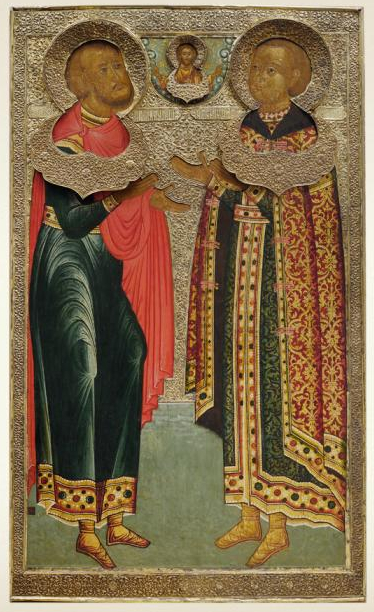
The stored primary image is a Muscovite panel of 1639–1640s from the Cathedral of the Archangel Michael in the Moscow Kremlin, in a chased and gilded silver riza: the martyr stands at the left in a red mantle over a green tunic, hand raised toward the blessing Christ in the medallion above, and the riza inscription names him "Saint John of Belgorod" — the Russian style for this saint. He is paired with the Tsarevich Ivan Mikhailovich, son of Tsar Michael Romanov, whose namesake icon this is; the pairing is itself a witness to how far the Moldavian martyr's cult had travelled by the seventeenth century.
The second stored image is a section of the martyrdom cycle painted on the exterior of the church of the Monastery of Voroneț in Bukovina (1547, under Metropolitan Grigorie Roșca), with its Slavonic titles still legible: in the upper register the saint is scourged and then beaten a second time before the enthroned eparch; below, he is dragged behind a grey horse through the streets; and at the lower right the two angels cense the headless body while the archer draws a bow that he will not be able to loose. At the right stands the great votive inscription of the Voroneț exterior painting, naming Metropolitan Grigorie and the year.
Disputed questions
- The year of the martyrdom. The Romanian and Greek tradition, followed here, places it in 1330 or 1332, under the Nogai Tatar overlordship of the White Fortress. The Prologue tradition and some Slavonic and Serbian recensions give 1492, and a further variant gives 1642 — datings that cannot be reconciled with the translation of the relics to Suceava at the beginning of the fifteenth century, and that most probably arose from scribal confusion of numerals in the Slavonic passion. The early fourteenth-century date is the one the historical evidence supports.
- The year the relics reached Suceava. The received tradition and most Romanian accounts say 1402; a substantial modern argument, resting on the diplomatic history of Alexander the Good's negotiations with Constantinople, says 1415. The church date of the commemoration, June 24, is constant either way.
- The religion of the governor and the identity of the denouncer. The Slavonic passion calls the eparch a fire-worshipper "of the Persian faith"; historically he will have been a Tatar of the Golden Horde, and the "fire and sun" of the text is more likely the shamanic sky-religion of the steppe than Iranian Zoroastrianism. The shipmaster is a "Latin" (Western Christian) in the passion; the name Reitz belongs to the Romanian tradition rather than to the earliest text.
- "Great Martyr" and "New Martyr." Greek books style him Great Martyr (μεγαλομάρτυς) for the severity of his sufferings; Slavonic and OCA usage styles him New Martyr, and the epithet "the New" distinguishes him from the ancient Johns. He is not, strictly, a martyr of the Ottoman period — he died under the Tatars, a century before the fall of Constantinople — and the entry records both styles rather than choosing between them.
- Not to be confused with John of Vlachia (May 12), the young Wallachian captive martyred at Constantinople in 1662, nor with John of Suzdal, nor with the several new-martyrs named John of the Ottoman centuries. The commemoration of a "miracle of John of Trebizond who contended at Asprokastron," entered separately in some Greek synaxaria on the same day, belongs to this saint and is not a second person; likewise "John the Confessor of Suceava," which appears as a distinct line in some calendar lists, is a doubling of this entry.