
Jonah the Presbyter
Our Venerable Father Jonah the Presbyter, Father of Theophanes the Hymnographer and Theodore the Branded
Venerable · Priest
Commemorated 21 September
Jonah the Presbyter (ninth century), called the Sabbaite, was a married priest of Palestine who, after the death of his wife, ended his days as a monk of the Lavra of St. Sabbas the Sanctified, where God granted him a gift of healing. His chief glory in the Church's memory is his fatherhood: his two sons are Theophanes the Hymnographer, later Metropolitan of Nicaea, and Theodore — the brother-confessors whose faces the iconoclast emperor Theophilus branded with mocking verses, whence their name "the Branded" (Graptoi). He is commemorated on September 21, the same day as the Prophet Jonah, from whom he must be distinguished.
.jpg)
Jonah lived in Palestine in the late eighth and early ninth centuries, a presbyter leading a devout married life, and raised two sons who would become two of the great confessors of the second iconoclast persecution. Both boys were given to the Lavra of St. Sabbas in the Judaean desert for their education and were tonsured there: Theophanes, the hymnographer whose canons fill the service books, later Metropolitan of Nicaea (commemorated October 11), and Theodore (commemorated December 27). When the brothers went to Constantinople to contend for the holy icons, the emperor Theophilus had twelve derisive iambic verses branded onto their faces with hot irons — the origin of their surname Graptoi, "the Inscribed" or "Branded." Theodore died in prison of his sufferings; Theophanes lived to see Orthodoxy restored in 843.
After the death of his wife, Jonah followed his sons' path and withdrew to the same Lavra of St. Sabbas, where he lived out his old age in ascetic labour. The tradition — carried by the synaxaria and the Slavic-tradition lives — records that the Lord glorified him with a gift of wonderworking and healing, and the verses of the Greek synaxarion play on his name and his prophetic namesake's wanderings: leaving the place of this unstable life, Jonah found a place standing and sure. He reposed in peace at the Lavra in the ninth century; no exact year is transmitted.
Feast and commemoration
September 21 on the church calendar as kept in the Greek and Antiochian tradition (Old Calendar civil October 4); the Slavic service books, as with the Prophet Jonah, commemorate him one day later, on September 22 (so the OCA). He has no proper service; his memory is kept within the synaxarion of the day, which at the leavetaking of the Elevation is dominated by the service of the feast. No proper troparion or kontakion is transmitted to him in the received books.
Iconography
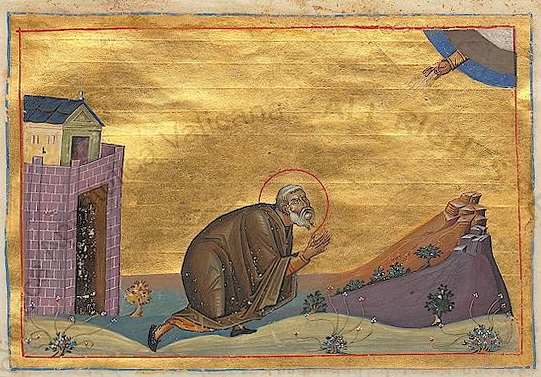
Jonah is depicted as an aged monk of the desert in the brown monastic habit, bareheaded, with a rounded grey beard. The stored image is the miniature of the Menologion of Basil II (Constantinople, c. 985), whose caption names him expressly: the elderly presbyter-monk kneels in prayer on the desert hillside outside the walls of his monastery, toward the hand of God appearing from heaven — an image of the accepted prayer of a wonderworking elder.
Disputed questions
- Not to be confused with the Prophet Jonah, commemorated on the same day — two men of one name sharing September 21, an invitation to confusion which the service books themselves forestall by styling the presbyter "the Sabbaite" or "father of Theophanes and Theodore." Nor is he the later Russian venerable Jonah of Yashezersk, whom the Russian calendar keeps on September 22.
- Identity of "Jonah the Sabbaite." The Greek synaxarion's "our venerable father Jonah the Sabbaite" is standardly identified with the father of the Graptoi; the identification is universal in the received tradition, though the earliest notices name him only as a Sabbaite monk.