
Jonah the Prophet
The Holy Prophet Jonah
Prophet
Commemorated 21 September
Jonah son of Amittai, of Gath-hepher in Galilee, prophesied in Israel in the eighth century before Christ and is the central figure of the Book of Jonah: the prophet who fled from God's call, was swallowed by the great fish, prayed from its belly, and after three days was cast up to preach repentance to Nineveh. The Lord himself made him the pattern of his own death and rising — "as Jonah was three days and three nights in the belly of the whale, so shall the Son of Man be in the heart of the earth" — and Jonah's prayer became the sixth of the Church's biblical canticles, echoed in the sixth ode of every canon. He is among the oldest subjects in all Christian art.

In the Scriptures
Outside the book that bears his name, Jonah appears once in the historical books: "Jonah the son of Amittai, the prophet, who was of Gath-hepher" foretold the restoration of Israel's borders from the entrance of Hamath to the sea of the Arabah, fulfilled under Jeroboam II (2 Kings 14:25). This places him in the northern kingdom in the first half of the eighth century BC, an elder contemporary of Amos and Hosea and, in the traditional reckoning, a successor in the prophetic line of Elisha. Gath-hepher lay in Galilee of the Gentiles, a few miles from the later Nazareth — a fact the Fathers relished against the Pharisees' claim that "out of Galilee ariseth no prophet" (John 7:52).
The Book of Jonah tells the story on which his whole veneration rests. The word of the Lord came to him: "Arise, go to Nineveh, that great city, and cry against it." Jonah rose — and fled in the opposite direction, taking ship at Joppa for Tarshish, "from the presence of the Lord." The Lord hurled a great wind on the sea; while the pagan sailors each cried to his own god and threw the cargo overboard, the prophet slept in the hold until the shipmaster woke him — a heathen bidding a prophet pray. The lot fell on Jonah, and his confession is the creed of the whole book: "I am a Hebrew; and I fear the Lord, the God of heaven, who made the sea and the dry land." At his own bidding — "take me up, and cast me forth into the sea" — the sailors, praying that innocent blood not be laid to them, threw him overboard; the sea ceased its raging, and the sailors feared the Lord, sacrificed, and made vows: the first-fruits of the Gentiles, converted by the prophet's very flight.
"And the Lord appointed a great fish to swallow up Jonah" — the κῆτος, the sea-beast, of the Septuagint — "and Jonah was in the belly of the fish three days and three nights." From that living tomb he prayed the psalm that the Church has sung ever since: "I cried unto the Lord out of my affliction, and he heard me; out of the belly of hell cried I, and thou heardest my voice… The waters compassed me about, even to the soul; the depth closed me round about… yet hast thou brought up my life from corruption, O Lord my God" (Jonah 2). And the fish, at the Lord's command, vomited Jonah out upon the dry land.
The word came a second time, and Jonah went to Nineveh, "an exceeding great city of three days' journey," and cried his eight-word sermon of doom — forty days, in the Hebrew text, three days in the Septuagint, and Nineveh shall be overthrown. And the unthinkable happened: the Ninevites believed God. They proclaimed a fast and put on sackcloth, from the greatest to the least; the king rose from his throne, laid aside his robe, and sat in ashes, decreeing that man and beast alike fast and cry mightily to God — "who can tell if God will turn and repent?" And God saw their works, that they turned from their evil way, and repented of the evil he had said he would do.
The last chapter turns the searchlight on the prophet himself. Jonah was displeased exceedingly and angry: this, he says, is why he fled — "for I knew that thou art a gracious God, and merciful, slow to anger, and of great kindness." He asked to die, sat down east of the city in a booth to see what would become of it, and God appointed a plant — the qiqayon, the "gourd" of the old versions — to shade his head, and Jonah rejoiced in it with great joy. Then God appointed a worm at dawn, and the plant withered; and a scorching east wind, till Jonah fainted and again asked to die. The book ends with God's unanswered question, one of the summits of the Old Testament: "Thou hast had pity on the gourd, for which thou hast not laboured… and should not I spare Nineveh, that great city, wherein are more than sixscore thousand persons that cannot discern between their right hand and their left hand, and also much cattle?"
The sign of Jonah
Jonah's Orthodox veneration rests above all on the Lord's own words. To the scribes and Pharisees demanding a sign, Jesus answered: "An evil and adulterous generation seeketh after a sign; and there shall no sign be given to it, but the sign of the prophet Jonah: for as Jonah was three days and three nights in the whale's belly, so shall the Son of Man be three days and three nights in the heart of the earth. The men of Nineveh shall rise in judgment with this generation, and shall condemn it: because they repented at the preaching of Jonah; and, behold, a greater than Jonah is here" (Matthew 12:39–41; cf. 16:4; Luke 11:29–32).
The Church accordingly reads the whole book as prophecy in action. Jonah's descent into the deep and the beast's belly is the type of Christ's death and descent into Hades; his three days in the fish, of the three days in the tomb; his casting up unharmed, of the Resurrection; the sailors saved through his self-offering, and Nineveh spared at his preaching, of the salvation of the Gentiles; even his sulking under the withered gourd was read by the Fathers as the figure of Israel grieving at the mercy shown the nations. For this reason the entire Book of Jonah is one of the Old Testament readings of the Paschal vigil, chanted at the Vesperal Liturgy of Holy Saturday as the Church waits at the tomb: the one prophetic book read complete in the Byzantine rite, at the one moment its typology comes true.
The sixth ode: Jonah in the daily prayer of the Church
Jonah's prayer from the belly of the fish (Jonah 2:3–10) is the sixth of the nine biblical canticles appointed at Matins, and every canon ever composed in the Byzantine tradition therefore carries Jonah within it: the irmoi and troparia of each canon's sixth ode are modelled on his cry from the deep — "I cried unto the Lord out of my affliction…" — usually turned into the worshipper's own confession of engulfing sin and rising hope. By a happy providence of the calendar, on the very day of Jonah's memory the Church sings, at the leavetaking of the Elevation of the Cross, the katavasia of the Cross for Ode 6:
In the belly of the sea-beast Jonah stretched out his palms in the form of a cross, plainly prefiguring the saving Passion; wherefore, coming forth on the third day, he sketched beforehand the Resurrection, transcending the world, of Christ God, who was nailed in the flesh and by his rising on the third day enlightened the world.
(Translated for this collection from the Greek: Νοτίου θηρὸς ἐν σπλάγχνοις…)
Traditions and tomb claims
A tradition recorded in the pseudo-Epiphanian Lives of the Prophets and repeated by Jerome and the later synaxaria identifies Jonah with the son of the widow of Zarephath, raised from the dead by Elijah (1 Kings 17) — so that the prophet of the Resurrection-sign was himself a man once raised, and the "son of Amittai," son of truth, was the boy whose raising made his mother confess "the word of the Lord in thy mouth is truth." The same tradition has him retire after the Nineveh mission to Gentile country, and die and be buried in the land of his fathers.
His grave has been claimed since antiquity in several places. The most famous claim is Nebi Yunus, "the prophet Jonah," one of the two mounds of ancient Nineveh itself, opposite Mosul: a shrine-mosque over the reputed tomb stood there for centuries until it was blown up by the Islamic State in July 2014 — the destruction exposing, beneath the shrine, the remains of an Assyrian palace. A second claim is kept at el-Meshhed, ancient Gath-hepher, his native town in Galilee; a third at Halhul near Hebron; and Lebanese tradition venerates a site near Sarafand, the ancient Zarephath. As with most prophets, no claim can be verified; the multiplicity is itself a witness to the breadth of his cultus among Christians, Jews, and Muslims alike.
Feast and commemoration
September 21 on the church calendar as kept in the Greek and Antiochian tradition (Old Calendar civil October 4), the leavetaking of the Elevation of the Cross. The Slavic service books commemorate the prophet one day later, on September 22 with the hieromartyr Phocas — a rare fixed one-day divergence between the Greek and Slavic menaia, recorded here without harmonisation (the OCA accordingly lists him on the 22nd). His book is read entire at the Vesperal Liturgy of Holy Saturday, and his canticle grounds the sixth ode of the canon throughout the year.
Hymns
Troparion — Tone 2
Celebrating the memory of thy prophet Jonah, O Lord, through him we entreat thee: save our souls.
Original translation from the Greek
Kontakion — Tone 2
Thou wast shown forth a wondrous prophet: receiving the command of God, thou wast three days in the whale as the figure of the three-day Resurrection, and camest forth from the beast unharmed, and wast revealed a radiant preacher to Nineveh the great city; wherefore with joy we honour thee, O Jonah, as a herald of God's love for mankind.
Original translation from the Slavonic
Iconography
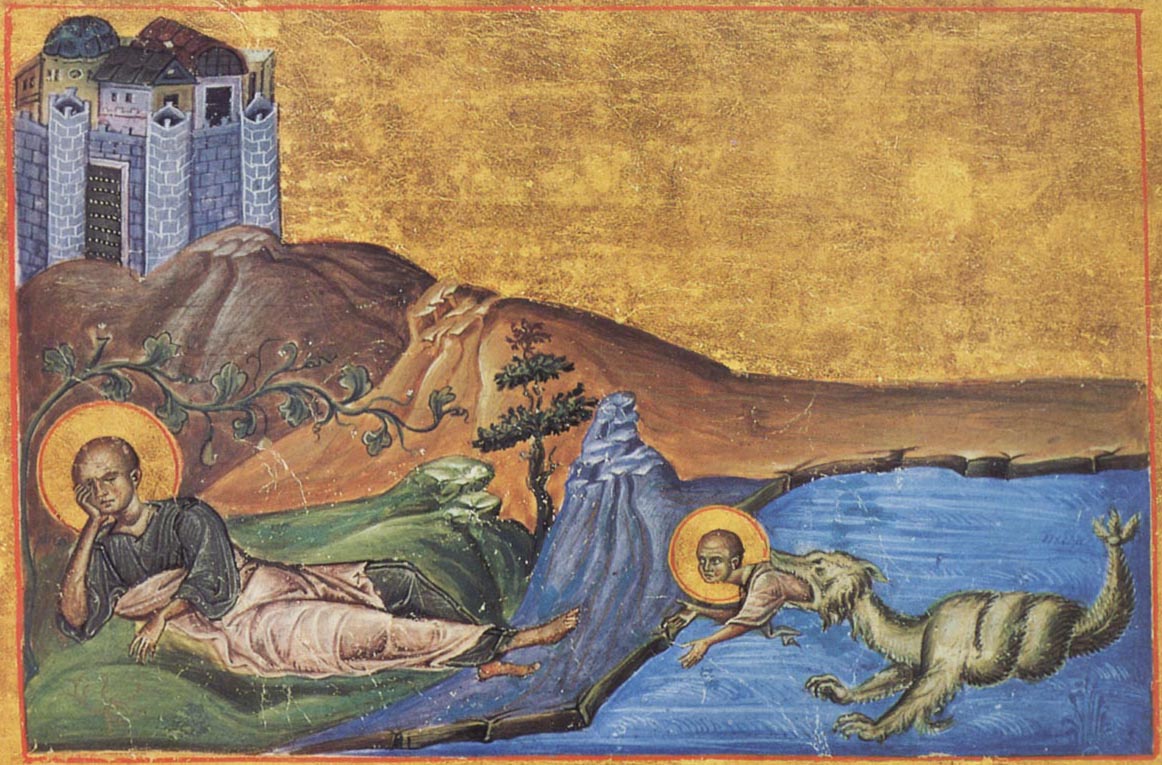
Jonah is among the very oldest subjects of Christian art. The third-century Roman catacombs (Callixtus, Priscilla, Sts. Peter and Marcellinus) paint the Jonah cycle — cast to the sea-beast, disgorged, and resting beneath the gourd — dozens of times, as an image of death and resurrection for the Christian dead; the "Jonah resting" figure borrows the classical sleeping-Endymion type. The cycle fills early sarcophagi (the Vatican "Jonah Sarcophagus", c. 290) and free-standing sculpture (the Cleveland Jonah marbles, Asia Minor, c. 270–280), and passes thence into Byzantine psalter and prophet-book illumination, where the ketos becomes a serpentine sea-dragon. In later Byzantine and Russian icons Jonah appears both in prophet rows — an elderly figure with a scroll of his prayer — and in the narrative type. The stored image is the miniature of the Menologion of Basil II (Constantinople, c. 985), which compresses the cycle into one frame: the sea-dragon disgorging the prophet, and Jonah again, reclining under the gourd vine before the walls of Nineveh.
Disputed questions
- Date and composition. The prophet of 2 Kings 14:25 belongs to the eighth century BC, and the Church's calendar commemorates that man. The date and literary genre of the Book of Jonah are, in modern scholarship, a separate and much-debated question (many date the book's composition after the Exile; others defend an earlier origin). The Church's reading of the book — sealed by the Lord's own use of it — does not hang on the debate, and the entry above simply presents the canonical narrative.
- Forty days or three. The Hebrew text gives Nineveh forty days' respite, the Septuagint — the Church's liturgical text — three, a reading the Fathers connected with the three days of the sign itself.
- The gourd. The plant of Jonah 4 (Hebrew qiqayon, probably the castor plant) was rendered "gourd" (κολόκυνθα) by the Septuagint and "ivy" (hedera) by Jerome — a change that provoked, as Augustine reports, actual uproar in the church of Oea and a celebrated exchange between the two saints on the authority of the Greek versus the Hebrew text.
- Not to be confused with Jonah the Presbyter of Palestine, father of the hymnographer-confessors Theophanes and Theodore the Branded, commemorated on the same day — see the cross-note there — nor with the later Russian saints of the name (Jonah of Moscow, Jonah of Yashezersk).