
Joseph the Sanctified of Samakos
Our Venerable Father Joseph the Sanctified, surnamed Samakos, of Crete
Venerable · Priest · b. c. 1440, at Keramoi (Azokeramos) in Siteia, Crete — d. January 22, 1511, in Crete
Commemorated 22 January — Repose in Crete, 29 August — Deposition of his relics at Zakynthos (1669)
Joseph the Sanctified (c. 1440 – 1511), surnamed Samakos, was a Cretan hieromonk of the last generation before the Ottoman conquest of the island, a priest-monk of radical poverty and prayer whose incorrupt and fragrant relics made him one of the best-loved saints of Crete and, afterwards, of Zakynthos. Born in the far east of Crete and formed from boyhood in the monasteries of his homeland, he gave away his inheritance to the poor, was ordained priest despite his youth, and lived a hidden ascetic life marked by unceasing almsgiving — the tradition remembers loaves miraculously supplied when he had given all his bread away. He reposed on January 22, 1511, and his relics were found incorrupt and sweet-smelling and worked many healings. When the Ottomans took Herakleion in 1669, the relics were carried to safety on Zakynthos, where they are venerated still. He is kept on January 22 (his repose) and August 29 (the deposition of his relics).
.png)
Joseph was born about the year 1440 — a little before the fall of Constantinople — in the village of Keramoi (identified with today's Azokeramos) at the easternmost end of the province of Siteia in Crete, of pious and God-fearing parents who raised him in the fear of God and the knowledge of the Scriptures. Drawn from boyhood to the ascetic life, he attached himself to the nearby Monastery of Panagia Akroteriane (Our Lady of the Cape), and as a young man moved to Handaka (Herakleion, the Venetian Candia) to serve at its dependency, the monastery of St John the Theologian, under the guidance of a spiritual elder. There, though still young, he grew so quickly in discernment and self-denial that he was called a paedariogeron — a "young elder" — and, at his elder's urging, was ordained to the priesthood, becoming a hieromonk; from this holiness of life comes the surname the Church gives him, "the Sanctified" (ὁ Ἡγιασμένος), the same epithet borne by Sabbas the Sanctified.
When his parents died, Joseph distributed his whole inheritance to the poor, after the Lord's word to the rich young man (Matthew 19:21), and bound himself the more strictly to monastic poverty. His life was one of unremitting prayer, vigilance, and almsgiving: he gave away every gift and coin, and even the loaves left from the Liturgy, keeping nothing for himself. The most cherished of the miracles told of him belongs to this openhandedness — that having given away all the prosphora (the altar-bread) with nothing left for the Liturgy, he found, before the service, fresh warm loaves miraculously provided. Another tradition recalls that when he was maliciously accused before the civil judge of insulting the religion of others, he was vindicated and his accusers put to shame. So he passed his years, hidden and laborious, in the Cretan monasteries.
Joseph reposed in the Lord on January 22, 1511, at about the age of seventy(-one), and was buried in his monastery. His sanctity was made manifest when, after some years, his body was found incorrupt and giving off a divine fragrance, and thereafter a stream of miracles — healings of the sick, of the blind, and of the demon-possessed — drew the veneration of the whole island.
Relics and translation to Zakynthos
For a century and a half the incorrupt relics of Joseph were the treasure of Crete. When the long Ottoman siege of Herakleion ended in the fall of the city in 1669, the devout priest Antonios Armakis, unwilling to leave the saint's body to the conquerors, carried the relics to the Ionian island of Zakynthos, then under Venetian rule, and on August 29, 1669 deposited them in the Convent of St John of Mantineia (in the Xerobouni region). In 1915 they were translated within the island to the Church of the Pantocrator at Gaitani, near the town of Zakynthos, where they remain, incorrupt, an object of veneration to this day. The Church keeps his repose on January 22 and the deposition of his relics on August 29.
Feast and commemoration
Joseph is kept on January 22 (church date; New Calendar civil January 22; Old Calendar civil February 4), the day of his repose, on which he is commemorated with the Apostle Timothy and Anastasius the Persian. A second feast, the deposition of his relics at Zakynthos, is kept on August 29. His veneration, at first Cretan and then centred on Zakynthos, is kept in the Greek calendars; he is a saint of the local synaxaria of Crete and the Ionian Islands rather than of the universal Menaion, though the feast is now widely observed. The day falls in no fasting season (August 29, the Beheading of the Forerunner, is itself a strict fast day, but Joseph's relic-feast is a secondary commemoration of that day).
Hymns
Troparion — Tone 8
In thee, O Father, was the divine image preserved with exactness; for taking up the Cross thou didst follow Christ, and by thy deeds thou didst teach us to despise the flesh, for it passeth away, but to care for the soul, a thing immortal. Therefore doth thy spirit rejoice with the Angels, O Venerable Joseph.
Original translation from the Greek
Iconography
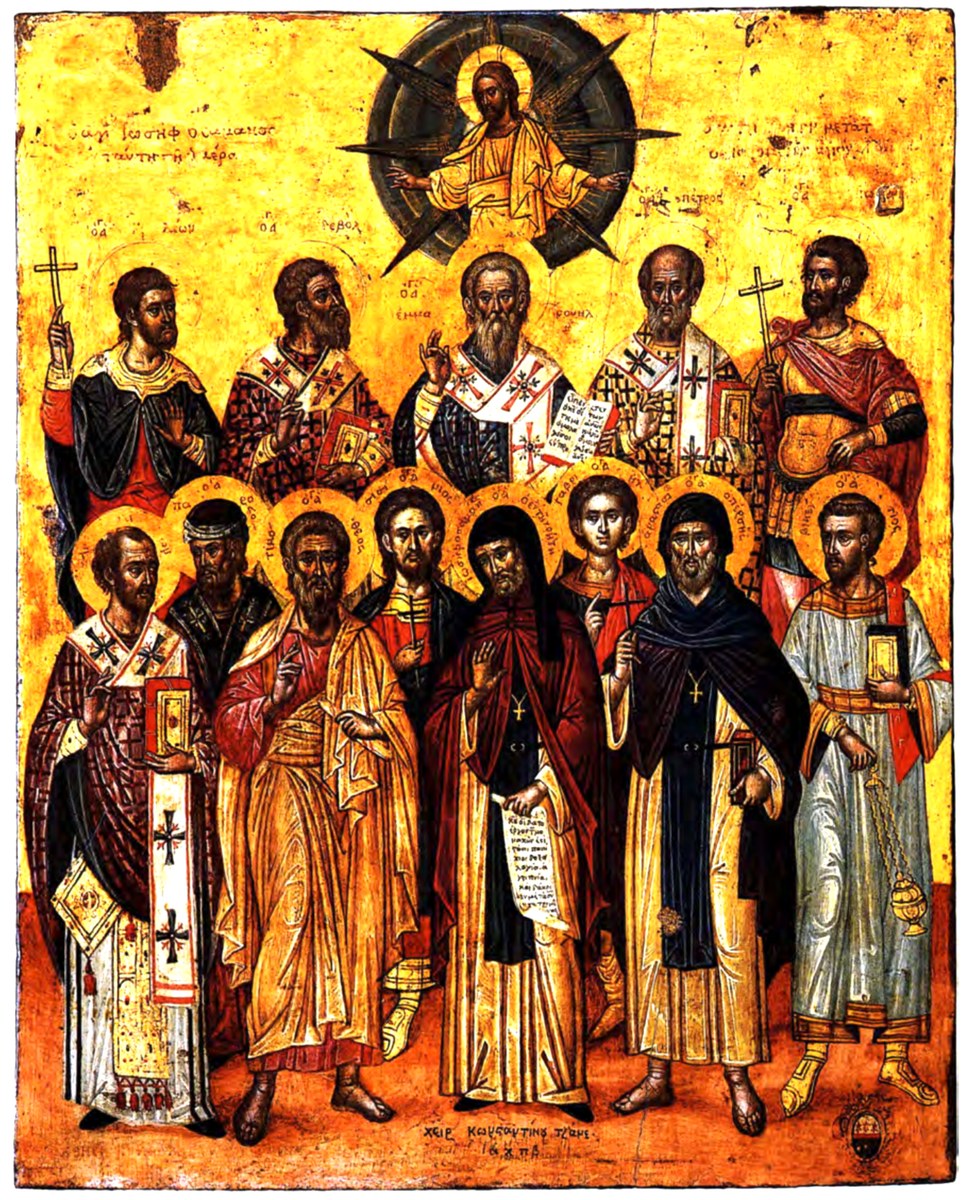
Joseph is depicted as a Cretan hieromonk in the monastic schema, an elder with a full beard, holding a scroll or a cross, in the settled type of a venerable father; where his incorrupt relics are the theme, the reliquary is shown. He belongs, with Timothy and Anastasius, to the company of the saints of January 22 gathered in the Cretan-school panel of Konstantinos Tzanes.
The stored image is that panel — The Saints of the 22nd of January, by the Cretan master Konstantinos Tzanes (1633–1685; Hellenic Institute of Byzantine and Post-Byzantine Studies, Venice) — which sets Joseph Samakos among the saints of his feast-day, together with Timothy, Anastasius the Persian, and the martyrs of Adrianople (source, public domain, pd-old-work). A separate, identity-verified single icon of Joseph alone is wanting.