
Sabbas the Sanctified
Our Venerable and God-bearing Father Sabbas the Sanctified
Venerable · b. 439 — d. 532
Commemorated 5 December — Repose at the Great Lavra
Sabbas the Sanctified (439–532) was the great organiser of monasticism in the Judaean desert and one of the most influential ascetics in the history of the Church. A Cappadocian who came to Palestine as a youth, he founded the Great Lavra above the Kidron gorge — the monastery of Mar Saba, inhabited without a break from 483 to the present day — together with a whole network of lavras and coenobia, and was appointed by the Patriarch of Jerusalem archimandrite of all the anchorites of Palestine. A pillar of the Council of Chalcedon, he twice travelled as an aged monk to plead the cause of Orthodoxy and of his devastated province before the emperors Anastasius and Justinian. The liturgical order worked out at his Lavra — the Jerusalem, or Sabaite, Typikon — governs Orthodox worship to this day. His feast is December 5.

The life of Sabbas is known in exceptional detail because his biographer, Cyril of Scythopolis, was a monk of his desert who wrote within a generation of his death, gathering his information from elders who had lived with the saint. The Life of Sabas is one of the fullest and most reliable of all Byzantine hagiographies, and the account below follows it.
Origins and early life
Sabbas was born in 439 at Mutalaska, a village in the district of Caesarea in Cappadocia, to John (surnamed Konon), an officer of the imperial army, and his wife Sophia. When Sabbas was five his father was posted to Alexandria and took his wife with him, leaving the boy and the family estate in the charge of a maternal uncle. Ill-treatment there, and a bitter quarrel between this uncle and a paternal uncle over the guardianship and the property, drove the child from home; at the age of eight he entered the nearby monastery of Flavianae, and there he found his vocation.
Cyril preserves the memories that the monks kept of the boy: his rapid mastery of letters and of the whole Psalter, and above all his early command of the appetites. Working one day in the monastery orchard he was seized by the wish to eat an apple before the appointed hour; taking one, he checked himself, threw it to the ground and trampled it, and made a rule never again to eat apples — a small act the tradition treasured as the seed of his lifelong self-mastery. When his uncles, reconciled, tried to draw him back to the world and to marriage and the management of his inheritance, he refused, and at seventeen received the monastic tonsure. He remained about ten years at Flavianae.
Coming to Palestine and formation in the desert
Drawn to the holy places and to the great desert fathers of Palestine, Sabbas came to Jerusalem around 456, when he was eighteen, and sought out Euthymius the Great (January 20), the most celebrated ascetic of the Judaean wilderness. Euthymius, who did not receive beardless youths into the solitary life of his own lavra, sent him down to the neighbouring coenobium governed by Theoctistus, where Sabbas was schooled in the disciplined common life. There he laboured in perfect obedience, carrying water, gathering wood, and serving the brethren, and there Euthymius, watching his progress, gave him the name paidariogerōn — the "child-elder," old in judgement while young in years. Euthymius took him, with the deacon Domitian, into the deep desert of Rouba for the weeks of Great Lent, forming him in the extremes of the anchoretic life.
After the death of Euthymius in 473 Sabbas withdrew ever further into solitude, living for some years in the wilderness by the Jordan and in the harsh country south-east of Jerusalem, near the Dead Sea. Cyril describes a period of four years passed in almost total isolation before, in about 478, when he was thirty-nine, Sabbas settled in a cave high on the eastern cliff of the Kidron gorge, reached only by a rope, in one of the most forbidding landscapes of the inhabited world. There he lived alone five years, and there, as his fame spread, disciples began to gather at the foot of his crag.
The Great Lavra
From about 483 the community that formed around Sabbas in the Kidron ravine became the Great Lavra — the monastery known to later ages as Mar Saba. Its organisation followed the lavriotic pattern rather than the cenobitic: the monks lived as semi-anchorites, each in his own cell or cave scattered along the gorge, keeping silence and solitude through the week and coming together only on Saturdays and Sundays for the common services and a shared meal, after which they returned to their cells with the week's provisions and the raw material of their handwork. It was a mode of life demanding proven maturity, and Sabbas governed it with a shepherd's discernment, tempering the severity of the desert to the strength of each brother.
The early years brought their trials. Cyril relates that when Sabbas first came to his cliff-cave he shared it with a lion, which withdrew before the monk's prayer — one of the desert stories that fixed the lion in the saint's iconography. More pressing was the community's need of water in that arid ravine, which was met, the Life says, by a spring that opened at the foot of the tower after Sabbas's prayer, and flows still. As the brotherhood grew he built the churches of the Lavra: first the small cave-church later dedicated to Saint Nicholas, then, on a site he regarded as shown him by God (the "God-built church," theoktistos), the great church of the Mother of God that remains the heart of the monastery.
Sabbas himself long shrank from ordination, holding the priesthood incompatible with a monk's humility; but in 490 the Patriarch Sallustius of Jerusalem ordained him priest and consecrated the Lavra's church. It is to this — his consecration to offer the Holy Mysteries, joined to the transparent holiness of his life — that the tradition traces his epithet the Sanctified (Hēgiasmenos), which distinguishes him among the many monastic Sabbases of the calendar.
Archimandrite of the anchorites; the many monasteries
In 494 the Patriarch of Jerusalem appointed Sabbas archimandrite and exarch over all the monks of Palestine who lived the eremitic and lavriotic life, while Theodosius the Cenobiarch (January 11) was set over all who lived in coenobia. Between them the two friends governed the whole monastic world of the Holy Land, and their joint authority made the Palestinian desert one of the decisive forces in the Church of the age.
Sabbas was the founder of many houses. Besides the Great Lavra he established the New Lavra (507); the coenobium of the Cave (Spelaion); the fortress-monastery of Castellium (492), which he raised on the ruins of an ancient stronghold and cleansed of the demons that were said to haunt it; the "Little Coenobium" that served as a novitiate for the Great Lavra; and the monasteries of the Scholarius, of Heptastomos, of Zannos and of Jeremias, together with hospices for pilgrims at Jericho and at Jerusalem. Through these foundations the ordered ascetic life was carried across the whole wilderness between Jerusalem and the Jordan.
Not all the desert accepted his governance. Twice a faction of discontented monks rose against him — the second time some sixty of them, who could not endure his authority — and Sabbas, rather than fight for his place, withdrew in silence to the region of Scythopolis and Nicopolis, founding new communities there, until the Patriarch recalled him and settled the rebels in the New Lavra. That house later became, to Sabbas's grief, a seed-bed of the Origenist speculation — the pre-existence of souls and kindred doctrines — that troubled Palestinian monasticism after his death and was condemned under Justinian; the aged Cyriacus the Hermit was among those who resisted it.
Defender of Chalcedon; the embassies to the emperors
Sabbas was an unwavering adherent of the Council of Chalcedon (451) and its confession of the two natures of Christ, at a time when successive emperors and much of the East leaned toward the anti-Chalcedonian party. Under his leadership and that of Theodosius the monks of Palestine became the mainstay of Chalcedonian Orthodoxy in the region, and twice the Church sent the old abbot on embassy to Constantinople.
The first journey, about 511–512, was undertaken at the bidding of the Patriarch Elias of Jerusalem, to plead before the Emperor Anastasius I — a supporter of the Henotikon and the opponents of Chalcedon — both for the orthodox confession and for relief and protection for a province worn down by war and by Saracen raids. Cyril tells with relish how the imperial guards, seeing only a ragged and insignificant old monk, would not admit him among the ambassadors, until the emperor learned who he was; Anastasius, disarmed by his humility, received him with honour and granted his petitions, and though he could not move him from Chalcedon he dismissed him with gifts for his monasteries.
The second embassy fell in 531, when Sabbas was about ninety-two. The great Samaritan revolt of 529 had devastated Palestine, and the Patriarch Peter sent Sabbas to the Emperor Justinian I and the Empress Theodora to obtain the remission of taxes for the ruined province, funds for rebuilding the churches, a hospital and a fortress for the desert monks, and the protection of Orthodoxy against the Samaritans, the Origenists and other heresies. Justinian, who venerated him, granted all that he asked. Cyril records that when Theodora begged the saint to pray that she might bear a child, Sabbas declined, unwilling to ask of God an heir who — he foresaw — would be nourished in the doctrines of Severus and trouble the Church more than Anastasius had done: a refusal the tradition remembers as a mark of his prophetic discernment.
Repose
Returning from Constantinople, Sabbas fell ill soon after reaching his Lavra. He named the monk Melitas as his successor, gave his last counsels to the brethren, and after four days of silence died in his cell on 5 December 532, in his ninety-fourth year. He was buried in the Great Lavra in the courtyard between the two churches, where his tomb is still shown and venerated.
Relics and translations
The body of Sabbas remained incorrupt at the Great Lavra for centuries and became one of the desert's treasures. In the age of the Crusades the relics were carried off to the West and came at length to Venice, where they were kept in the church of San Antonino. There they lay until 1965, when — as a gesture of goodwill following the Second Vatican Council and the meeting of Pope Paul VI with the Patriarch Athenagoras — the relics were restored to the monastery of Mar Saba. The incorrupt body was received back into the Lavra it had founded fourteen centuries before, and rests there today, one of the few relics of a great early father returned to its original home.
Veneration and later cultus: Mar Saba and the Sabaite Typikon
The Great Lavra of Sabbas has been inhabited continuously since 483, one of the oldest surviving monasteries in the world and, through the Byzantine and Islamic centuries alike, a school of Orthodox theology, hymnography and liturgical order. Within its walls or its dependencies lived and worked John of Damascus — the great theologian and defender of the icons, who wrote his works there and lies buried in the Lavra — Cosmas of Maiuma the hymnographer, the two confessor-brothers Theodore and Theophanes the Branded, Stephen the Hymnographer the saint's own kinsman, and many another poet and confessor. The monastery gave to the Church a whole tradition of sacred song.
Its most far-reaching legacy is liturgical. The order of services developed at the Lavra — the Typikon of Saint Sabas, also called the Jerusalem Typikon — took shape over generations from a nucleus that the tradition traces to the founder himself. Combined later with the hymnographic riches of the Stoudios monastery of Constantinople, this Sabaite order became, in its "neo-Sabaite" form, the standard Typikon of the Byzantine rite: the framework of the daily cycle, of Vespers, Matins and the Hours, and of the reckoning of feasts and fasts, that governs Orthodox worship to the present day. Few individual saints have shaped the ordinary prayer of the whole Church so deeply.
Feast and commemoration
Sabbas is commemorated on December 5 (church date; Old Calendar civil December 18), the day of his repose, universally throughout the Byzantine rite. The feast falls within the Nativity Fast and on the eve of the great feast of Nicholas of Myra (December 6), so that in the services of the day the memory of the desert-father is joined to the forefeast of the wonderworking hierarch. His name is invoked in the dismissal of the Lavra and of countless monasteries that follow the order which bears his name.
Hymns
Troparion — Tone 8
By the streams of thy tears thou didst till the barrenness of the desert, and by thy sighs from the depths thou didst bear fruit a hundredfold in labours; and thou becamest a luminary, shining upon the whole world by miracles, O Sabbas our venerable Father. Intercede with Christ God that our souls may be saved.
Original translation from the Greek
Kontakion — Tone 8
Offered to God from infancy as a blameless sacrifice through virtue, O blessed Sabbas, thou wast shown by Him who knew thee before thy birth to be an adornment of the venerable and a praiseworthy settler of the wilderness. Wherefore I cry to thee: Rejoice, O Father of great renown.
Original translation from the Greek
Appointed readings
Epistle — Galatians 5:22–6:2
22But the fruit of the Spirit is love, joy, peace, longsuffering, gentleness, goodness, faith, 23Meekness, temperance: against such there is no law. 24And they that are Christ’s have crucified the flesh with the affections and lusts. 25If we live in the Spirit, let us also walk in the Spirit. 26Let us not be desirous of vain glory, provoking one another, envying one another. 1Brethren, if a man be overtaken in a fault, ye which are spiritual, restore such an one in the spirit of meekness; considering thyself, lest thou also be tempted. 2Bear ye one another’s burdens, and so fulfil the law of Christ.
Gospel — Matthew 11:27–30
27All things are delivered unto me of my Father: and no man knoweth the Son, but the Father; neither knoweth any man the Father, save the Son, and he to whomsoever the Son will reveal him. 28Come unto me, all ye that labour and are heavy laden, and I will give you rest. 29Take my yoke upon you, and learn of me; for I am meek and lowly in heart: and ye shall find rest unto your souls. 30For my yoke is easy, and my burden is light.
Iconography
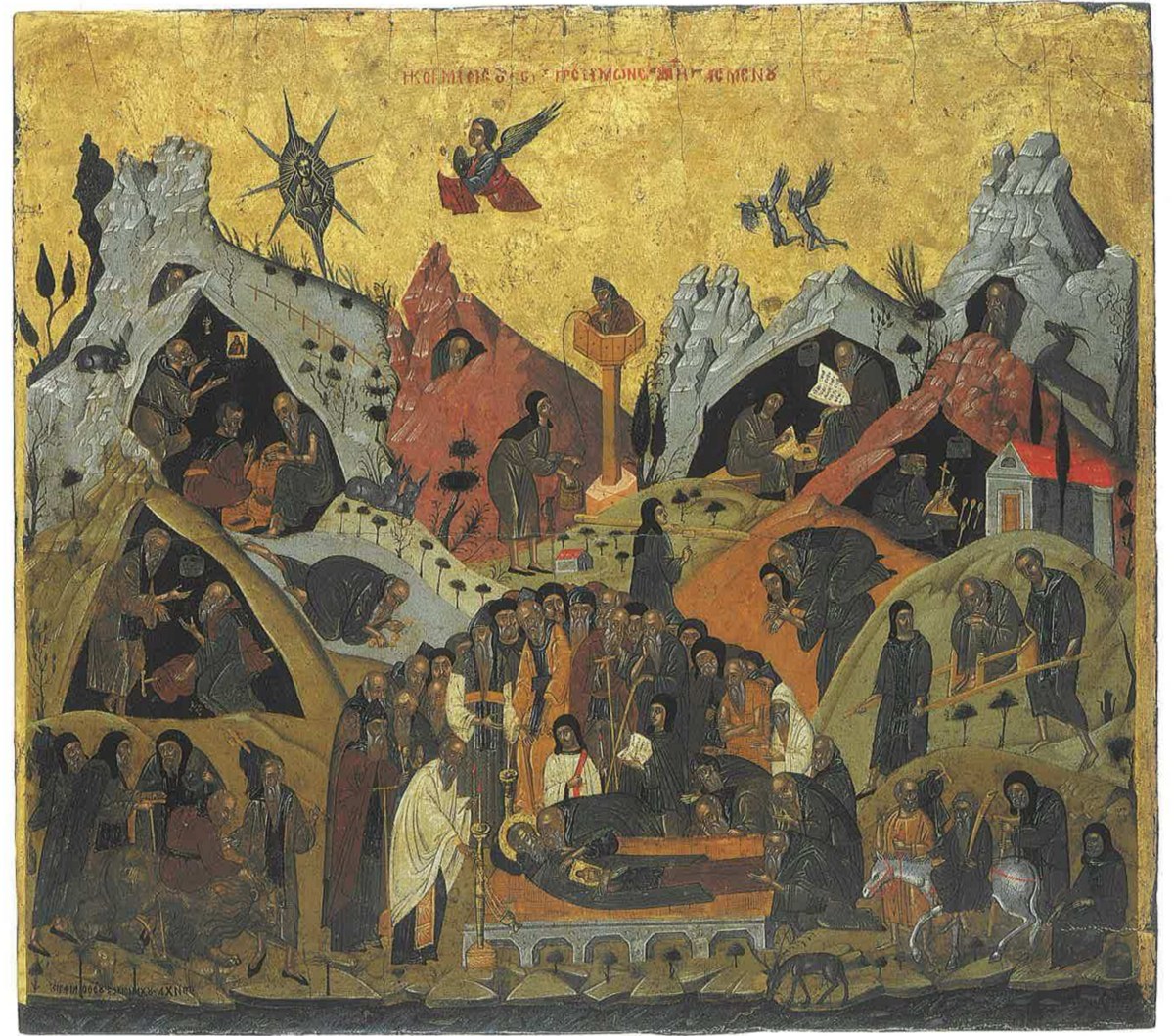
Sabbas is depicted as an aged monk of the great schema, with a long white beard narrowing to a point, holding a scroll or a cross and blessing; behind or beside him the desert lavra and its cliffs are often shown, and in narrative icons a lion recalls the story of his cave. The stored image is a Cretan icon of the Dormition of Sabbas the Sanctified by Filotheos Skoufos, painted at Venice about 1656 (Rena Andreadis Collection, Athens): the saint lies in death amid the mourning monks of the Lavra, while around them the whole life of the desert monastery — caves, cells, the churches, the working brethren, and the lion — unfolds across the golden mountains. Skoufos painted it in the very city that then held the saint's relics.
Disputed questions
- The date of birth and age. Cyril's chronology yields the birth-year 439 and an age at death of ninety-three or ninety-four; the round figure "ninety-four" is conventional.
- The Typikon. The received text of the Jerusalem Typikon is the product of centuries of development and cannot be attributed to Sabbas as author; what the tradition rightly ascribes to him is the founding of the liturgical usage of the Lavra from which that Typikon grew. The distinction is one of historical precision, not of veneration.
- Not to be confused with the several other monastic Sabbases of the calendar — Sabbatius of Solovki (a distinct name and saint), Sabbas of Storozhevsk (the Russian disciple of Sergius of Radonezh), or Sabbas of Vishera. Nor with the two martyr-Sabbases, both of Gothic stock and both drowned in rivers: Sabbas Stratelates, the Roman general martyred under Aurelian (April 24, †272), and Sabbas the Goth, the reader drowned in the Mousaios under Athanaric (April 12, †372). "The Sanctified" is proper to this Sabbas alone.