
Julian and Caesarius of Terracina
The Holy Martyrs Julian the Presbyter and Caesarius the Deacon, at Terracina in Italy
Hieromartyr · Martyr · Priest · Deacon · d. 1st century (as transmitted)
Commemorated 7 October
Julian the presbyter and Caesarius the deacon were martyred together at Terracina on the coast of Italy south of Rome — the Byzantine calendars transmit the first century. Caesarius, imprisoned for denouncing the pagan gods and their human sacrifice, was being dragged to the temple of Apollo when the temple collapsed on its priests; arrested at about the same time, the priest Julian was condemned with him, and the two were sewn into a sack and drowned in the sea. Their bodies came ashore and were buried by Christians; the relics of Caesarius were later taken to Rome, where churches still bear his name. They are commemorated together on October 7.

The pair belong to the ancient martyr-traditions of Terracina, the harbour town on the Appian Way between Rome and Naples. The passio that underlies both the Western and the Byzantine notices tells of Caesarius, a deacon come from Africa, who witnessed the town's yearly abomination: a young man, pampered at public expense, hurled himself from the cliff above the town as a sacrifice to Apollo "for the welfare of the state." Caesarius denounced the practice and the gods it honoured, and was thrown into prison. When he was at length dragged in chains toward the temple of Apollo, the temple collapsed before he reached it, burying its priest and many of the worshippers. About the same time the authorities seized Julian, a presbyter of the town's small church; the two clerics were condemned together, sewn into a sack, and cast into the sea — the old Roman parricide's punishment turned against the fathers of the Christian flock. The sea gave the bodies back, and Christians buried them near the town.
The Greek synaxarion preserves the scene in its distich for the day: "To the two athletes, given to the sack and to the deep, God the Word turns the sackcloth into joy."
The same hagiographic dossier furnishes the day's remaining Terracina names in the Constantinople synaxarion, commemorated in its own brief lines: Leontius the ex-consul (ὁ Ὑπατικός), whom the passio presents as the magistrate converted by Caesarius's endurance, who "believed in Christ, prayed, and was perfected in peace"; and the martyrs Eusebius the presbyter and Felix, companions of the same cycle, "perfected by the sword." Having no independent cultus, they are covered here rather than in separate entries.
Relics and later cultus
The relics of Caesarius were taken to Rome, as the OCA life also notes, and his cult there was ancient and honoured: the church of San Cesareo de Appia keeps his name on the Appian Way, and an oratory of Saint Caesarius stood within the imperial palace on the Palatine — the deacon of Terracina, by the happy accident of his name, becoming a Christian patron for the Caesars. Terracina venerates him as its patron; his arm reliquary and relics remain in the cathedral there, and towns named San Cesario in the south of Italy carry the cult. Julian is remembered with him, in East and West alike, as the senior in orders and companion in death.
Feast and commemoration
October 7 (church date; Old Calendar civil October 20), on the universal calendar: the Greek synaxarion lists the pair with their distich — naming Julian the presbyter first, as the Slavic books also do — and the OCA keeps "Martyrs Julian the Presbyter and Caesarius the Deacon at Terracina." The Roman church keeps Caesarius (with Julian) on November 1. The day's proper service belongs to Sergius and Bacchus, and no proper hymns for these martyrs are appointed in the received Menaion.
Hymns
Troparion — Tone 4 (from the common of martyrs)
Thy martyrs, O Lord, in their contest received incorruptible crowns from Thee, our God; for possessing Thy strength they cast down the tyrants and shattered the feeble insolence of the demons. By their intercessions save our souls.
Original translation from the Greek
Iconography
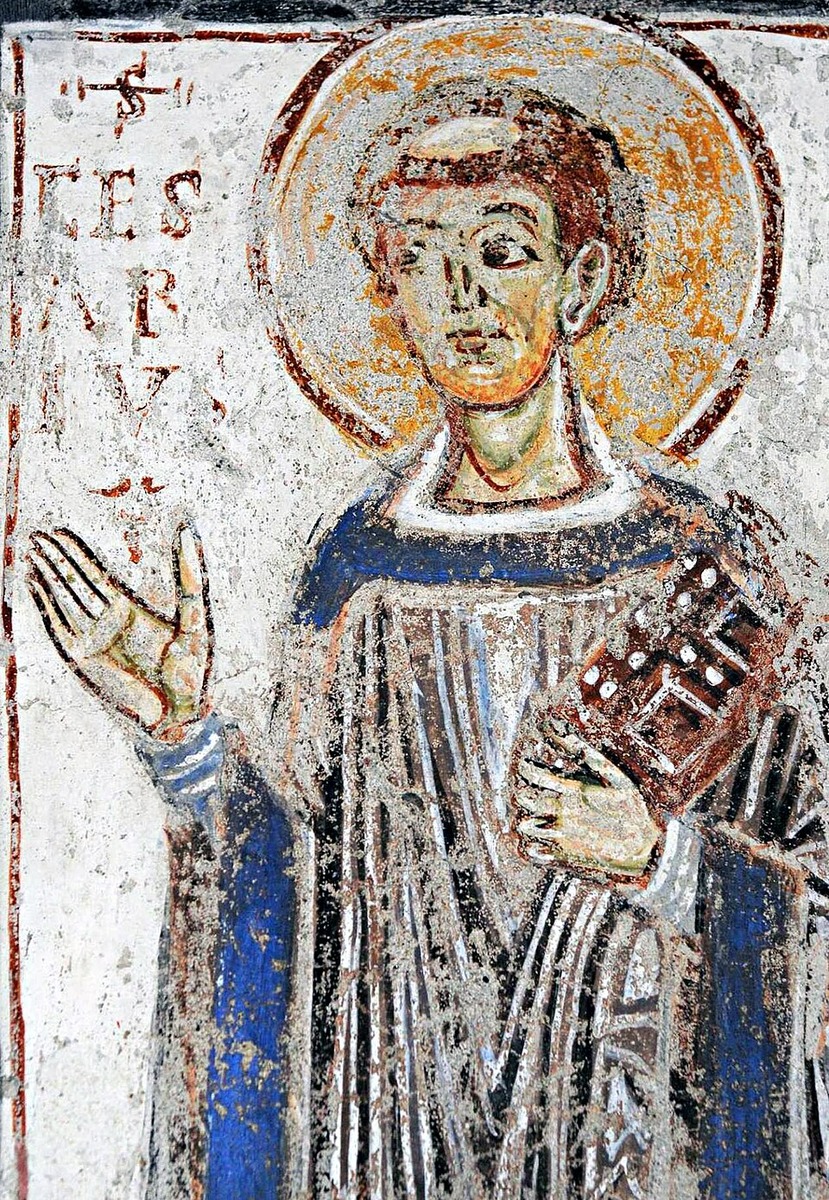
The Eastern tradition has no fixed type for the pair; they would be shown as presbyter and deacon — Julian in phelonion, Caesarius in the deacon's sticharion and orarion — with the sack and the sea as the narrative attributes. The surviving pre-modern imagery belongs to the Western cult of Caesarius: the stored image is the Romanesque fresco of the saint, inscribed with his name, from the crypt of the cathedral of Anagni (12th–13th century) — the young deacon in dalmatic, book in hand, his right hand raised. Julian appears with him in the later fresco cycles of Terracina itself.
Disputed questions
- Date. The Byzantine and Slavic calendars transmit the first century, and that is retained in the entry's record; the Western passio is a much later composition (its recensions set the drama under various emperors), and modern hagiographers regard the martyrs' precise date as beyond recovery. The disagreement of the recensions is recorded here rather than resolved.
- Two Caesarii of the calendar. The Roman calendar keeps Caesarius of Terracina on November 1; the Byzantine calendar commemorates on that same November 1 a different martyr Caesarius, of the company martyred at Damascus. When the November 1 company is authored, the reciprocal "not to be confused" note is due.
- Not to be confused (Julian) with the hieromartyr Julian of Galatia (September 12/13) — a distinct martyr-priest of Asia Minor.
- Africa tradition. The passio's statement that Caesarius came from Africa is followed by recent Italian hagiography (hence "Caesarius of Africa" in some modern references); the Eastern notices know him simply as the deacon martyred at Terracina.