
Julian of Galatia and his Forty Companions
The Holy Martyr Julian of Galatia, Presbyter, and the Forty Martyrs with him
Martyr · Priest · d. 4th century
Commemorated 12 September
Julian was a priest of Galatia in the fourth century who, in time of persecution, hid in a cave near Ancyra with forty companions and continued to celebrate the divine services there. Arrested, he refused either to betray his companions or to sacrifice to the idols; stretched on a red-hot iron grate, he signed himself with the Cross and was preserved unharmed by an angel, and he was finally beheaded, praying that blessing would rest on all who took earth from his grave. The forty, hearing the heavenly voice that received him, came out of hiding, confessed Christ, and were beheaded in their turn. They are commemorated together on September 12.
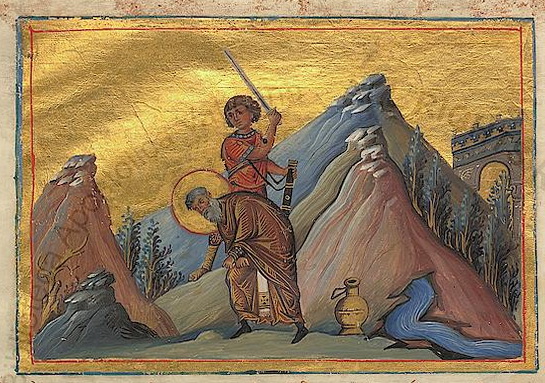
.jpg)
Julian lived in the fourth century in Galatia in Asia Minor, not far from Ancyra (the modern Ankara). A presbyter, he passed the years of persecution neither in flight nor in surrender: with forty like-minded Christians he withdrew to a cave in the district and there continued to celebrate the divine services for the hidden community. The verses of the Greek synaxarion remember him as an ascetic as well as a confessor — "mingling contests with ascetic sweats, Julian receives a double crown" — a line implying that the cave was as much a hermitage as a refuge.
Report of the cave and its priest reached the governor of the Galatian district. Julian was arrested and interrogated on two demands: that he disclose where the rest of the Christians were concealed, and that he offer sacrifice to the gods. He refused both. He was then stripped and stretched upon an iron grate heated red-hot; the martyr signed himself with the sign of the Cross, and an angel of the Lord cooled the flame, so that he rose unharmed. Asked who he was and by what art he had quenched the fire, he answered only: "I am a servant of God."
The torturers then brought out his aged mother and threatened her with outrage unless she persuaded her son to sacrifice. The old woman answered with a boldness the notices record with evident relish: violence done to her body against her will would be no sin of hers before God, but rather an act of martyrdom. Humiliated, they sent her away and condemned Julian to death. Before the sword he gave thanks, asked strength to endure, and made a petition that passed into the veneration of his memory: that those who took earth from the place of his burial should receive forgiveness of sins and deliverance from the passions, and that neither harmful insects nor birds should descend upon their fields — the prayer of a rural priest for a farming people. Commending his spirit to God, he bent his neck beneath the sword, and a voice from heaven summoned him to the Kingdom.
The voice was heard also in the cave. Emboldened, the forty came out to the place of his suffering, found him already perfected, and openly confessed themselves Christians. All forty were arrested, brought before the governor, and beheaded.
Feast and commemoration
September 12 (church date; Old Calendar civil September 25), within the leavetaking of the Nativity of the Theotokos. The Greek Menaion's synaxarion lists him on September 12, but part of the Greek tradition (including the current GOARCH calendar) keeps him on September 13, and the Russian calendar prints his memory on both days — a one-day drift the sources transmit without comment.
Hymns
Troparion — Tone 4 (from the common of martyrs)
Thy martyrs, O Lord, in their contest received incorruptible crowns from Thee, our God; for possessing Thy strength they cast down the tyrants and shattered the feeble insolence of the demons. By their intercessions save our souls.
Original translation from the Greek
Iconography
The Menologion of Basil II (c. 985) gives the scene of Julian's end: an aged, bowed, grey-bearded figure in a hilly landscape, his neck bared to the executioner's raised sword — the single elderly victim distinguishing this miniature from the group-martyrdom scenes of the manuscript. Later minology icons show him as a priest among the September saints; the forty companions have no iconographic tradition of their own.
Disputed questions
- Date. The notices agree only on the fourth century; the persecution is not named. Placements under the last years of Diocletian's persecution (c. 305–311) are conventional rather than transmitted.
- The company. The forty are anonymous in all the calendars consulted; no member has an independent cultus, and they are therefore kept in this one entry with Julian, per this collection's rule for companion groups.
- Classification. Though a presbyter, Julian is styled simply "Martyr" by the Greek synaxarion and the OCA; the Russian calendar styles him "Hieromartyr Julian of Galatia, presbyter." This entry follows the Greek and OCA lead in its types while recording the Russian usage here.
- Not to be confused with the several other martyrs Julian of the fixed calendar — among them Julian of Tarsus (June 21) and the Julian commemorated on September 4 in the group of Centurion, Theodore, Amianus and Julian of Kandaula — none of whom is connected with the Galatian presbyter; likewise distinct is the presbyter Julian martyred with Caesarius the deacon at Terracina (October 7).