
Kerkyra and the martyrs of Corfu
The Holy Virgin-Martyr Kerkyra and the Holy Martyrs who suffered with the Apostles Jason and Sosipater in Corfu
Martyr · Virgin · d. 1st century
Kerkyra was, by the received account, the daughter of Kerkyllinos, the ruler of the island of Corfu in the first century, who confessed Christ when she learned why the apostles Jason and Sosipater and their fellow-prisoners were suffering in her father's gaol. She gave away her jewels and her goods to the poor, withstood her father's rage and his attempt to shame her, and was at the last hung upon a tree and shot to death with arrows. With her the Church keeps on this day the whole company of the island's first martyrs: the seven condemned robbers whom the apostles converted in prison and who were boiled in a cauldron of pitch, the gaoler who confessed Christ at the sight of their end and was mutilated and beheaded, the robber set upon Kerkyra who believed instead of harming her, and the martyrs Zenon, Vitalis, Eusebius and Neon, perfected by fire. They are the first-fruits of Corfu, and the company from which the church of the island grew.
_-_икона_08281_Иасон,_Сосипатр_и_Керкира.png)
The prison at Corfu
The narrative of this day is one story with two entries: the apostles Jason and Sosipater, disciples of Paul, came from Asia to the island of Kerkyra (Corfu), built there a church in the name of the Protomartyr Stephen, and were shut up by the island's ruler in the public prison. All the martyrs commemorated here were made Christians inside that prison or by the sight of what happened in it. Their story is therefore told around the apostles' — the fuller account of the mission is given in the entry for Jason and Sosipater — and the tradition of Corfu holds them together as the island's first martyrs.
The seven robbers
Seven men lay in that gaol under sentence for robbery, and the tradition transmits their names: Saturninus, Iakischolus, Faustianus, Januarius, Marsalius, Euphrasius and Mammius. Through the nights of their imprisonment they heard the apostles pray and preach, and they believed; and when they were brought out, it was as confessors of Christ and no longer as thieves. They were put to death in a cauldron of boiling pitch, to which the Greek notice adds wax and brimstone. The synaxarion's own verse turns on the good thief of the Gospel: learning that a robber's portion was Eden, the robbers hastened to obtain it through burning pitch.
The gaoler
The man who had kept the prison door watched the seven go into the cauldron, and cried out that he too was a Christian. The ruler had his left hand struck off, then both his feet, and then his head — a graduated mutilation intended to break him, which the account records precisely and which the calendars remember without giving him a name.
Kerkyra, daughter of Kerkyllinos
The Greek synaxarion names her simply: Saint Kerkyra, daughter of Kerkyllinos the king, who was perfected pierced with arrows. Learning from within her father's house what the prisoners were dying for, she declared herself a Christian, took off her ornaments and distributed her jewels and possessions to the poor, and would not be persuaded to sacrifice. Her father, humiliated by his own daughter's confession, first had her shut up, and then — in the harshest detail of the story — set a robber upon her to violate her and so disgrace her before the people. The account relates that the man was prevented, in one telling by a bear that came upon him; that Kerkyra healed the injury he had taken; and that he became a Christian himself and was put to death by fire. Slavic notices give him the name Murin and call him Christodoulos — "the servant of Christ" — describing him as an Ethiopian.
The ruler then ordered the chamber where she was held to be set alight; and when the fire did not touch her, he had her hung upon a tree, choked with the smoke of bitter fumes kindled beneath her, and shot with arrows until she died. The synaxarion's verse plays on her rank: pierced with the shots of arrows, the king's daughter shone out from her wounds as from pearls. She is the patronal virgin-martyr of the island whose name she bears — or which bears hers — and the Greek tradition treats her name and that of the island as one word.
Zenon, Vitalis, Eusebius and Neon
The Greek synaxarion of the day adds two further notices. In the first, the martyrs Zenon and Vitalios are perfected by fire, and the verse gives them a small dialogue: Do not be afraid of the flame, Vitalios; for I will lead, and Zenon will go in first. In the second, the martyr Eusebios is perfected by fire, with the verse: what filth could that fire of yours scour away, Eusebius, refined gold of Christ? The Slavonic Menaion adds Neon. All four belong to the Corfiot company, though the notices do not say in what order or by whose sentence they suffered, and the sequence of the persecution cannot now be reconstructed.
The end of the persecution
The persecution ended, according to the account, when the apostles themselves were cast into the boiling pitch and came out of it unharmed; the ruler who then held the island believed and was baptised with the name Sebastian, and the churches of Corfu were built. The martyrs of this day are thus remembered as the seed of the island's conversion — a company of condemned criminals, a prison guard, a king's daughter and men known only by their names and by the fire that took them.
Feast and commemoration
April 28 (church date; New Calendar civil April 28, Old Calendar civil May 11), kept with the apostles Jason and Sosipater, whose service the day carries. The Greek Menaion keeps the same company on April 29, giving April 28 to the Nine Martyrs of Cyzicus; the divergence is recorded in full in the apostles' entry. Because Pascha may fall as late as May 8, this day comes either within Great Lent or in the Pentecostarion according to the year, and the service is sung with the propers the Typikon appoints for each case.
Kerkyra is honoured in her own right on the island of Corfu, where her memory is kept with that of the apostles, and where the tradition places her passion and their burial. She has no separate feast, and no Wikidata entity was located for her under any of the spellings Kerkyra, Kerkira, Cercyra or Corcyra (verified 2026-07-26).
Hymns
Troparion — Tone 4 (common of a virgin-martyr)
Your ewe-lamb Kerkyra cries out to you with a great voice, O Jesus: I love you, my Bridegroom, and in seeking you I contend; I am crucified and buried together with you in your baptism, and I suffer for your sake, that I may reign with you; I die for you, that I may live in you. Receive me as a spotless sacrifice, offered to you in love. By her intercessions, as you are merciful, save our souls.
Original translation from the Greek
Kontakion — Tone 2 (common of several martyrs)
You who are the source of all light and the crown of those who contend, have strengthened the first-fruits of the island of Kerkyra: a king's daughter, and prisoners loosed from their chains, and men refined in the fire. By their prayers, O Christ, grant your mercy to us who honour them.
Original translation from the Greek
Synaxarion
Learning that a robber's portion was Eden, the robbers made haste to obtain that same portion through burning pitch. Pierced with the shots of arrows, the king's daughter shone out from her wounds as from pearls. Do not be afraid before the flame, O Vitalios: for I will lead the way, and Zenon will enter first. What filth could that fire of yours scour away, O Eusebius, refined gold of Christ?
Iconography
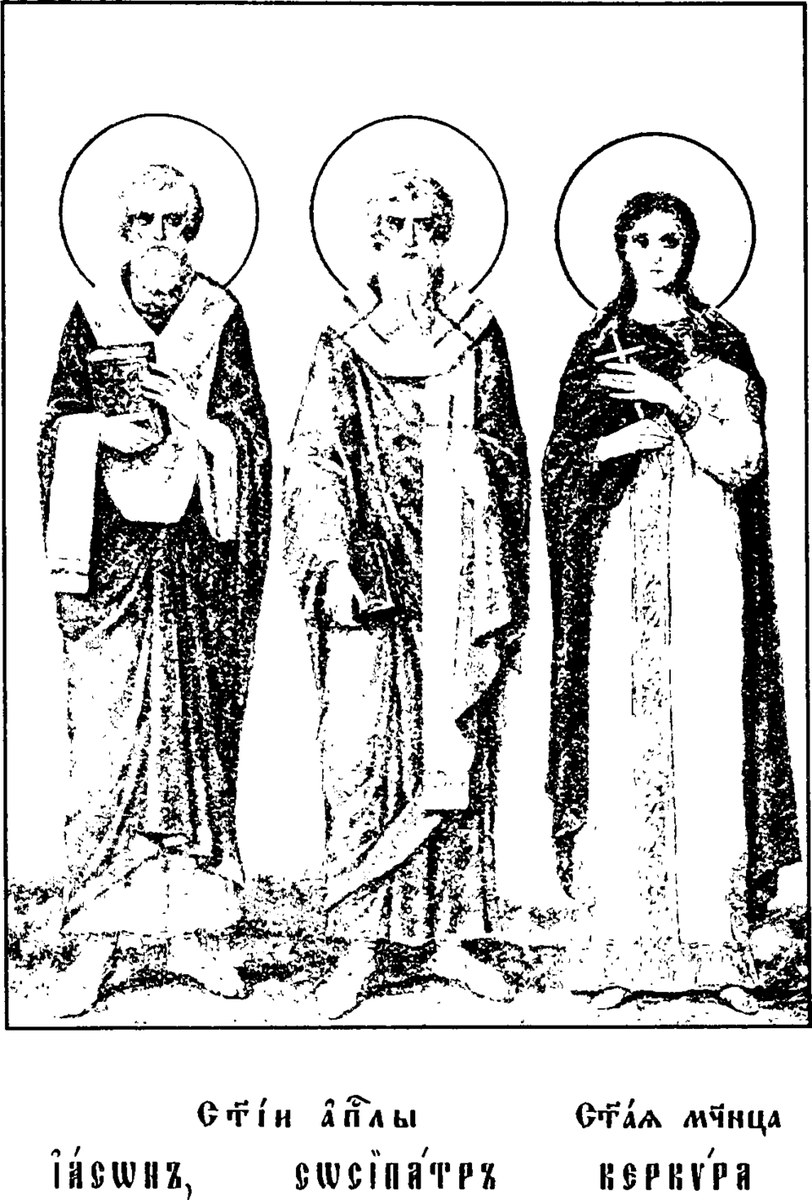
Kerkyra is painted as a virgin-martyr: a young woman, uncovered or lightly veiled, in the long tunic and mantle, holding the martyr's cross in her right hand, sometimes with a martyr's crown or palm. Her regal parentage is occasionally marked by richer dress or by a diadem, since the synaxarion calls her a king's daughter. Where she is shown in narrative, the scene is her passion: bound to a tree and pierced with arrows, with the fire kindled beneath her — an iconography close to that of the Great Martyr Sebastian, and easily mistaken for it where the inscription is lost. Her usual place, however, is beside the apostles who converted the island, as the third figure of the day's composition.
The companions have no independent iconography. Where they appear it is in the narrative scenes of the passion: the seven robbers in the cauldron of boiling pitch, the gaoler mutilated at the prison door, and the martyrs perfected by fire.
The stored image is the engraving for this day from the illustrated pre-revolutionary Russian Lives of the Saints (1903–1911, after St Dimitry of Rostov): Kerkyra stands at the right with the cross, captioned in Church Slavonic Ст҃а́м мч҃нца Керкýра, beside the apostles Jason and Sosipater. It is the same three-figure engraving stored with the apostles' entry, kept here under this slug so that each entry is self-contained; no pre-modern icon of Kerkyra alone has been located.
Disputed questions
- Whether Kerkyra should be counted with the apostles or apart. The calendars treat the whole company as one commemoration: the OCA titles the day "the Apostles Jason and Sosipater of the Seventy, the virgin Kerkyra, and those with them," and the Greek Menaion gives the day's service to the apostles and provides only synaxarion notices and verses for Kerkyra and the rest. This entry gathers the martyrs into one file because they have no proper service of their own and no cultus independent of the apostles' mission, while the apostles are entered separately as apostles of the Seventy with their own hymnography.
- The names of the seven robbers. Transmitted with wide orthographic variation: Iakischolus / Iakischolos / Iakiskhol / Inischolus; Marsalius / Marsalios; Mammius / Maminus / Mammios. The Greek synaxarion notice does not name them at all, speaking only of "the seven holy martyr-robbers"; the roll comes from the Slavic tradition and the Lives of St Dimitry of Rostov.
- Murin, Christodoulos, and Vitalis's household. The robber converted by Kerkyra is named Murin in Slavic sources and identified with a "Christodoulos the Ethiopian"; some Western and OrthodoxWiki listings of this day give instead "Vitalius, his wife Valeria and Christodoulos the Ethiopian," which appears to be a secondary conflation of the Corfiot Vitalios with an unrelated pair. The primary notices know only Zenon, Vitalios, Eusebios and (in Slavonic) Neon.
- Date, and historicity. The whole company is placed in the first century because the narrative is bound to the apostles' mission; no persecution of Christians on Corfu is otherwise documented for that period, and the passion in its present form is a hagiographic composition of later date. The names, and the church of the Protomartyr Stephen on the island, are the load-bearing elements of the tradition.
- Calendar divergence. These martyrs stand on April 28 in the Slavic books and on April 29 in the Greek, following the apostles with whom they are commemorated.