
Jason and Sosipater
The Holy Apostles of the Seventy Jason and Sosipater, Enlighteners of Corfu
Apostle of the Seventy · Apostle · Bishop · d. 1st century
Commemorated 4 January — Synaxis of the Seventy Apostles, 28 April — The two apostles and enlighteners of Corfu (Slavic and Antiochian-American usage; the Greek Menaion keeps them on April 29)
Jason and Sosipater are two apostles of the Seventy, disciples and kinsmen of the Apostle Paul, whom the Church honours together as the enlighteners of Corfu (Kerkyra). Both are greeted by name in the New Testament — Jason as Paul's host at Thessalonica whose house was stormed by the mob (Acts 17:5–9), and both as those who send greeting from Corinth, "Jason and Sosipater, my kinsmen" (Romans 16:21). The tradition makes Jason a native of Tarsus, its first-fruits and its bishop, and Sosipater a man of Achaia and bishop of Iconium. Leaving their sees, the two sailed west to the island of Corfu, built there the first church in the name of the Protomartyr Stephen, and were imprisoned by the island's ruler; from that prison they converted seven condemned robbers and the gaoler who guarded them, and at last the king's own daughter Kerkyra and the ruler himself, who was baptised Sebastian. They ended their days on the island in great old age, and Corfu keeps them as its apostles to this day.
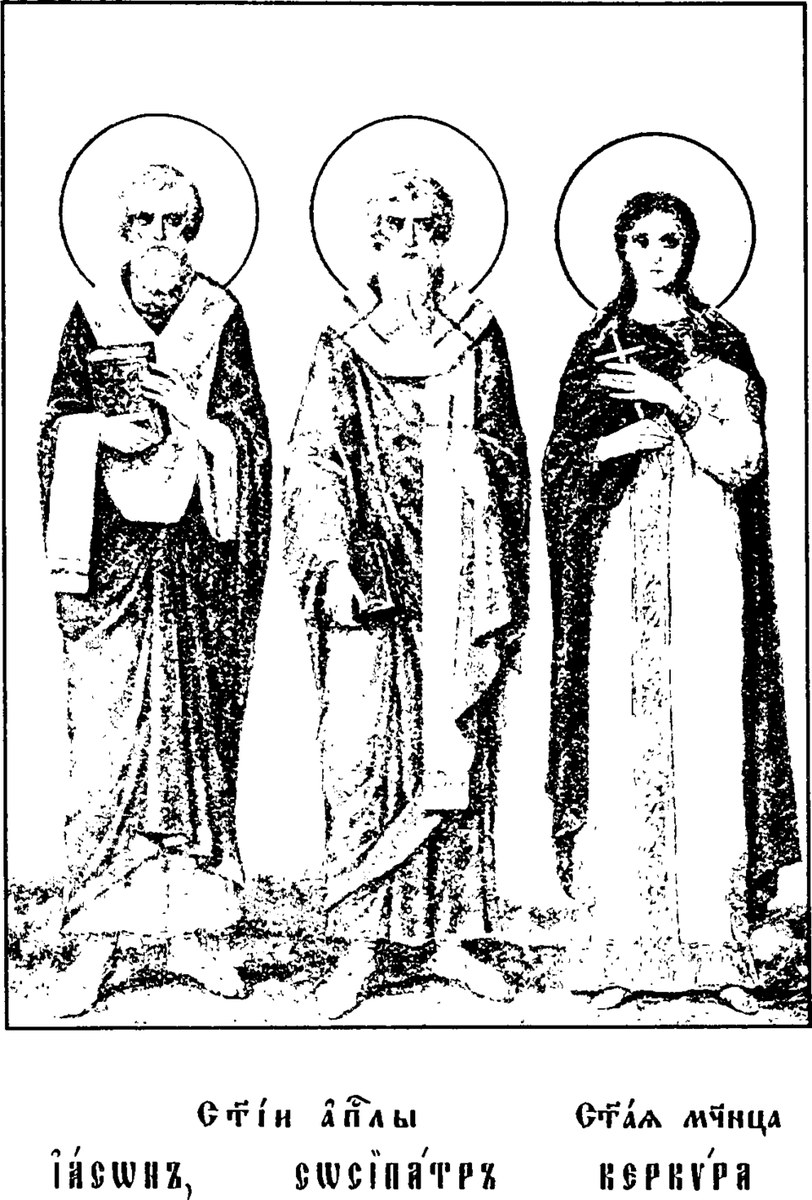
_-_икона_08281_Иасон,_Сосипатр_и_Керкира.png)
Two kinsmen of Paul
Both names stand in the closing greetings of the Epistle to the Romans, written from Corinth: "Timotheus my workfellow, and Lucius, and Jason, and Sosipater, my kinsmen, salute you" (Romans 16:21). Paul calls the three of them συγγενεῖς — kinsmen, that is, either blood relations or, as the ancient commentators more often take it, fellow Jews of his own nation. The Church numbers both among the Seventy whom the Lord "appointed... and sent two and two before his face" (Luke 10:1), and their joint feast belongs to the great series of April and November commemorations in which the synaxaria distribute the companions of Paul named in Romans 16.
Jason (Ἰάσων) is remembered as a man of Tarsus in Cilicia — Paul's own city — and as the first of that city to believe, whom Paul afterwards set over it as bishop. He is generally identified with the Jason of the Acts of the Apostles, the Thessalonian believer in whose house Paul and Silas lodged, and who, when the crowd could not find the apostles, was dragged before the magistrates and made to give security for them: "and when they had taken security of Jason, and of the others, they let them go" (Acts 17:5–9). The identification is old and general in the Byzantine tradition, which reads the Tarsian convert and the householder of Thessalonica as one man, travelling in Paul's company; some modern readers keep them apart (see Disputed questions).
Sosipater (Σωσίπατρος) is remembered as a native of Achaia and, in the received notices, as bishop of Iconium, where Tertius the scribe of Romans succeeded him. He is traditionally identified with the Sopater of Beroea, son of Pyrrhus, who was one of the seven companions who went with Paul into Asia after the collection was gathered (Acts 20:4). His fuller notice belongs to his other feast, and is given in the entry for the six apostles of Romans 16 — see Olympas, Rodion, Sosipater, Erastus, Quartus and Tertius (November 10). He is not minted afresh here: the two feasts are two commemorations of one apostle, gathered by the synaxaria into two different first-century companies.
The mission to Corfu
The two apostles are said to have left their sees in the east and sailed westward, as the hymnography of their feast puts it — "having lighted up the East you passed to the West, and there set like the sun in the body, while in the spirit you were raised to God." Their field was the island of Kerkyra (Corfu) in the Ionian Sea, at the mouth of the Adriatic, on the sea-road between Greece and Italy.
There they preached Christ and gathered a community, and there they built a church in the name of the Protomartyr Stephen — by the received account the first church on the island, and one of the earliest anywhere dedicated to a martyr. The ruler of Corfu, whom the Greek synaxarion names Kerkyllinos and styles "the king," had them seized and shut up in the public prison.
The seven robbers and the gaoler
In that prison lay seven condemned robbers, whose names the tradition transmits as Saturninus, Iakischolus, Faustianus, Januarius, Marsalius, Euphrasius and Mammius. Hearing the apostles preach through the nights of their confinement, the seven believed, and their sentence for robbery became a confession of Christ: they were put to death in a cauldron of boiling pitch — the Greek notice adds wax and brimstone to the pitch — and the Church keeps them on this same day as the seven martyr-robbers, "who, learning that a robber's lot was Paradise, hastened to obtain it through burning pitch." The gaoler who had guarded them, seeing their end, cried out that he too was a Christian; his left hand was struck off, then both his feet, and then his head.
Kerkyllinos, Kerkyra and the conversion of the island
The king's daughter Kerkyra, learning why the prisoners suffered, confessed Christ, gave away her jewels and her goods to the poor, and could not be turned by her father's rage. He shut her up, set a robber upon her to shame her, burned the chamber where she was held, and at the last had her hung upon a tree and shot to death with arrows. Her passion and the martyrdoms that followed it are given their own entry — Kerkyra and the martyrs of Corfu.
Jason and Sosipater themselves were cast into a cauldron of boiling pitch and came out of it unhurt. According to the account, this was the undoing of the persecution: the ruler who succeeded Kerkyllinos, seeing that the fire had no power over them, believed and was baptised with the name Sebastian, and thereafter helped the apostles to build churches on the island. The two lived on in Corfu into extreme old age, ordaining clergy, baptising the islanders and confirming the church they had planted, and there they reposed — Jason, says the Greek verse of the synaxarion, "receiving the end of a corruptible life, and finding another that has no end."
Veneration and later cultus
Corfu venerates the two as its apostles and first hierarchs. The church of Saints Jason and Sosipater in Corfu town — a cross-in-square Byzantine building of about the eleventh or twelfth century, one of the oldest churches on the island, and traditionally built over the site of their burial — carries their memory and is said to keep relics of them; the Greek tradition also connects relics of the pair with the monastery of Hosios Loukas. Their feast is one of the principal days of the local church of Corfu, and their names are among the very few first-century apostles whose cultus is fixed to a single Western Greek island rather than to a mainland see.
In the Latin martyrologies Jason and Sosipater appear on July 12, an independent tradition of the same apostles that does not depend on the Byzantine synaxarion.
Feast and commemoration
April 28 (church date; New Calendar civil April 28, Old Calendar civil May 11) in the Slavic Menaia and in the calendar of the Orthodox Church in America, which titles the day "the Apostles Jason and Sosipater of the Seventy, the virgin Kerkyra, and those with them."
The Greek Menaion keeps the two apostles on April 29 and gives April 28 to the Nine Martyrs of Cyzicus and to Memnon the Wonderworker — the two days being, in effect, transposed between the Greek and the Slavic books. The Greek arrangement is not merely a printer's accident: the hexameter verse of the Greek synaxarion itself fixes the day, "on the twenty-and-ninth Jason departed the earth." This entry follows the Slavic and American placement on April 28, and the divergence is recorded rather than resolved; readers using Greek service books should look for the propers of Jason and Sosipater under April 29. Because the Antiochian Archdiocese's own calendar pages could not be read directly (the site is script-rendered), the Antiochian usage is inferred from the American practice and should be confirmed in a later pass.
Both apostles are commemorated again with the whole company at the Synaxis of the Seventy Apostles on January 4, and Sosipater a third time on November 10 with the apostles of Romans 16. April 28 falls between Great Lent and the Pentecostarion depending on the year — Pascha may come as late as May 8 — so the service is sung either with the Lenten or with the paschal propers as the Typikon directs.
Hymns
Apolytikion — Tone 3
Holy apostles, intercede with the merciful God, that he may grant our souls forgiveness of offences.
Kontakion — Tone 2
Illumined by the teachings of Paul, you became luminaries of the whole inhabited earth, O thrice-blessed ones; for you enlighten the world unceasingly with wonders — Jason, the fountain of healings, and Sosipater, the glory of the martyrs of Christ. O God-bearing apostles, protectors of those in distress, entreat God that our souls may be saved.
Original translation from the Greek
Oikos
O apostles who speak of God, heralds of true worship, teachers and ever-venerable protectors of the devout, who stand before God and are filled with the divine light and adorned with crowns: enlighten us, we pray, that we may keep your all-festal feast in reverence and in songs of praise. For we are all your flock, ransomed from error by grace; and since you are saviours of the faithful, hasten to the Creator, to plead with boldness that our souls may be saved.
Stichera
You left behind all that is pleasant, having loved Christ, and clave to him with your souls, O glorious ones, and followed in his footsteps in faith, all-wise Jason and Sosipater; wherefore intercede with him, that peace and great mercy be granted to our souls. Jason and Sosipater, enlighten my soul that is darkened by the passions — you who lit up the whole earth with your godly teachings, and lessened the darkness of the idols, and brought the whole human race, saved, to Christ our God.
Original translation from the Greek
Iconography
Jason and Sosipater are painted as apostles of the first generation and as hierarchs: elderly, high-browed, with the pointed grey beard of the apostolic type, vested in the phelonion and omophorion of bishops, one hand blessing and the other holding the Gospel book — the usual manner of showing those apostles of the Seventy whom the tradition made bishops. Where the two appear with Kerkyra, she stands beside them in the maiden's tunic and mantle with the martyr's cross in her hand, and the group forms the standard composition of the day. Narrative scenes are rarer, and show the cauldron of boiling pitch from which the apostles came out unharmed, or the little church of the Protomartyr Stephen which they raised on the island. In Corfu their images belong to the church that bears their name.
The stored image is the engraving for this day from the illustrated pre-revolutionary Russian Lives of the Saints (1903–1911, after St Dimitry of Rostov), captioned in Church Slavonic Ст҃íи апо́столы Іа́сωнъ, Сωсіпа́тръ and Ст҃а́м мч҃нца Керкýра: at the left Jason in the omophorion with the Gospel, in the centre Sosipater in the hierarch's vesture, and at the right Kerkyra with the cross. It reproduces the received iconographic type; a pre-modern Corfiot or Byzantine icon of the two apostles would be an upgrade and has not been located.
Disputed questions
- Jason of Tarsus and Jason of Thessalonica. The Byzantine tradition treats them as one man: the Tarsian who first believed in Paul's own city, was made its bishop, and is the Jason who gave security for Paul before the magistrates of Thessalonica (Acts 17). Nothing in Scripture asserts the identity, and modern commentators often keep a Thessalonian Jason distinct from the Jason greeted from Corinth in Romans 16. The synaxaria and the Wikidata entity alike merge the two; the merger is recorded here as tradition, not as demonstrated fact.
- Sosipater and Sopater of Beroea. The identification of the Sosipater of Romans 16:21 with the Sopater son of Pyrrhus of Acts 20:4 rests on the closeness of the names and on their common association with Paul at Corinth, and is traditional rather than explicit.
- Where Sosipater reposed. The notices for his November 10 feast make him bishop of Iconium and say that he reposed there; the Corfiot tradition of this day has both apostles ending their lives on the island. The two statements are not reconciled in the sources, and both are transmitted; the likeliest account is that a see in Asia Minor and a later western mission belong to different strands of the same tradition.
- Martyrs or confessors? The kontakion of the day hails Sosipater as "the glory of the martyrs of Christ," and the pair are sometimes styled hieromartyrs. The narrative itself, however, has them delivered unhurt from the cauldron and reposing in old age after the island's conversion; the classification here follows the narrative, and treats the hymn's language as honouring their share in the sufferings of their companions.
- The name of the ruler. The Greek synaxarion calls Kerkyra "daughter of Kerkyllinos the king"; the Slavic notices leave the first ruler unnamed and name only the convert Sebastian, who is presented as his successor. Some retellings collapse the two into a single ruler who persecutes and then believes.
- The number and names of the companions. The seven robbers are named consistently in outline but with wide orthographic variation (Iakischolus / Iakischolos / Inischolus; Marsalius / Mammius / Maminus). The Greek synaxarion of the day adds the martyrs Zenon, Vitalios and Eusebios, perfected by fire; the Slavonic Menaion adds Neon and the converted robber Murin (Christodoulos). No transmitted roll is definitive.