
Kuksha of the Kiev Caves
The Holy Hieromartyr Kuksha of the Kiev Caves, Enlightener of the Vyatichi, and his disciple the Martyr Nikon
Hieromartyr · Venerable · Martyr · d. after 1114, among the Vyatichi on the Oka
Commemorated 27 August — Martyrdom among the Vyatichi with his disciple Nikon, 28 September — Synaxis of the Venerable Fathers of the Near Caves
Kuksha was a monk-priest of the Kiev Caves monastery in the early twelfth century who went out to the Vyatichi — the last openly pagan Slavic tribe of the Rus' lands, settled along the upper Oka — baptised them, and was killed there with his disciple Nikon after many tortures, some time after 1114. His death was known at Kiev the same day because Pimen the Faster, standing in the monastery church, cried out that their brother Kuksha had been slain that morning for the Gospel, and then died himself. Kuksha is the chief missionary martyr of the Caves monastery, and his relics lie in the Near Caves.

The witness
Almost everything known of Kuksha stands in one paragraph of the Kiev Caves Paterikon — the letter of Simon, bishop of Vladimir and Suzdal (†1226; commemorated May 10), to Polycarp, archimandrite of the Caves (commemorated July 24). Simon, himself formerly a monk of the Caves, writes that he cannot keep silent about the holy hieromartyr and black-robed Kuksha of that monastery: that everyone knows how he cast out demons, baptised the Vyatichi, brought down rain, dried up a lake, and worked many other wonders, and how after many torments he was killed together with his disciple Nikon.
The notice is short but it is contemporary in the sense that matters: Simon writes from inside the house, to another monk of the house, about a man whose story the whole community knew. No vita was ever composed, and the later Slavic synaxaria add nothing but the date.
The Vyatichi
The Vyatichi were the Slavic tribe of the Oka basin, in the country that later became the Oryol and Kaluga lands. They were the most stubbornly pagan of the eastern Slavs and the last to be brought under Kievan rule; Nestor the Chronicler (commemorated October 27), writing in the Primary Chronicle a generation before Kuksha, records their customs with open horror — that they lived, as he puts it, from one day to the next, knowing nothing of the law of God and making a law of their own. They burned their dead, kept several wives, and were still sacrificing in the sacred groves when Kuksha came among them.
That is the mission: a hieromonk from the great monastery of Kiev walking two hundred miles north-east into forest country that no bishop governed, to preach to a people who had already killed missionaries. The wonders reported of him — the rain in drought, the drying of a lake, the casting out of demons — are the standard signs of a mission to pagans, and they are the form in which the Paterikon records that the preaching worked: the Vyatichi were baptised.
Martyrdom
He was seized, tortured at length, and beheaded, together with his disciple Nikon, who had gone out with him and died with him. The Paterikon gives no year. The dating "after 1114" is a deduction from the associated notice that Kuksha preached in the time of Theoctistus, bishop of Chernigov — the former abbot of the Caves who held Chernigov from 1113 until 1123, and in whose diocese the Vyatichi lands lay. Nothing narrower can be established.
The cry of Pimen the Faster
The most striking element of the story is not the martyrdom but its report. At the same hour, in the church of the Caves monastery at Kiev, Pimen the Faster — a monk otherwise remembered only for the severity of his abstinence — called out aloud before the brethren that their brother Kuksha had been killed that day for the Gospel; and having said it, he gave up his soul. The two are therefore commemorated together on August 27, and it is this joint commemoration, not any independent feast, that brings Pimen the Faster onto this day alongside his own principal memorial in May.
The bodies of both were brought to the monastery and buried in the Near (Antoniev) Caves, where they rest; both are numbered among the venerable fathers of the Near Caves commemorated on September 28.
Veneration
Kuksha's cult is Kievan and, later, particularly strong in the lands he evangelised. The Oryol and Kaluga dioceses honour him as their apostle; a spring near Karachev is associated with him, and churches in the Vyatichi country carry his name. The Caves monastery's own Paterikon, printed at Kiev from 1661 and repeatedly illustrated with engraved plates, carried his memory throughout the Russian world.
Feast and commemoration
August 27 (church date; New Calendar civil August 27, Old Calendar civil September 9), kept in the Russian, Ukrainian and OCA calendars, where the entry reads "Hieromartyr Kuksha and Venerable Pimen the Faster of the Kiev Near Caves." The Greek and Antiochian calendars do not carry it; on this day the universal commemoration is Poemen the Great, and the accidental meeting of the Egyptian Poemen with the Kievan Pimen the Faster on one page is a standing source of confusion in Slavic calendars. Kuksha is also commemorated on September 28 with the venerable fathers of the Near Caves.
Hymns
Apolytikion — Tone 4 (common of a hieromartyr)
Sharing the manner of the Apostles and succeeding to their thrones, thou didst go out to a people sitting in darkness, O Kuksha, and didst enlighten the Vyatichi with the waters of baptism; and having endured many torments thou wast slain with thy disciple for the Gospel's sake. Wherefore, O hieromartyr, intercede with Christ God that our souls may be saved.
Iconography
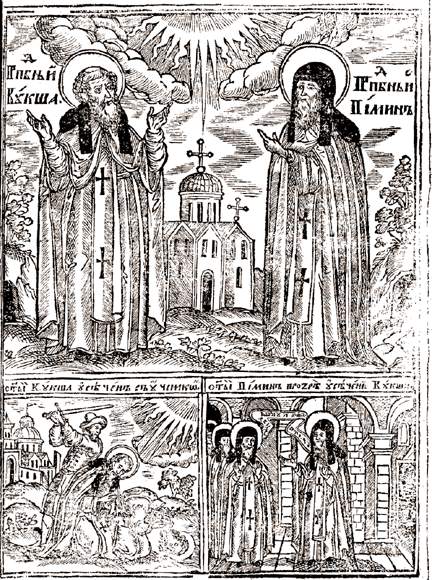
Kuksha is painted as a monk-priest of the Caves: in the dark monastic habit with the epitrachelion showing beneath it, a full brown or greying beard, holding a cross in the right hand — the martyr's cross — and often a scroll or a Gospel in the left, with the koukoulion of the schema. In the composite icons of the Fathers of the Near Caves he stands in the ranks with a small inscription; in the paired images he is shown with Pimen the Faster, the two standing on either side of a church, which is the Caves monastery.
The stored image is an eighteenth- or nineteenth-century engraving of the Kiev Caves Paterikon type: the two saints standing above with their names in Slavonic — прпбный Кукша and прпбный Пимин — with rays of light from the clouds between them and the monastery church below; and beneath, two narrative registers, captioned "St Kuksha was slain with his disciple" (the executioner with raised sword, the disciple already fallen, the beasts below) and "St Pimen foresaw the slaying of Kuksha" (Pimen standing in the church with two monks, his hand raised as he cries out). It is a complete visual statement of the commemoration.
Disputed questions
- The name. Kuksha is not a baptismal name but a Slavic byname (it has been connected with a dialect word for the jay), and his monastic or baptismal name is not recorded. This has no bearing on his identity but occasionally confuses catalogues.
- The date. "After 1114" is the conventional formula and reflects the Theoctistus synchronism; some Russian sources print 1113 and some the 1110s generally. There is no primary datum.
- Not to be confused with Nicon of the Kiev Caves, the eleventh-century abbot of the monastery: Kuksha's companion Nikon is a different and much later man, a disciple with no independent cultus, commemorated only with his master.
- Not to be confused with Kuksha of Odessa (Kosma Velichko, 1875–1964), the elder of the Odessa Dormition monastery glorified in 1994, who took the name in this saint's honour. The two are separated by eight centuries; the modern elder's feast is September 16.