
Poemen the Great
Our Venerable and God-bearing Father Poemen the Great, of Egypt
Venerable · b. c. 340, in Egypt — d. c. 450, in Egypt
Commemorated 27 August — Repose in Egypt after a long life in the desert
Poemen — the name means "shepherd" — is the greatest of the Egyptian desert fathers by sheer weight of transmitted teaching: more sayings stand under his name in the Apophthegmata Patrum than under any other abba, close on 187 in the Greek alphabetical collection, nearly a quarter of the whole. He was one of a family of brothers who all took the monastic habit at Scetis, fled the sack of the desert by the Mazices about 407 with his elder brother Anoub, and passed the rest of a very long life as the reluctant father of a great company of monks. He would not see the governor, would not see his own mother, and would not speak of lofty things; what he taught instead was discretion, the refusal to judge another, and the hidden life — "bear your own sins, and do not busy yourself with anyone else's." He reposed about 450, and the Church calls him the Great.
_-_S.Poimen.jpg)
Origins and the brothers
Poemen was an Egyptian, born about 340, and belonged to a large family of brothers of whom the tradition says that all entered the monastic life together. Two are named in the sayings themselves: Anoub, the eldest, remembered under his own entry in the Apophthegmata and commemorated by the Church in his own right, and Paisius. Several others appear without names — "the brethren of Abba Poemen" — and the family so constituted a household within the desert, an inner circle that never quite dissolved into the wider settlement. Poemen was not the eldest, but from early on he was the one to whom the others deferred; the sayings show Anoub explicitly handing over the government of the company to his younger brother.
They went to Scetis (the Wadi al-Natrun, south-west of the Delta), the sternest of the three great monastic settlements of Lower Egypt, the country of Macarius the Great, of Moses the Ethiopian, of John the Dwarf, of Arsenius and Sisoes. Scetis was not a monastery in the later sense but a scattering of cells around a church, where each monk lived alone or with a disciple and the brethren met on Saturday and Sunday. It was into that discipline that Poemen and his brothers were tonsured.
The best-known story of these years is of their mother. She came out to the desert to see her sons, and they would not come out of the cell to her. She waited a long time at the door and wept. Poemen at last spoke to her through the shut door: Do you want to see us here, or in the age to come? She answered that she wanted to see them here. He said that if she would bear the loss now, she would certainly see them there — and she went home consoled. The story is characteristic of him in a way that is easy to misread: it is not coldness but the same refusal of half-measures that runs through everything he says. He would not let the monastic life be a thing negotiated at the door.
The sack of Scetis and the years at Terenuthis
About the year 407 the desert was overrun by the Mazices, Libyan raiders from the west, in the first of the great devastations of Scetis. The settlement was broken up and the monks scattered. Poemen, Anoub and five brothers went north to Terenuthis on the Nile and took shelter in a ruined pagan temple, agreeing to keep silence with one another for a week while they decided what to do.
What Anoub did there in that week became one of the most quoted lessons of the desert. Every morning he went out and threw stones at the face of the stone idol standing in the ruin; every evening he came back and said to it, Forgive me. At the week's end Poemen asked him what he meant by it. Anoub answered that he had done it for their sakes: the idol had neither answered him back when he insulted it nor been moved when he flattered it, and if the brothers could not live together in that temper — unstirred alike by insult and by honour — then they had better separate. Poemen received the rebuke as a rule of common life, and the company held together. The episode is preserved in the Apophthegmata both under Anoub's name and under Poemen's, and it fixes the two brothers permanently in the memory of the Church.
Ascetic struggle and the refusal of fame
Poemen's reputation grew until it became, for him, a positive danger. The story most often told of his old age is of the governor of the province, who wished to see him. Unable to get an interview, the magistrate had Poemen's sister's son arrested on a pretext and let it be known that he would release the boy at a word from the old man. The family came to Poemen weeping. He sent back an answer of five words that has never been forgotten: Poemen has no children. He wrote to the governor that the young man should be examined according to law and, if he deserved death, should die — an answer so far from what was expected that the magistrate released the prisoner and abandoned the attempt.
The same instinct shows in the story of the governor who simply announced a visit. Poemen reasoned with himself that if the great began to come and show him honour, the crowds would follow, his quiet would go, and with it the humility he had gained only by the grace of God — and he sent word asking not to be visited. Fame, in his estimate, was not a temptation to be resisted at the moment of its arrival but a condition to be refused in advance.
Yet he was not a man who guarded his own peace at the expense of others. When he learned that an elder already living near Scetis was aggrieved at his arrival — because monks were leaving that elder to come to Poemen — he took his brothers and food and went to make peace. The old man would not open. Poemen stood at the door in the heat and said that he would not leave until he was received; and when at last the door opened, the elder said that what he had heard of Poemen was true, but that what he now saw was a hundred times more.
His own estimate of himself never rose. He said, sighing, that he would be cast down where Satan was cast down. When a visiting monk began on sublime and heavenly matters, Poemen turned away his face and would not answer; those present explained to the bewildered visitor that the old man did not speak of high things. The visitor began again, this time on the passions of the soul and the war of thoughts — and Poemen turned to him with a glad face and said, Now you have spoken well, and talked to him at length.
The character of the teaching
What survives of Poemen is not a treatise but a manner of judgement. Four themes carry almost the whole of it.
Discretion. He is the desert's great teacher of diakrisis — the weighing of the case in front of you rather than the application of a rule. Asked how long a man ought to repent for a grave sin, he called three years long, and a year long, and forty days long, and said that if a man repents from the bottom of the heart and does not go back to the thing, God will accept three days. He was himself a hard faster, sometimes going a week and more without food, and he told others to eat every day, but never to fullness. Hearing of a monk who had fasted a whole week and then lost his temper, he said that the man could go seven days without bread but could not go one without anger. Of the instruments of the solitary life he named poverty, hardship, austerity and fasting — and then said that the guides of the soul are watchfulness, self-knowledge and discernment, which is to say that the instruments are not the thing itself.
Not judging. This is the note struck most often and most sharply. A brother asked whether he should cover his neighbour's sin when he saw it; Poemen answered that if we uncover our brothers' sins God will uncover ours, and that a man should not believe his own eyes — his own sin is the beam and his brother's the splinter. He said that a man who has a corpse of his own lying in the house is a fool to leave it and go out to weep over the dead of his neighbour. He said that the whole aim of the ascetic works is simply this, not to judge; and that there is no passion worse than judging. When brothers wanted a fallen monk driven out, Poemen came into the assembly with a leaking basket of sand on his back — his own sins, he said, running out behind him where he could not see them, while he came to sit in judgement on another man's.
Silence and the heart. Asked whether it is better to speak or to keep silence, he said that whoever speaks for God's sake does well, and whoever keeps silence for God's sake does well also — the question is not the mouth. And then the sentence that undoes any complacency about silence: a man may look as though he is silent, but if his heart is condemning others he is talking without stopping; and there may be a man who talks all day and is truly silent, because he says nothing useless. Teach your mouth to say what is in your heart, he told a brother.
The hidden life. He would not have his monks reach beyond their measure. Do not give your heart to what does not satisfy your heart. On the wearing down of a hard heart he used an image of the desert's own patience: water is soft and stone is hard, but hang a jar above the stone so that the water falls drop by drop, and it hollows the stone; so the word of God upon the heart. On the war of thoughts he set a man between a fire on his left hand and a jar of water on his right — the fire is the enemy's suggestion, the water is prayer, and the whole art is to reach for the jar. He named three things as always useful: to fear God, to pray often, and to do good to one's neighbour; and he said that evil is never driven out by evil, but that if a man does you harm, do him good, and your good will overcome his wickedness.
Above all he taught weeping. Asked what a man should do under temptation, he said: weep, and beg God's goodness for help — and elsewhere, flatly, that weeping is the road the Scriptures and the fathers give us, and there is no other way but this. When word came that Arsenius had died, Poemen wept and said, "Blessed art thou, Abba Arsenius, for thou didst weep for thyself in this world; he who does not weep here will weep for ever hereafter."
The Apophthegmata and the Poemen collection
Poemen's disciples wrote down what he said, and it is largely through that habit that the Apophthegmata Patrum exists at all. In the Greek alphabetical collection — the form in which the sayings are best known, printed in Migne under the letters of the abbas' names — the entry for Poemen runs to about 187 items, more than for any other father and close to a quarter of the collection's bulk. A great many of them are not his own words at all but his report of others': Abba Poemen said that Abba Anthony said…, Abba Poemen said of Abba John the Dwarf…, and so with Moses, Sisoes, Ammonas, Pambo, Arsenius, Macarius. He never met Anthony the Great; what he had, he had at second hand and passed on.
That double character — the largest personal entry and the largest body of transmitted material — has led modern scholarship (Derwas Chitty, Jean-Claude Guy, Lucien Regnault, Graham Gould among them) to speak of a "Poemen collection": a nucleus of sayings gathered and edited in the circle of his disciples, around which the wider alphabetical collection crystallised in the late fifth and sixth centuries. On this view Poemen dominates the Apophthegmata not only because he said a great deal but because the book was, at its origin, largely his community's book. The judgement does not diminish him; it explains why the desert's memory of itself is shaped so much in his idiom.
Repose
Poemen reposed about the year 450, at a great age — the tradition says 110 — and was at once numbered among the saints. The epithet "the Great" was fastened on him, the sources say, not for austerity, in which others outdid him, but for the depth of his humility, the soundness of his judgement, and his long self-spending service to other people's souls.
Feast and commemoration
August 27 (church date; New Calendar civil August 27, Old Calendar civil September 9). Poemen is the principal commemoration of the day in every Orthodox usage — Antiochian, Greek, Slavic and Coptic alike — and the day falls in the quiet stretch of late August, after the apodosis of the Dormition on August 23 and two days before the strict fast of the Beheading of the Forerunner on August 29. In the Coptic Church, which keeps his memory in its own calendar, he is Anba Poimen of Scetis, one of the fathers of the Wadi al-Natrun whose monasteries still stand. Because his sayings are read at the refectory and in the cell throughout the year, his liturgical feast is in practice the smaller part of his commemoration.
Hymns
Apolytikion — Tone 8
By the streams of thy tears thou didst make the barren desert fruitful, and by thy sighing from the depths thou didst bring thy labours to a hundredfold harvest; thou wast made a beacon for the whole world, shining with miracles, O Poemen our father: intercede with Christ God that our souls may be saved.
Kontakion — Tone 4
A shepherd indeed wast thou, as thy name declared, O father, feeding the flock of Christ in the pastures of discretion; for thou didst refuse the praise of men and take up the weeping that has no other road, and thou didst teach us to bear our own burden and judge no man. Wherefore, O Poemen, we cry to thee: forget not them that honour thee.
Original translation from the Greek
Iconography
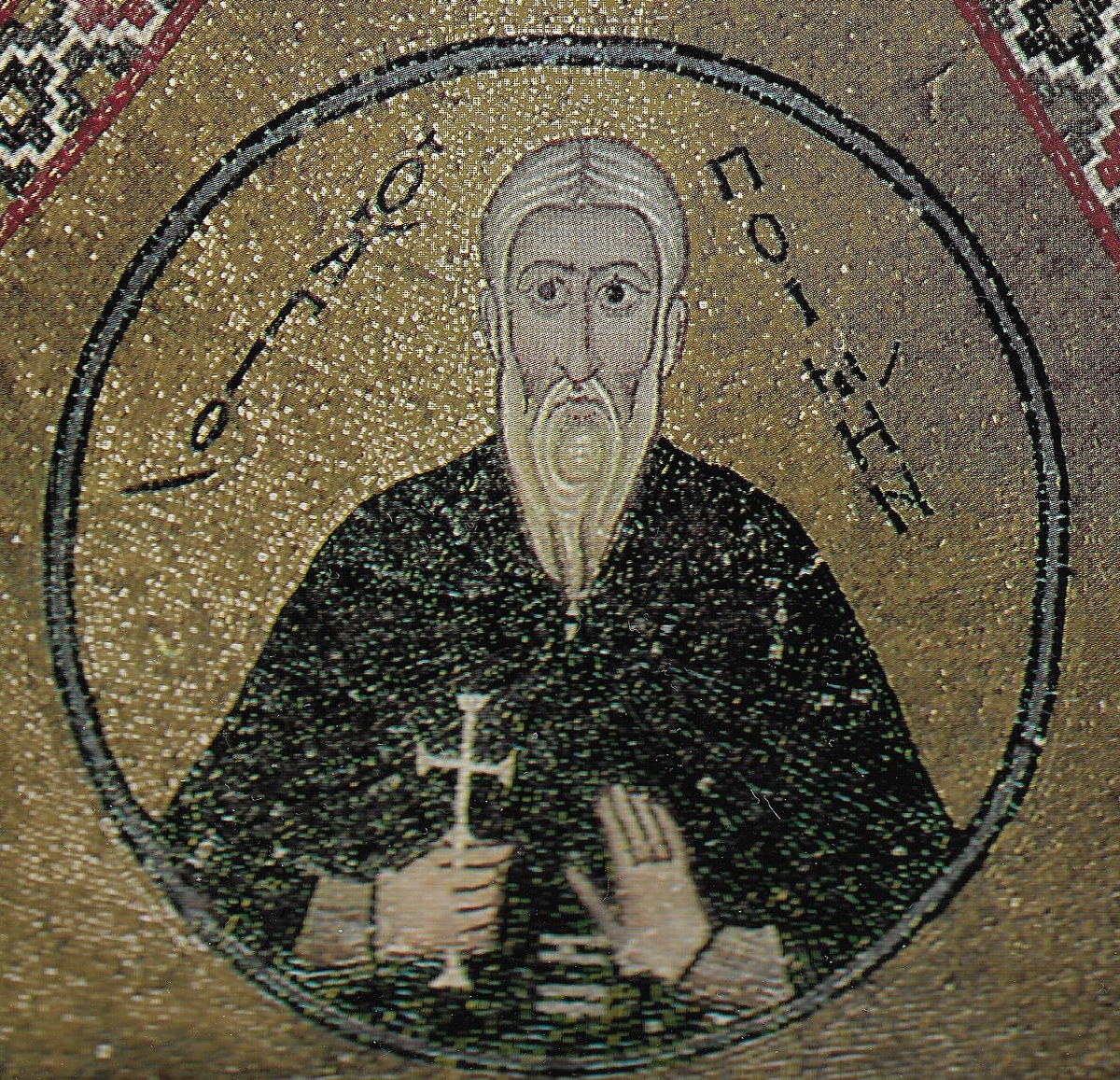
Poemen is painted as a very old monk of the Egyptian type: gaunt, deeply lined, with a long white beard falling in narrow strands, dressed in the dark tunic and analavos of the schema, often with the koukoulion thrown back or drawn over the head. His hand is raised in blessing or holds an unrolled scroll bearing one of his own sentences — most often the warning against judging, or the words about weeping. He belongs to the standing company of desert fathers who fill the lower registers of monastic churches and the margins of menologia, and he is regularly grouped with Anthony the Great, Paul of Thebes, Macarius, Arsenius, Sisoes and his own brother Anoub; on the great menaion icons of the Byzantine and Russian tradition he stands at the head of the August 27 rank. Distinctive attributes are few — the desert fathers are told apart chiefly by inscription and by the shape of the beard — so a legible Ο ΑΓΙΟΣ ΠΟΙΜΗΝ is the surest identification.
The stored image is the eleventh-century mosaic medallion in the katholikon of Hosios Loukas in Boeotia, one of the finest surviving Middle Byzantine sets of monastic portraits: the saint bust-length in a gold roundel, inscribed with his name, in the black monastic habit, blessing with the right hand and holding a small cross.
Disputed questions
- The dates. The traditional span c. 340 – c. 450, giving 110 years, comes from the Byzantine synaxaria and carries the marks of a hagiographical topos. The internal evidence of the sayings is looser: Poemen is remembered as a young monk at Scetis before the raid of 407 and as a very old man surrounded by disciples afterwards, which places his active life roughly in the first half of the fifth century and makes a birth around 340 plausible but not demonstrable. Chitty and others have preferred a floruit of c. 400–450 without committing to the extreme longevity. Recorded here as transmitted, with the caution stated.
- One Poemen or several? More than one monk of the name appears in the desert literature, and it is not certain that every one of the 187 sayings belongs to the same man. Where a saying is set among named contemporaries — Anoub, Paisius, John the Dwarf, Sisoes, Arsenius, Anthony's disciples — the attribution is secure; a residue is simply "Abba Poemen said," and scholars differ on how much of it was drawn in by the gravitational pull of a famous name.
- Not to be confused with Poemen of Palestine, the sixth-century solitary of the Rouba desert who is commemorated on the same day, August 27, and who died torn by wild beasts — a distinct person, of a later century and another country, whose only notice is a chapter of the Spiritual Meadow.
- Not to be confused with the Kievan Pimens. Pimen is simply the Slavonic form of Poemen, and two monks of the Kiev Caves bear it: Pimen the Much-Ailing (†1110, feast August 7) and Pimen the Faster (twelfth century, feast May 8, and kept with the Hieromartyr Kuksha on August 27, this same day). The August 27 coincidence makes the confusion a real and recurring one in Slavic calendars and in icon captions; neither Kievan father has anything to do with the Egyptian abba beyond the borrowed name. Nor is he to be confused with the later Russian hierarchs named Pimen, including the twentieth-century Patriarch Pimen of Moscow, who is not a saint.