
Leo the Great
Our Father among the Saints Leo the Great, Pope of Rome
Bishop · b. c. 400, Tuscany (or Rome) — d. 10 November 461, at Rome
Commemorated 18 February — Repose at Rome
Leo the Great (c. 400 – 461) was Pope of Rome from 440 to 461, one of the greatest of the Roman pontiffs and a Father of the whole Church. Against the Monophysite teaching of Eutyches he set out, in his Tome — the dogmatic letter to Flavian of Constantinople — the confession of the one Christ in two natures, divine and human, united in one person without confusion or division; and when that letter was read at the Fourth Ecumenical Council at Chalcedon in 451, the Fathers acclaimed it as the faith of the Apostles: "Peter has spoken through Leo." A tireless pastor and preacher, he defended the Roman flock against Manichaeans and Priscillianists, upheld the order of the Church, and in 452 went out to meet Attila the Hun at the river Mincio and turned him back from Italy; three years later he wrung from the Vandal Genseric the sparing of Rome's people from the sword. He reposed on 10 November 461, the first pope the Church has called "the Great." The Orthodox Church keeps him on February 18 as a pillar of the Chalcedonian faith.

Origins and early career
Of Leo's birth and youth little is securely known. The oldest notice, in the Liber Pontificalis, makes him "a Tuscan" (natione Tuscus), the son of one Quintianus; a Roman upbringing is equally possible, and by the time he enters history he is wholly a man of Rome and its Church. He was formed in the Latin rhetorical culture of the age — his surviving sermons show a trained and disciplined Latin, sinewy and grave — and he came early into the service of the Roman clergy. As a deacon, and then archdeacon, under Popes Celestine I (422–432) and Sixtus III (432–440), he was already a figure of weight in the affairs of the Western Church: he corresponded with Cyril of Alexandria, took a hand against the Pelagian and Nestorian currents, and was trusted with delicate business of state. Indeed, at the very moment of his election he was absent from Rome — sent by the imperial court into Gaul to reconcile the quarrelling generals Aëtius and Albinus, whose feud endangered the defence of the province. The clergy and people of Rome chose the absent archdeacon to succeed Sixtus; Leo returned, and was consecrated bishop of Rome on 29 September 440.
The pastor and preacher
Leo understood the episcopate as a pastoral office before all else, and the governing image of his ministry is the shepherd who must give account for his flock. Ninety-odd sermons survive — preached on the feasts of the Lord, on the fasts and the collections for the poor, on the anniversaries of his own consecration and on the two Apostles Peter and Paul, the founders and patrons of the Roman Church. They are short, weighty, and doctrinally exact: the Tome against Eutyches is in substance a distillation of what Leo had long preached about the Incarnation, that in Christ "the Word was made flesh" without ceasing to be God and without leaving the manhood less than fully man. Some hundred and twenty letters also survive, the working correspondence of a bishop who took seriously the care of the churches — decretals on discipline and the sacraments, interventions in the affairs of Gaul, Spain, Africa and the East, and above all the letters of the Eutychian controversy.
He was a stern guardian of the faith within his own city. He hunted out and condemned the Manichaeans who had fled to Rome from Africa before the Vandal invasion, examining them, exposing their secret and immoral rites, and preaching against them; and he moved against the Priscillianists of Spain, sending to Bishop Turribius of Astorga (447) a detailed refutation of their errors. In all this he acted not as an innovator but as a conservator — the settled Latin instinct that the bishop of Rome is the keeper of the apostolic tradition entrusted to Peter.
The Eutychian controversy and the Tome
The great work of Leo's life was doctrinal. In the East, the reaction against Nestorius — who had so distinguished the two natures of Christ as to seem to divide him into two sons — had bred an opposite error. The aged archimandrite Eutyches of Constantinople, zealous against Nestorius, taught that after the union there was in Christ only one nature, the divine having as it were absorbed the human, so that the Lord's flesh was not truly of one substance with ours. In 448 Eutyches was accused before a synod at Constantinople under the patriarch Flavian, and, refusing to confess "two natures after the union," was condemned and deposed.
Eutyches appealed — to Rome among others — and Flavian sent Leo a full account. Leo's answer, dated 13 June 449 and addressed to Flavian, is the celebrated Tome (Epistola 28). In lucid Latin it confesses one and the same Son, our Lord Jesus Christ, "perfect in Godhead and perfect in manhood, truly God and truly man," born eternally of the Father and in time of the Virgin; the two natures are united in the one person of the Word without being confounded or changed, and without being torn apart. Each nature keeps its own reality and does what belongs to it — "the Word doing what belongs to the Word, and the flesh carrying out what belongs to the flesh" — yet the two act in communion, in the one Christ, so that it is the one Lord who both works miracles and suffers, who is hungry and who feeds the multitudes, who weeps for Lazarus and who raises him. This is the classical Western statement of the communicatio idiomatum, the sharing of the properties of the two natures in the one person.
The Robber Council and Chalcedon
Leo asked that the Tome be read and its faith received. Instead, in August 449 a council convened at Ephesus under Dioscorus of Alexandria — backed by the court eunuch Chrysaphius and the emperor Theodosius II — reinstated Eutyches, refused even to read Leo's letter, deposed Flavian, and did its work amid such violence that Flavian was assaulted and died of his injuries within days. Leo, learning of it, branded the assembly a latrocinium — a "Robber Council," a council of brigands, not of bishops — and the name has stuck. He pressed for a true council and for the vindication of the Tome.
His opportunity came with a change of reign. Theodosius II died in 450; his sister Pulcheria and her consort Marcian summoned a general council, which met at Chalcedon in 451 — the Fourth Ecumenical Council, the largest of antiquity. There Leo's Tome was solemnly read (the second session), and the Fathers received it with the acclamation the Church has never forgotten: "This is the faith of the Fathers; this is the faith of the Apostles… Peter has spoken through Leo; Cyril and Leo have taught alike." The council went on to draw up its Definition: one and the same Christ, Son, Lord, Only-begotten, made known in two natures without confusion, without change, without division, without separation, the difference of the natures being in no way removed by their union, but rather the property of each preserved and concurring in one person and one hypostasis. Leo's Tome and Cyril of Alexandria's dogmatic letters stand together as the charters of that faith.
Two cautions belong to an honest telling. First, the acclamation was not unexamined enthusiasm: a number of the more strictly Cyrilline bishops (the Illyrian and Palestinian delegations) hesitated at certain phrases of the Tome — above all "each nature does what is proper to it" — fearing they leaned toward Nestorius; a commission compared the disputed passages with Cyril's letters, found them consonant, and only then was the harmony affirmed. The council received the Tome because it agreed with Cyril and the Fathers, not as an oracle standing above conciliar judgement — a distinction the Orthodox East has always kept in view. Second, Leo confirmed the doctrinal decrees of Chalcedon but withheld his assent from its 28th canon, which gave the see of Constantinople privileges equal to Rome's and second rank in the Church; Leo defended the older order of the apostolic sees and the canons of Nicaea, and the disagreement over Constantinople's standing outlived him. On the faith of Chalcedon, however, Leo and the council were one, and it is as the doctor of that faith that the East venerates him.
Attila and Genseric
Leo's pontificate fell in the years when the Western Empire was breaking under the barbarian migrations, and twice he stood between Rome and destruction. In 452, when Attila and his Huns, having ravaged the north of Italy, threatened Rome itself, an embassy went out to treat with him, and at its head was Leo. He met Attila near Mantua, by the river Mincio, and — by what means the sources do not fully explain, though a later tradition tells of a vision of the Apostles Peter and Paul standing guard over the pope — Attila agreed to withdraw beyond the Danube. Three years later, in 455, Leo could not turn back the Vandal Genseric, whose fleet took the city; but his intercession spared Rome the worst — the Vandals sacked but did not burn the city, and refrained from the general massacre and the torture of its people. In an age of collapse the bishop of Rome had become, in fact as well as in prayer, the guardian of his city.
Repose
Leo governed the Roman Church for twenty-one years. He reposed on 10 November 461 and was buried in the portico of the Basilica of Saint Peter; his relics were later brought within the basilica, where they remain. He is the first bishop of Rome to whom the Church has given the title "the Great" — a title only he and, later, Gregory the Dialogist among the popes have borne — and in the West he was in 1754 declared a Doctor of the Church.
Feast and commemoration
Leo is kept universally on February 18 (church date; Old Calendar civil March 3), the day near his repose assigned him in the Byzantine synaxaria. The Greek, Slavic and Antiochian calendars agree on the day. Because February 18 falls in late winter, the feast very often coincides with the pre-Lenten weeks or the opening of Great Lent, and in years when it falls in Cheesefare week or Lent the saint's office is combined with the Triodion; local practice governs the degree of festal celebration. In the West his feast is November 10 (formerly April 11), near the day of his death. The Orthodox Church venerates him specifically as a Father and teacher and a pillar of the Chalcedonian confession — one of the few bishops of Old Rome, with Clement, Silvester and Gregory the Dialogist, held in the fullest honour of the Byzantine calendar.
Hymns
Troparion — Tone 8
Guide of Orthodoxy, teacher of piety and holiness, luminary of the Church, God-inspired adornment of hierarchs: O wise Leo, by thy teachings thou hast enlightened all, O lyre of the Spirit. Intercede with Christ God, that our souls may be saved.
Original translation from the Greek
Kontakion — Tone 3
Seated upon the throne of the priesthood, O glorious one, thou didst stop the mouths of the spiritual lions, and with the God-inspired doctrines of the holy Trinity thou didst pour upon thy flock the light of the knowledge of God. Therefore wast thou glorified, as a divine initiate of the grace of God.
Original translation from the Greek
Appointed readings
Epistle — Hebrews 7:26–8:2
26For such an high priest became us, who is holy, harmless, undefiled, separate from sinners, and made higher than the heavens; 27Who needeth not daily, as those high priests, to offer up sacrifice, first for his own sins, and then for the people’s: for this he did once, when he offered up himself. 28For the law maketh men high priests which have infirmity; but the word of the oath, which was since the law, maketh the Son, who is consecrated for evermore. 1Now of the things which we have spoken this is the sum: We have such an high priest, who is set on the right hand of the throne of the Majesty in the heavens; 2A minister of the sanctuary, and of the true tabernacle, which the Lord pitched, and not man.
Gospel — John 10:9–16
9I am the door: by me if any man enter in, he shall be saved, and shall go in and out, and find pasture. 10The thief cometh not, but for to steal, and to kill, and to destroy: I am come that they might have life, and that they might have it more abundantly. 11I am the good shepherd: the good shepherd giveth his life for the sheep. 12But he that is an hireling, and not the shepherd, whose own the sheep are not, seeth the wolf coming, and leaveth the sheep, and fleeth: and the wolf catcheth them, and scattereth the sheep. 13The hireling fleeth, because he is an hireling, and careth not for the sheep. 14I am the good shepherd, and know my sheep, and am known of mine. 15As the Father knoweth me, even so know I the Father: and I lay down my life for the sheep. 16And other sheep I have, which are not of this fold: them also I must bring, and they shall hear my voice; and there shall be one fold, and one shepherd.
Iconography
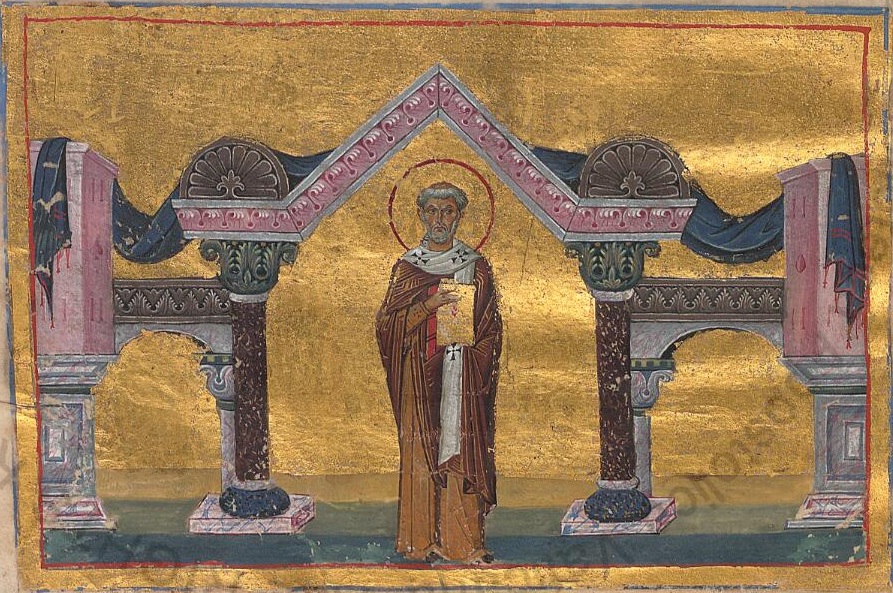
Leo is depicted in the settled type of a hierarch of the West and of the apostolic age of the Roman Church: an aged bishop, high of brow, with a short rounded beard, vested in the phelonion (or, in Western-influenced images, the pallium and papal vesture) over the sticharion, wearing the omophorion and holding a Gospel-book or a scroll, his right hand raised in blessing. Byzantine menologia give him among the hierarchs of February; the epithet "the Great" and his likeness to the other great teaching-bishops govern the portrait. Where the scene is narrative rather than a portrait, he is shown before the council, his Tome in hand, or at the meeting with Attila — the mitred bishop confronting the barbarian king on horseback, the Apostles Peter and Paul appearing in the air above with drawn swords, a subject beloved of later Western art (Raphael's fresco in the Vatican Stanze is its most famous form).
The stored image is the miniature for February 18 from the Menologion of Basil II (Constantinople, c. 985; Vatican, Vat. gr. 1613): Leo vested as a bishop in the cross-marked omophorion, blessing, in the Byzantine hierarch-type (source, public domain, pd-old-work).
Disputed questions
- Leo and the Roman see. No Father of the West states the theology of the Petrine primacy more strongly than Leo. He held that the Lord's word to Peter ("Thou art Peter, and upon this rock…") founded a perpetual office, and that Peter continues to govern and to speak through the bishops of Rome, his heirs; "the care of the universal Church should converge to the one see of Peter." The Orthodox Church honours Leo's sanctity and his Christology without end, and reads his Petrine language in the patristic sense — a real primacy of honour and witness within the college of the bishops and under the authority of the councils — rather than in the sense of the later Western doctrine of universal jurisdiction and infallibility. That his Tome was received at Chalcedon only after conciliar examination, and that his own 28th-canon protest did not prevail, are the very points on which East and West afterwards read his legacy differently. The distinction is recorded here, not resolved.
- Chalcedon and the non-Chalcedonians. For the Oriental Orthodox Churches (Coptic, Syriac, Armenian, Ethiopian) the Tome of Leo and the Definition of Chalcedon marked not a triumph but a rupture: holding to Cyril's formula "one incarnate nature of God the Word," they rejected "in two natures" as a concession to Nestorius, and Leo's memory is not honoured among them. Modern theological dialogue has argued that the division rests in large part on the different senses given to the word physis/nature; the Eastern Orthodox Church continues to confess Chalcedon and the Tome as the true faith. The disagreement is ancient and is stated, not adjudicated, here.
- Not to be confused with the several other Leos of the calendar: Leo of Catania (bishop of Catania in Sicily, wonderworker, 9th c., kept February 20), a wholly different saint of a later age; the Byzantine emperors named Leo; and the later Popes Leo III (who crowned Charlemagne) and after. "Leo the Great" and "Pope of Rome, †461" belong to this Leo alone.