
Luarsab II of Georgia
The Holy Martyr Luarsab II, King of Kartli
Martyr · King · b. 1587 — d. 1622, strangled in the fortress of Gulab-Kala near Shiraz in Persia
Commemorated 21 June — Commemorated with Archil II among the martyr-kings of Georgia
Luarsab II (1587–1622), of the Bagrationi house, was king of Kartli from boyhood, a ruler remembered for learning and piety as much as for the victory his small army won over a far larger Ottoman force at Kvenadkotsi in 1609. Caught between the Ottoman and the Safavid empires, he was summoned by Shah Abbas I of Persia, went to him rather than let his country be laid waste, and refused both to break the fast at the Shah's table and to accept Islam. He was carried to Persia and held seven years in the fortress of Gulab-Kala near Shiraz, beaten and pressed to apostatise, and at last strangled with a bowstring in 1622, at thirty-five, two of his servants dying with him. Georgia keeps him with the eighth-century martyr-king Archil II on June 21.

A king at fourteen
Luarsab was the son of George X, king of Kartli, and came to the throne in 1606 when his father died — poisoned, the Georgian tradition holds, at the instigation of Shah Abbas I, whose policy was to break the Georgian kingdoms and settle their people in Persia. The boy king was about nineteen. The sources describe him as unusually well educated and unusually devout: attentive to the churches, generous to the poor, strict in the fasts, and of a physical beauty that the chroniclers dwell on because it later became one of the instruments of his temptation.
Kvenadkotsi, 1609
In 1609 an Ottoman army — the Georgian sources put it at sixty thousand — crossed into Kartli and came down toward Tashiskari. Luarsab, with the general Giorgi Saakadze, could raise perhaps fourteen thousand men. The tradition remembers what the king did on the eve of the battle: he kept an all-night vigil with his army, and in the morning the whole force communicated before it moved. At Kvenadkotsi the Georgians fell on the invaders and routed them utterly. The victory made his name, and it is the one moment of his reign in which the kingdom acted as a kingdom.
The Shah
It did not save him. Abbas I returned to the destruction of Georgia with a persistence that reads as personal. To buy peace, Luarsab consented to give his sister Helen in marriage to the Shah — a sacrifice the Georgian tradition records without excusing — and when Abbas invaded again in 1614 and demanded the king's person, Luarsab, refusing to let his country be ravaged on his account, went to him. His words on setting out are transmitted as his own: that he placed all his hope in Christ, and that whether life or death awaited him, blessed be the Lord God.
The Shah received him with honour and then began the work of breaking him. At the royal table, on a fast day, Luarsab would not eat the meat set before him. Pressed to accept Islam — with the promise of his kingdom restored, and with threats when promises failed — he refused. Abbas sent him into Persia.
Seven years and the bowstring
He was imprisoned in the fortress of Gulab-Kala, near Shiraz. There he remained seven years, in chains, beaten, examined again and again, and left in the conditions designed to wear a young man to nothing. Two of his servants stayed with him and shared the imprisonment. Neither the length of it nor the offers repeatedly renewed moved him from his confession.
In 1622 — the Georgian tradition connects the final order with Abbas's rage at the alliance of the Georgians with the Ottomans, and with the refusal of Luarsab's family to give him up as dead — the Shah gave the order. Luarsab was strangled with a bowstring in his cell, and the two servants were killed with him. He was thirty-five years old. His body was buried by Christians at Shiraz, and the Georgian tradition holds that his relics were afterwards translated; their present resting-place is disputed, and the church of Saint George at Shiraz is one of the sites claimed.
Veneration
Luarsab was venerated in Georgia almost at once — a king who had given his life rather than his faith, in the generation when the Safavid pressure on Georgian Christianity was at its height and apostasy was the ordinary price of survival. His own kinswoman Queen Ketevan was tortured to death at Shiraz in 1624, two years after him, in the same city and by the order of the same Shah; his memory belongs with hers and with the martyrs of the Persian and Ottoman persecutions of Georgia: Kaikhosro the Georgian (†1612), the Martyred Fathers and Mothers of Atchara, and the rest.
Feast and commemoration
June 21 (church date; New Calendar civil June 21, Old Calendar civil July 4), kept jointly with Archil II. The two are commemorated together as the martyr-kings of Georgia, though nine centuries lie between them: what joins them is that each died refusing to exchange Christ for the religion of a conquering empire — Archil under the Arabs, Luarsab under the Persians — and each went voluntarily into the enemy's hands to spare his people. Georgian, Russian and OCA usage; the Greek books do not keep them. June 21 falls inside the Apostles' Fast in most years, the fast having no fixed beginning but always ending on June 28 — an apt setting for a king remembered for keeping a fast at a hostile table.
Hymns
Troparion — Tone 4 (common of a martyr)
Thy martyr Luarsab, O Lord, in his contest received an incorruptible crown from thee, our God; for possessing thy strength, he cast down the tyrants and shattered the feeble insolence of the demons. By his intercessions save our souls.
Original translation from the Georgian
Iconography
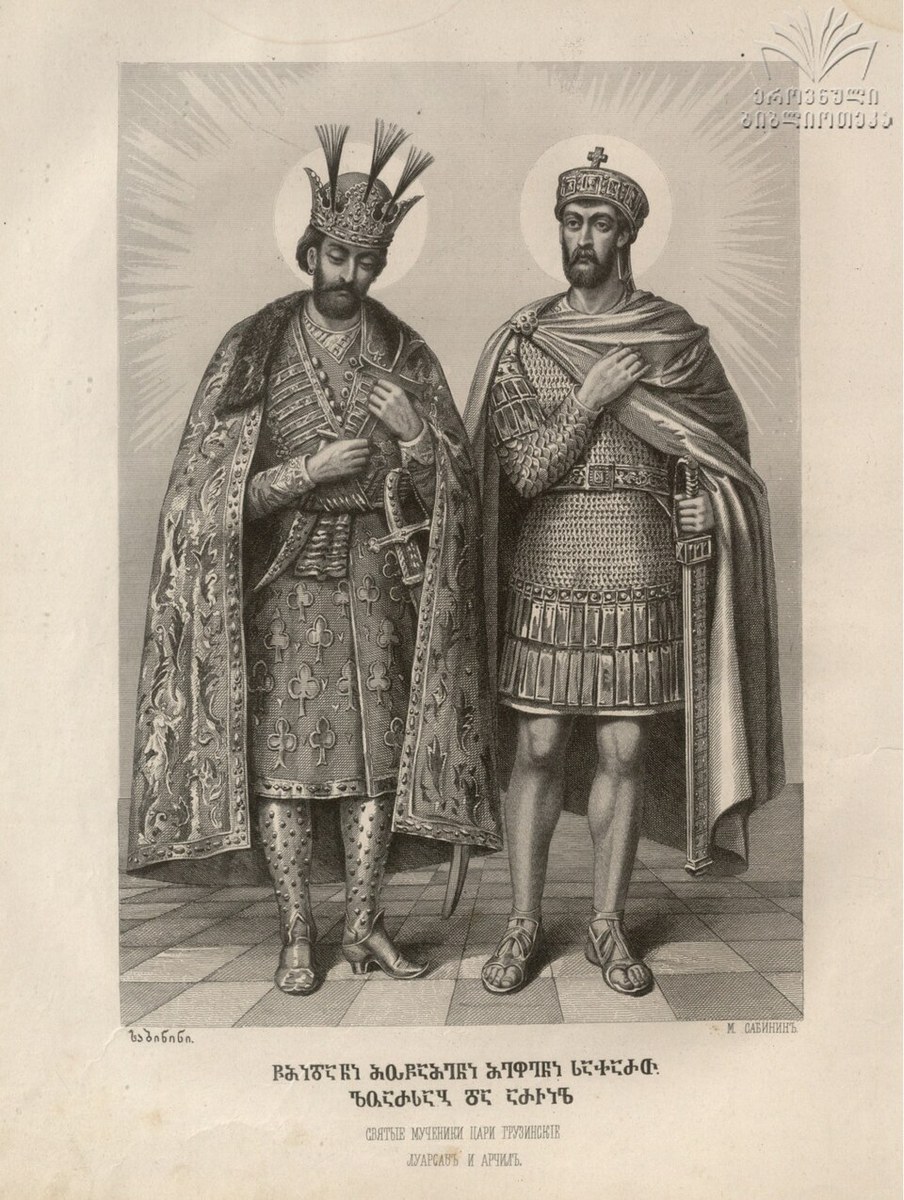
Luarsab is painted as a young crowned martyr: beardless or lightly bearded, in the brocaded Persianate court dress of the Georgian seventeenth century — long robes worked with gold, a heavy embroidered cloak, a plumed crown rather than the closed Byzantine one — with the cross of the martyrs in his hand and a sabre at his side. The bowstring is sometimes shown. The standard composition sets him beside Archil II, so that the two martyr-kings stand together in the regalia of their two epochs.
The stored image is that double plate entire, from Mikhail (Gobron) Sabinin's Paradise of Georgia (sak'art'velos samot'khe, St Petersburg, 1882), the illustrated corpus of the Georgian saints from which most modern Georgian iconographic types descend: two haloed kings standing on a tiled floor against rays of light, Luarsab at the left in the plumed crown and the flowered brocade with his sabre at his hip, Archil at the right in scale armour and the cross-surmounted crown. The plate is signed М. САБИНИНЪ and captioned in Georgian and Russian, Святые мученики цари Грузинскіе Луарсабъ и Арчилъ — "the holy martyr-kings of Georgia Luarsab and Archil" — which verifies the identification of both figures. Sabinin died in 1900 and the plate was published in 1882: out of copyright by age.
Disputed questions
- The manner of death. The Georgian tradition is unanimous that he was strangled; some later retellings, and the English notices derived from them, say only that he was "martyred" or that he was beheaded. Strangling with a bowstring was the Safavid method for royal prisoners and is much the likeliest.
- The year. 1622 is the received date. A few accounts give 1620 or 1621, and the seven-year imprisonment is counted from 1614 or from 1615 accordingly.
- The relics. Whether the body remained at Shiraz, was translated to Georgia, or lies in the church of Saint George at Shiraz is unsettled; no claim rests on a documented translation.