
Archil II of Georgia
The Holy Martyr Archil II, King of Kartli and Kakheti
Martyr · King · d. 20 March 744, beheaded by the Arab commander at the camp in Kartli
Commemorated 21 June — Commemorated with Luarsab II among the martyr-kings of Georgia
Archil (†744) was a king of the Chosroid house, a descendant of Mirian's line, who ruled in Kartli and Kakheti during the catastrophic Arab invasion led by the commander the Georgian chronicles call Murvan the Deaf. He rebuilt what the invaders had razed, and when a second Arab army came he went into their camp to sue for peace for his people. Required to renounce Christ and accept Islam, the old king answered that he would not forsake the true God; he was imprisoned, tortured, and at last beheaded on 20 March 744, being about eighty years of age. His body was carried secretly to the church at Notkora in Kakheti, which he himself had built. Georgia keeps him with the later martyr-king Luarsab II on June 21.

The house of Mirian in a broken kingdom
Archil belonged to the Chosroidoi, the dynasty descended from Mirian, the first Christian king of Iberia, who was baptised at the preaching of Nina, Equal-to-the-Apostles and died in 342. By Archil's day, four centuries later, the kingship had been reduced almost to a memory: the Persian and then the Arab conquest had swept away the royal authority, the Umayyad governors ruled from Tiflis, and what survived of the Georgian crown survived in the mountain provinces and by sufferance. Archil ruled with his brother Mir in what remained of Kartli, and afterwards in Kakheti in the east.
The invasion of Murvan the Deaf
The great disaster of his reign was the campaign of the Arab general whom the Georgian sources name Murvan Qru — Murvan the Deaf — commonly identified with Marwan ibn Muhammad, later the last Umayyad caliph. His armies came through Georgia about 735–737 burning as they went; the chronicles remember the destruction of city after city, and the martyrdom of the princes David and Constantine of Argveti belongs to the same campaign. Archil and Mir withdrew westward into Egrisi and the fortresses of the Black Sea coast, and the tradition records that the invaders were at last turned back at the rivers Abasha and Tskhenistsqali by a storm and a flooding that the Georgians received as an act of God rather than of arms.
What followed is the part of Archil's life that the Georgian Church remembers most warmly. He came back into a wasted country and rebuilt it: cities, fortresses, and above all churches, among them the church at Notkora in Kakheti. He settled refugees, restored the ruined sees, and gave the eastern provinces two decades of recovery. He is remembered as a builder-king, not a warrior-king.
Martyrdom
A second Arab commander — the sources give his name as Asim (Georgian Chichum-Asim) — came into Kakheti some years afterwards. Archil, now an old man, judged that his people could not survive another sack, and went himself into the Arab camp to negotiate. The commander, learning who he was, made the surrender of his faith the price of peace: let the king become a Muslim, and the country would be spared.
Archil refused. The answer preserved in the Georgian tradition is short and absolute — that it would never be that he should forsake Christ, the true God; that to deny Him would be to die the only death that matters. He was imprisoned, examined repeatedly, and tortured; the Arabs, the account says, hoped to break him by his age and by the promise of restoring his kingdom to him. He held. On 20 March 744 he was beheaded by Asim's order.
Relics
The Christians of the country recovered his body and carried it secretly to Ertso, and thence to the church he had built at Notkora in Kakheti, where it was buried. His grave was venerated there, and the Georgian Church numbered him among her martyrs. His descendants continued the royal line into the Bagratid period, so that the memory of Archil is also a dynastic memory: the last of the Chosroid kings and the first of the martyr-kings of a Georgia under Islam.
Feast and commemoration
June 21 (church date; New Calendar civil June 21, Old Calendar civil July 4), on which the Georgian Church and the Russian and OCA calendars derived from it commemorate the two martyred kings — Archil II of Kartli and Luarsab II of Kartli — together, though they are separated by nearly nine centuries. The pairing is thematic rather than historical: both died refusing to apostatise to Islam under a conquering power, the one Arab, the other Persian. His actual day of death, 20 March, is recorded in the chronicles but is not the calendar date. Georgian, Russian and OCA usage; the Greek books do not keep him.
Hymns
Troparion — Tone 4 (common of a martyr)
Thy martyr Archil, O Lord, in his contest received an incorruptible crown from thee, our God; for possessing thy strength, he cast down the tyrants and shattered the feeble insolence of the demons. By his intercessions save our souls.
Original translation from the Georgian
Iconography
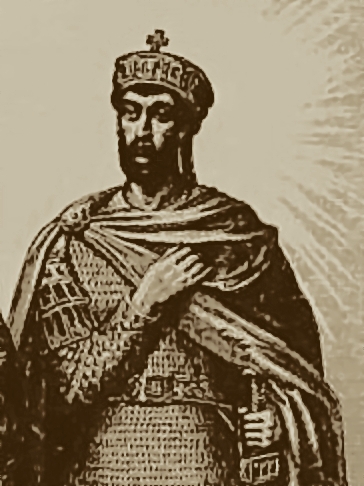
Archil is painted as a crowned king and martyr: in the imperial loros or in the mail and cloak of a Georgian sovereign, the closed crown on his head, the cross of the martyrs in his right hand, and often a sword — sheathed or held reversed — in his left, to show a ruler who did not use it to save himself. He is very rarely painted alone; the established composition of the Georgian tradition sets him beside Luarsab II, the two martyr-kings standing together, one in eighth-century Byzantine-derived regalia and one in the Persianate dress of the seventeenth century, so that the difference of nine hundred years is legible in the costume.
The stored image is a detail of exactly that composition: the plate of the martyr-kings from Mikhail (Gobron) Sabinin's Paradise of Georgia (sak'art'velos samot'khe, St Petersburg, 1882), the standard illustrated corpus of the Georgian saints, whose plates are the source of most modern Georgian iconographic types. Archil is the figure at the right — bearded, in a cross-surmounted crown, in scale armour and a heavy cloak, the right hand laid on the breast and the left resting on the hilt of his sword, with rays behind him. The full plate is captioned in Georgian and in Russian, Святые мученики цари Грузинскіе Луарсабъ и Арчилъ — "the holy martyr-kings of Georgia Luarsab and Archil" — which fixes the identification beyond doubt. Sabinin died in 1900 and the plate was published in 1882: the work is out of copyright by age.
Disputed questions
- The date, 744. The Georgian chronicle tradition gives 744 for the martyrdom; some reckonings put it in the 780s, and the campaign of Marwan is dated 735–737, which leaves a long interval between the invasion and the death. The gap is filled by the rebuilding years, but the chronology of the Arab commanders in Kartli in this period is not secure, and the identification of "Chichum-Asim" is uncertain.
- Which Archil? The Georgian royal onomastic repeats itself. This martyr-king is not Archil of Imereti and Kakheti (1647–1713), the poet-king and exile in Moscow, who died in his bed and is not a saint; nor is he the Archil who appears in the Bagratid lists. The Sabinin plate that supplies this entry's image is inscribed for the martyr-kings and removes the ambiguity.