
Lucian of the Kiev Caves
The Holy Hieromartyr Lucian, Presbyter of the Kiev Caves
Hieromartyr · Priest · d. c. 1243
Commemorated 28 August — Synaxis of the venerable fathers of the Kiev Caves whose relics repose in the Far Caves, 15 October — Kept on the day of his patron, Lucian of Antioch
Lucian was a priest-monk of the Kiev Caves monastery who suffered martyrdom under Batu Khan about the year 1243, in the devastation of Kiev that followed the Mongol storm of the city. Nothing more of his life is recorded: the whole of his transmitted history is the inscription on an ancient board bearing his icon, which names him a hieromartyr who suffered under Batu. His relics repose in the Far (Theodosius) Caves of the Lavra, and his memory is kept on October 15 — the feast of his patron, the hieromartyr Lucian of Antioch — and with the Far Caves fathers on August 28.
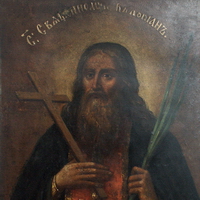

Lucian belongs to the generation of the Kiev Caves brotherhood that met the Mongol catastrophe. Batu's horde took and sacked Kiev in December 1240, and the monastery of the Caves was ravaged with the city; the communities that survived did so in the caves themselves and in dispersal. Of Lucian the record preserves a single fact: an inscription on an ancient board bearing his icon states that the hieromartyr Lucian suffered under Batu, about the year 1243 — a priest-monk, then, who met martyrdom in the aftermath of the sack. Nothing else is known of him: not his origins, his age, nor the manner of his death. His incorrupt relics repose in the Far Caves of Saint Theodosius, where the Lavra's tradition has venerated him among its holy fathers ever since; his feast is kept on October 15, the day of the hieromartyr Lucian of Antioch, evidently for the sake of his name-day, as the Russian sources themselves observe. The honest brevity of this record — one inscription, one grave — is itself a witness to the age that produced it, which had more martyrs than chroniclers.
Feast and commemoration
October 15 (church date; Old Calendar civil October 28), his particular memory, kept — as the Russian sources note — on the feast of his patron Lucian of Antioch; August 28 (Old Calendar civil September 10), the synaxis of the fathers of the Far Caves; and the movable synaxis of all the venerable fathers of the Kiev Caves on the second Sunday of Great Lent (the movable commemoration is recorded here in prose pending the repository's treatment of the Kiev Caves synaxes). A commemoration of the Russian tradition and the OCA; not part of the Greek calendar of the day.
Hymns
Troparion — Tone 4
Becoming a partaker of the ways of the Apostles and a successor of their thrones, thou didst find thy deeds, O God-inspired one, a passage to divine vision; wherefore, rightly dividing the word of truth, thou didst also suffer for the faith even unto blood, O Hieromartyr Lucian: intercede with Christ God that our souls may be saved.
Original translation from the Slavonic
Kontakion — Tone 4
Having lived piously in priesthood and in monasticism, and passed along the path of martyrdom, thou didst put to shame the tormentor and the hosts of the demons; wherefore, honouring thee, we cry to thee: deliver us ever from misfortunes by thy prayers, O Lucian our father.
Original translation from the Slavonic
Iconography
Lucian is depicted as a hieromonk-martyr of the Caves: dark-bearded, in monastic mantle over a priest's vestment, holding the cross of martyrdom in one hand and a martyr's palm or a scroll in the other. The stored image is a small icon of the Kiev Caves Lavra's own icon-painting workshop from about 1900, inscribed "the holy Hieromartyr Lucian," showing the saint half-length with cross and palm; the reproduction available is of low resolution, and a better image of the saint is wanted.