
Lucillian and his Companions
The Holy Martyrs Lucillian, Claudius, Hypatius, Paul and Dionysius, and the Holy Virgin-Martyr Paula, who suffered at Byzantium
Martyr · Child Martyr · Virgin · d. c. 270–275, at Byzantium
Commemorated 3 June — Martyrdom at Byzantium under Aurelian
On June 3 the Church keeps six martyrs of a single passion: Lucillian, an aged pagan priest of Nicomedia who in his old age was persuaded of the emptiness of the idols and confessed Christ; the four young boys Claudius, Hypatius, Paul and Dionysius, whom he found already imprisoned for the faith and who were beheaded before his eyes; and the virgin Paula, who had made her whole life the service of the confessors in prison — feeding them, dressing their wounds, burying their bodies — and who, having taken up Lucillian's body from his cross, was seized in her turn and beheaded. They suffered under Aurelian (270–275), first at Nicomedia and then at Byzantium, on the ground where Constantinople would rise within two generations, and their memory is among the oldest local commemorations of that city.
.jpg)
An old man's conversion
The passion sets the events in the reign of the emperor Aurelian (270–275), in Nicomedia in Bithynia — the great administrative city of the north-west of Asia Minor, which the fourth century would fill with martyrs. Lucillian was there an idol-priest, and an old man: the synaxarion is emphatic on both points, and both are the whole interest of his story. He had spent a long life in the service of the gods, and it was at the end of that life, when habit and office and reputation were all on the side of the temples, that he heard the Christian preaching and was persuaded. The Greek notice says he came to see the deceit (ἀπάτη) in what he had served; the hymnography of the day makes the point directly, hailing him as a star that rose out of the darkness of error, and it is on this that the Church has fixed in remembering him — that the last hour is not too late, and that a man may lose everything he has been in order to become a Christian.
He did not keep the change private. Lucillian preached, and the notices agree that many pagans of the city were converted by an old priest's testimony against his own former trade — which is precisely why he was denounced. The Slavonic and OCA accounts name Jews of the city as his accusers; the Greek notice has him brought before the count Libanius (the Slavonic tradition calls the magistrate Silvanus, prefect of Nicomedia). The discrepancy of the official's name is old and unresolved; nothing else in the account turns upon it.
The trial at Nicomedia
Ordered to sacrifice, Lucillian refused, and the tortures were those the passions of the period record over and over: his jaw was broken, he was beaten with rods, and he was hung head downward; then he was thrown into prison.
There he found four boys already lying in bonds for Christ — Claudius, Hypatius, Paul and Dionysius. The Greek calls them νήπια, infants or children; the Slavonic otroki, youths or boys. Nothing of their families or their homes is transmitted; the whole of what is known of them is that they were children, that they were already in prison for the faith before the old man came in, and that they and he encouraged one another until the end. The synaxarion verse counts them with a certain tenderness — "the children, twice two in number" — and calls them made sons of the Father by the sword.
All five were brought out together and cast into a furnace. A rain fell, the fire was quenched, and they were taken out unhurt. Nicomedia had no further use for them: the governor sent the whole company to Byzantium, that they might be put to death there.
The martyrdoms at Byzantium
At Byzantium the four boys were beheaded. Lucillian, spared nothing of the shame that was the point of the sentence, was nailed to a cross — the notices insist on the many nails, the crucifixion of an old man by hands that had first to break him — and so gave up his soul, about the year 270. The synaxarion verses set his death on the third day.
Paula the virgin
Paula belongs to a class of saints the persecutions produced in every city and the records mostly lost: the free Christian woman who was not arrested and who used that freedom entirely in the service of those who were. She lived at Byzantium (the Slavonic life makes her a native of Nicomedia who followed the confessors), and her work was the prisons — carrying in food, washing and binding the wounds of the tortured, and afterwards gathering up and burying the bodies of the martyrs. It is the ministry of the deaconesses and of the myrrhbearing women, practised at the risk of one's neck, and the Church has never treated it as a lesser thing than the confession in the arena.
She was doing it for Lucillian. Having taken his body down and given it burial with the four boys, she was denounced and seized. The Greek notice has her sent back to Nicomedia and cast into a furnace, from which she came out unharmed as the five had done, and then brought again to Byzantium; there, still confessing, she was beheaded. The distich of the day says she was cut off for having spoken of the sufferings before her — that is, for refusing to be silent about what she had seen done to the others.
She is the reason the day is not simply a martyrdom but a story: the woman who served the martyrs became one, and the Church keeps her name in the same line as theirs.
Relics and later veneration
The bodies were buried at Byzantium, and the commemoration is one of the pre-Constantinian local memories that the imperial city inherited when it was refounded. The Synaxarion of Constantinople notes a martyrium of Lucillian and his company in the city, and the Typikon of the Great Church keeps the six on June 3; from Constantinople the feast passed into the Greek Menaion, into the Slavonic books, and so to the whole Byzantine rite. Later Western notices report relics of Lucillian carried into Italy — Brescia is named — but the tradition of the translation is late and cannot be traced back to the Greek record.
Feast and commemoration
June 3 (church date; Old Calendar civil June 16). This is the day's principal and universal commemoration, kept by Greek, Antiochian, Slavonic and all Byzantine-rite usage alike, and the one for which the Menaion of June appoints the office — three stichera at Vespers, and a canon at Matins, with the synaxarion notice and its distichs read at the sixth ode. The rank is that of an ordinary commemoration (six stichera, no polyeleos), and the day falls always within the Pentecostarion or shortly after it, so the propers of the season take precedence in the appointed order of the service.
Because the company suffered at Byzantium, the six were reckoned among the local martyrs of Constantinople and are named in that character in the older synaxaria of the city.
Hymns
Apolytikion — Tone 4 (common of several martyrs)
Thy martyrs, O Lord, in their contest received incorruptible crowns from Thee, our God; for possessing Thy strength, they cast down the tyrants and shattered the feeble insolence of the demons. By their prayers, O Christ God, save our souls.
Kontakion — Tone 2 (common of martyrs)
The aged priest of the idols became the herald of Christ, and the four children were perfected by the sword, and the virgin who served the prisoners was crowned with them: wherefore, O six-fold company of the martyrs, ye stand now before the throne, entreating forgiveness for us who honour your memory.
Original translation from the Greek
Iconography
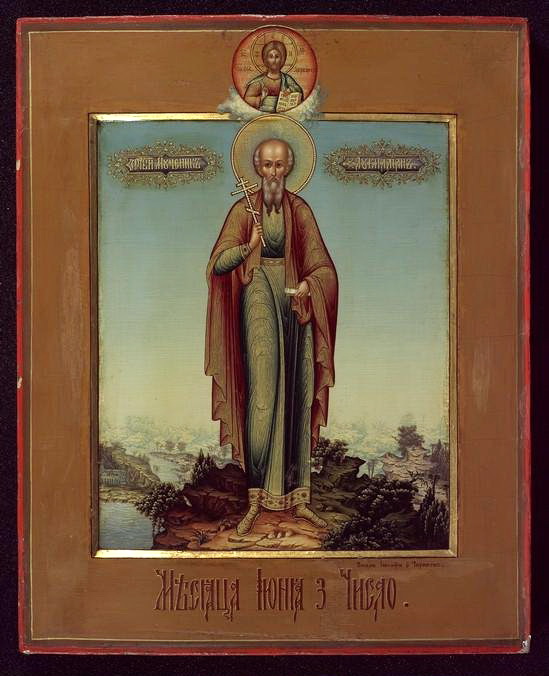
Lucillian is painted as an old man — long white beard, high bare forehead, the deep-lined face of great age — in the plain tunic and mantle of a layman, without vestments of any kind, since he was a priest of the idols and never of the Church; he holds the martyr's cross in his right hand, and his left is open. Where the passion is shown, his instrument is the cross with its many nails, and it is that, rather than any attribute of office, that identifies him. The four children stand as a row of small beardless figures in short tunics with crosses, indistinguishable from one another except by their inscribed names — Byzantine iconography makes no attempt to individualise them. Paula is shown as a young woman with the covered head of a virgin, holding a cross, and in narrative scenes carrying a vessel or a cloth toward a prison door, or bending over the body of the crucified old man.
The stored image is a 19th-century Russian panel (c. 1850) by the Moscow icon-painter Osip Semyonovich Chirikov, from a painted menologion set of one panel to the day: it is inscribed across the top СТЫЙ МУЧЕНИКЪ · ЛУКИЛЛІАНЪ ("the holy martyr Lucillian") and along the foot МѢСЯЦА ІЮНІА 3 ЧИСЛО ("the third day of the month of June"), which fixes both the identification and the calendar day. The saint stands full-length before a river landscape as an aged man in a red-brown mantle over a green-grey tunic, holding a small cross, with Christ blessing in a medallion above. It shows Lucillian alone: no pre-1900 image of the whole company of six has been located, and none of Paula by herself.
Disputed questions
- One commemoration or two? The day is kept as one commemoration of six martyrs, and this entry follows that. Every witness keeps them on a single line: the Greek synaxaria head the day "Λουκιλλιανός, Παύλη καὶ τὰ νήπια Κλαύδιος, Ὑπάτιος, Παῦλος καὶ Διονύσιος"; the Slavonic calendar reads "the martyrs Lucillian, Claudius, Hypatius, Paul, Dionysius, and the woman-martyr Paula the virgin"; the OCA heads its life "Martyr Lucillian and those who suffered with him at Byzantium." The Slavonic formula does mark Paula off grammatically — she is mučenica, named after the five men and with her own title the virgin — and the Greek places her second, immediately after Lucillian and before the children, which is a mark of honour rather than of separation. But no calendar gives her a distinct commemoration, no service book gives her a separate office, and the passion is a single narrative in which she is an actor from the beginning. She is therefore treated here within the group entry, with her own section, rather than split off into an entry of her own.
- Nicomedia or Byzantium? Both, in sequence: tried and tortured at Nicomedia, executed at Byzantium. Sources that name only one place are abbreviating. The company is accordingly found in lists both of the martyrs of Nicomedia and of the martyrs of Byzantium.
- The name of the magistrate. Libanius (a comes) in the Greek notice, Silvanus (prefect of Nicomedia) in the Slavonic and OCA lives. Neither is otherwise attested for Bithynia under Aurelian and the two cannot be reconciled; the entry names both and asserts neither.
- The date. The reign of Aurelian gives 270–275; the Greek notices attach the round year 270, and the Slavonic c. 273. Both are inferences from the reign, not independent data.
- Not the Paula of Rome. This Paula is not the noble Roman widow Paula the friend of St Jerome (†404, kept in the West on January 26), nor Paula who suffered with Ennatha and Valentina at Caesarea in Palestine (February 10). The three are distinct.
- Not the Hypatius of Gangra. The child Hypatius of this company is not Hypatius of Gangra the hieromartyr (November 14 / March 31), nor Hypatius of Ephesus (August 20).