
Luke the Evangelist
The Holy, Glorious and All-laudable Apostle and Evangelist Luke
Apostle of the Seventy · Apostle · Evangelist · d. late 1st century (aged 84, per the ancient prologue)
Commemorated 4 January — Synaxis of the Seventy Apostles, 22 April — Joint commemoration with apostles of the Seventy (Nathanael, "Luke" and Clement in Greek use); kept for the Evangelist in the Slavic and OCA calendars, which identify that company's "Luke" with him — see Disputed questions , 18 October — Repose at Thebes in Boeotia
Luke the Evangelist (first century, reposed in Boeotia at the age of 84 by the most ancient account) is the "beloved physician" of Colossians 4:14, the faithful travelling-companion of the Apostle Paul — "only Luke is with me" (2 Timothy 4:11) — and the author of the third Gospel and the Acts of the Apostles, the largest single contribution to the New Testament and the Church's first written history. The tradition, from Eusebius onward, makes him a native of Antioch in Syria, numbers him among the Seventy Apostles and as one of the two disciples of the road to Emmaus, and — from the sixth century — remembers him as the first painter of icons of the Theotokos. His relics were translated from Thebes to the church of the Holy Apostles in Constantinople in 357 and lie today in Padua, from which a rib was returned to his ancient tomb at Thebes in 1998. His feast is October 18.

Origins and early life
The New Testament names Luke three times, all in epistles of Paul's captivity: "Luke, the beloved physician" (Colossians 4:14), "Luke, my fellow-labourer" (Philemon 24), and "only Luke is with me" (2 Timothy 4:11). Everything else comes from the tradition, and the tradition is early and remarkably consistent. Eusebius opens his notice: "Luke, being by birth of those from Antioch, and by profession a physician, having been for the most part in the company of Paul and associating not casually with the rest of the apostles, has left us examples of the healing of souls which he acquired from them in two divinely inspired books." The so-called anti-Marcionite prologue to the Gospel — a text whose date is disputed between the second and fourth centuries but which preserves the oldest connected biography — says the same and more: "Luke was an Antiochene of Syria, a physician by profession, a disciple of the apostles, and later a follower of Paul until his martyrdom. He served the Lord without distraction, unmarried and childless, and fell asleep at the age of eighty-four in Boeotia, full of the Holy Spirit." Jerome repeats the Antiochene origin, and the Church's synaxaria have kept it ever since.
For a reference written from the perspective of the Antiochian tradition the point deserves its full weight: the first great historian of the Church — the writer who gave her the Nativity and the Ascension, Pentecost and the apostolic councils, in ordered narrative — was a son of Antioch. It was at Antioch that "the disciples were first called Christians" (Acts 11:26), and Acts handles the Antiochene church with the affectionate precision of a native: the founding of the community by the scattered of Stephen's persecution, the ministry of Barnabas and Saul there, the prophets and teachers of its church named man by man, the collection sent from Antioch to Judea, and Antioch as the launching-point of all three of Paul's missionary journeys. An old Western reading of Acts 11:28 (the "Western text" of Codex Bezae) even has the narrator say "when we were gathered together" at Antioch — a first-person touch, whatever its textual value, that the ancients took as the historian's signature in his home church.
His very name — Loukas, most likely a familiar shortening of the Latin Lucanus or Lucius — and the cultivated Greek of his books mark him as a man of Hellenistic culture, trained in the medical art, which in that age meant a liberal education. Whether he was a Gentile by birth or a Hellenized Jew (or a proselyte of Antioch, as some have suggested) is an old question. The common reading of Colossians 4:10–14, where Paul appears to list Aristarchus, Mark and Jesus Justus as "those of the circumcision" and then names Epaphras, Luke and Demas separately, has made Luke for most readers the one probable Gentile among the New Testament writers; others answer that the inference is fragile and that the evangelist's deep familiarity with the Septuagint, whose cadences he can imitate at will, argues a man formed in the synagogue. The question remains open; the tradition of the Church has not needed to settle it.
Among the Seventy
The Byzantine calendars style Luke "Apostle and Evangelist" and count him among the Seventy whom the Lord "appointed and sent two by two before His face" (Luke 10:1) — fittingly, since it is his Gospel alone that records their sending. The synaxaria add a beloved identification: that Luke was one of the two disciples to whom the risen Christ appeared on the road to Emmaus on the evening of Pascha (Luke 24:13–35). The evangelist names the one, Cleopas, and leaves the other nameless — and the tradition, reasoning here as it does with John, has seen in the veiled companion the writer himself. The Greek synaxarion's distich for October 18 puts the identification into the saint's own mouth: "Though once I was hindered from seeing Thee at Emmaus — saith Luke — now I behold Thee clearly, O Christ."
The tradition is not without its difficulty, and the Church's own scholars have long noted it: Luke opens his Gospel by distinguishing himself from the "eyewitnesses and ministers of the word from the beginning" whose testimony he had received (Luke 1:2). Some of the fathers accordingly held that Luke came to the faith only after the Lord's Ascension, as a disciple of the apostles — so the anti-Marcionite prologue expressly — while the synaxarion tradition lets him hear the Lord in the flesh, join the Seventy, and stand at Emmaus. Both lines are recorded below under Disputed questions; the Church's liturgical memory, here as elsewhere untroubled by the seam, sings both his apostolate and his historian's modesty.
The companion of Paul
With the Acts of the Apostles the biography gains firm ground of an extraordinary kind: at Acts 16:10 the narrative slips without announcement from "they" to "we." These "we-passages" — Acts 16:10–17, 20:5–15, 21:1–18, and 27:1–28:16 — are most naturally read as the diary of a companion who was present, and the unanimous tradition names that companion Luke. By this reckoning Luke joined Paul at Troas on the second missionary journey (c. 49) and crossed with him into Europe to Philippi — present at the conversion of Lydia and the earthquake in the prison. The "we" falls silent when Paul leaves Philippi and resumes six years later when Paul passes back through Philippi on the third journey (Acts 20:5), from which many have concluded that Luke remained at Philippi through those years, a pillar of the young Macedonian church. Thereafter he is with Paul continuously: the voyage to Jerusalem, the visit to James, and then — during Paul's two-year imprisonment at Caesarea — at liberty in Palestine, the very years in which a careful historian could have "followed all things accurately from the first" (Luke 1:3), questioning the eyewitnesses of the Lord's deeds, and, as the tradition holds, the Mother of God herself. The last "we" narrative is the great sea-passage of Acts 27–28 — the storm, the shipwreck at Malta, the arrival at Rome — told with a nautical precision that has made it a primary source for ancient seafaring.
At Rome Luke shared Paul's first imprisonment — it is from those years that Colossians and Philemon greet the churches in his name — and, by the witness of 2 Timothy, the second and last: "Demas hath forsaken me, having loved this present world... Only Luke is with me" (2 Timothy 4:10–11). The Church has never forgotten that verse: when the other companions had scattered, the physician remained at the side of the chained apostle awaiting execution. The hymnography of October 18 returns to it again and again — the Menaion's sticheron calls him "the companion of Paul's journeys" (συνέκδημος) and his kathisma remembers "the manifold dangers thou didst patiently endure with him." The anti-Marcionite prologue says simply that Luke served Paul "until his martyrdom."
The Gospel and the Acts
Luke's two books are a single work in two volumes, and he says so: both are addressed to the same Theophilus — "most excellent Theophilus," perhaps a Roman official, perhaps, as many fathers preferred, every "lover of God" the name denotes — and the second opens by resuming the first: "The former treatise have I made, O Theophilus, of all that Jesus began both to do and teach" (Acts 1:1). Together they are the largest authorial share of the New Testament, greater in bulk than the fourteen epistles of Paul; and the preface of the Gospel (Luke 1:1–4) is the only place where a New Testament narrative explains its own method: many had undertaken accounts; Luke, having followed everything accurately from the beginning, writes an ordered narrative "that thou mightest know the certainty of those things wherein thou hast been instructed." The ancients dated the work variously — the tradition the OCA transmits places Gospel and Acts at Rome about 62–63, under Paul's eye, and Acts' abrupt ending with Paul alive in Rome is still the strongest argument for an early date; much modern scholarship prefers the 70s or 80s, after the fall of Jerusalem. Irenaeus fixed the attribution for the whole later Church: "Luke, the follower of Paul, set down in a book the Gospel that Paul preached"; the Muratorian canon and the second-century titles of the manuscripts agree, and it is worth observing — as modern defenders of the tradition do — that a Church inventing an author for her third Gospel would hardly have chosen a name so obscure: not an apostle of the Twelve, but a physician mentioned three times in passing.
What the Church owes to this one writer is difficult to overstate. Without Luke there would be no Annunciation as the feast knows it, no Visitation, no Magnificat, Benedictus or Nunc Dimittis — the three canticles that have framed her daily prayer ever since — no manger and no shepherds, no Presentation in the Temple (the feast of the Meeting is entirely Lukan), no twelve-year-old Christ among the doctors. The tradition has always heard in those first two chapters, with their Semitic colouring so unlike the polished preface, and in the twice-repeated notice that "Mary kept all these sayings, pondering them in her heart" (Luke 2:19, 51), the evangelist's quiet citation of his source: these are the memories of the Theotokos, and Luke is above all her evangelist. To him alone the Church likewise owes the parables of the Good Samaritan, the Prodigal Son, the Rich Man and Lazarus, the Publican and the Pharisee, the Rich Fool, the Friend at Midnight and the Unjust Judge — the parables of divine mercy that the Triodion sets at the gates of Great Lent — and the penitent thief, Zacchaeus, the widow of Nain, the ten lepers, the Lord's prayer for His executioners, Emmaus, and the only narrative of the Ascension. His constant themes are the Church's own: the mercy of God toward the lost, the poor against the rich, the prominence of women, prayer, the Holy Spirit, and the reach of salvation "to all nations" — the genealogy of his Gospel runs back not to Abraham but to Adam. And the Acts continues the story as the Gospel's harvest: the Ascension and Pentecost, the first community in Jerusalem, Stephen, the conversion of Paul, Cornelius and the opening to the Gentiles, the council of Jerusalem, and the Gospel's progress from Jerusalem "unto the uttermost part of the earth" — the Church's first history, written before the word "church history" existed, by the Antiochene physician whom Paul called beloved.
The physician
"Luke, the beloved physician, and Demas, greet you" (Colossians 4:14). The notice is one of the incidental treasures of the New Testament — the one member of the apostolic company whose secular profession is named — and antiquity took it seriously: Eusebius and Jerome repeat it, and the fathers loved the figure of the healer of bodies become, in Eusebius's phrase, a physician of souls. The Menaion of October 18 plays on it constantly, calling him akestōr, healer, and praying in the oikos: "As a physician and disciple beloved, O Luke, heal the passions of my soul and body by thy mystical surgery."
A famous scholarly episode attached itself to the verse. In 1882 W. K. Hobart published The Medical Language of St. Luke, arguing from hundreds of parallels with Hippocrates, Galen and Dioscorides that the Gospel and Acts are saturated with the technical vocabulary of a Greek physician — the "needle" of Luke 18:25 a surgical needle, the "great fever" of Peter's mother-in-law a clinical grading, and so on. The argument was widely received until H. J. Cadbury's The Style and Literary Method of Luke (1920) showed, by testing the same vocabulary against Josephus, Lucian and the Septuagint, that nearly all of it belongs simply to educated Greek — whence the old seminar quip that by Hobart's method Cadbury proved Josephus a physician too. The sober residue accepted on both sides is that nothing in the language contradicts the tradition, and a few touches sit happily with it: where Mark says the woman with the issue of blood "had suffered many things of many physicians... and was nothing bettered," Luke the colleague writes only that she "could not be healed of any" (Mark 5:26; Luke 8:43). The profession itself the Church receives from Paul's plain word, not from statistics.
On the classification that this collection draws from the calendars, see Disputed questions below: the Church styles Luke Apostle and Evangelist, and does not number him among the unmercenary physicians.
Later preaching and repose
After the martyrdom of the chief apostles Peter and Paul (c. 64–68), the tradition — transmitted by the synaxaria and the Slavic menologies — has Luke leave Rome and preach in Italy, Dalmatia, Gaul (so some lines), and above all Achaia; the Russian tradition the OCA repeats adds Libya, Egypt and the Thebaid. His end came in Boeotia in central Greece, at or near Thebes. Of its manner two traditions stand side by side and are recorded here as the sources give them. The oldest witness, the anti-Marcionite prologue, knows a peaceful repose: he "fell asleep in Boeotia at the age of eighty-four, full of the Holy Spirit," unmarried and childless to the end. The later Byzantine hagiographic tradition, followed by the Great Synaxaristes and by the OCA's notice, makes him a martyr: hanged, for want of a cross, from an olive tree at Thebes — and already Gregory the Theologian in the fourth century had counted Luke among those who ended in contest for the truth. The synaxarion's second distich for the day holds to the age: "On the eighteenth Luke obtained the end of life." The Church's hymns for the feast celebrate apostle, evangelist, healer and God-proclaimer without insisting on either death; both traditions agree on Thebes, on great old age, and on a life spent wholly — in the prologue's lovely phrase — "serving the Lord without distraction."
Relics and translations
Luke was buried at Thebes in Boeotia, and his tomb there — a Roman sarcophagus of local marble, standing today in the Orthodox church of St. Luke at the edge of the ancient cemetery — has been a place of veneration from antiquity; the later Greek tradition tells that healing myrrh (kollyrion, the ancients called the eye-salve it resembled) was gathered at the grave. In 357 the emperor Constantius II had the relics translated to Constantinople and deposited in the church of the Holy Apostles with those of Andrew and Timothy — one of the first solemn translations of relics in Christian history, attested by Jerome and the church historians; the tradition adds that the officer charged with the translation was Artemius, dux of Egypt, the future great-martyr whom the Church commemorates two days after Luke, on October 20. The oikos of the Menaion still sings of the apostle's "revered and all-honoured body" laid "in the wondrous temple of the Apostles," proclaiming the Gospel as a "pillar of life inscribed."
From Constantinople the relics passed at an unrecorded date to Padua in Italy, where they rest now in an abbey church of Santa Giustina — the medieval Paduan account has them smuggled west during the iconoclast persecutions of the eighth century, while a more sceptical modern suggestion is the sack of Constantinople in 1204; the Paduan cultus is in any case attested from the twelfth century. The skull was taken from Padua to Prague by the emperor Charles IV in the fourteenth century and is kept in the cathedral of St. Vitus. In 1992 Hieronymus, Metropolitan of Thebes, asked the Roman Catholic bishop of Padua, Antonio Mattiazzo, for a portion of the relics for the saint's empty sepulchre at Thebes; the request led to a full exhumation and scientific study, and in 1998 the bishop gave to the Metropolitan the rib nearest the heart, which was solemnly returned to the ancient tomb in the Theban cathedral church of the saint. The scientific examination, whose results were published in 2001, found the skeleton of an elderly man of strong build whose radiocarbon dating (a death between roughly A.D. 72 and 416) and tooth-DNA affinity with ancient Syrian populations are consistent with — though they cannot prove — the identity of the Antiochene evangelist, and found also that the Prague skull fits the Padua skeleton.
The first iconographer
From the sixth century the tradition of the Church has honoured Luke as the first painter of icons — the azbyka calendar to this day appends "iconographer" (иконописец) to his name. The earliest surviving attestation is the notice of the church historian Theodore the Reader (Theodorus Lector, writing c. 530) that the empress Eudocia sent to Pulcheria from Jerusalem an icon of the Mother of God "which the Apostle Luke had painted" — the image later famous as the Hodegetria of Constantinople, the city's palladium, carried round the walls in sieges until its destruction by the Turks in 1453. In the iconoclast crisis of the eighth century the tradition became an argument: if the apostolic generation painted the Theotokos from the life, the icon is no late corruption but an apostolic inheritance, and the defenders of the icons — Andrew of Crete's circle, John of Damascus's successors, the Seventh Ecumenical Council's correspondents — appealed to Luke's panels. The developed tradition, as the OCA transmits it, tells that Luke painted the Virgin's image (in some forms, three images) and that she blessed it: "Let the grace of Him Who was born of me, and my mercy, be with these icons"; and it credits him also with the first icons of the apostles Peter and Paul. In the later Byzantine and Slavic world an abundance of the most venerated icons of the Theotokos came to bear the attribution — the Hodegetria itself, the Vladimir icon in Russia, Częstochowa in Poland, Sumela on the Pontic coast, Kykkos on Cyprus, the Mega Spelaion image — by a traditional count some seventy in all.
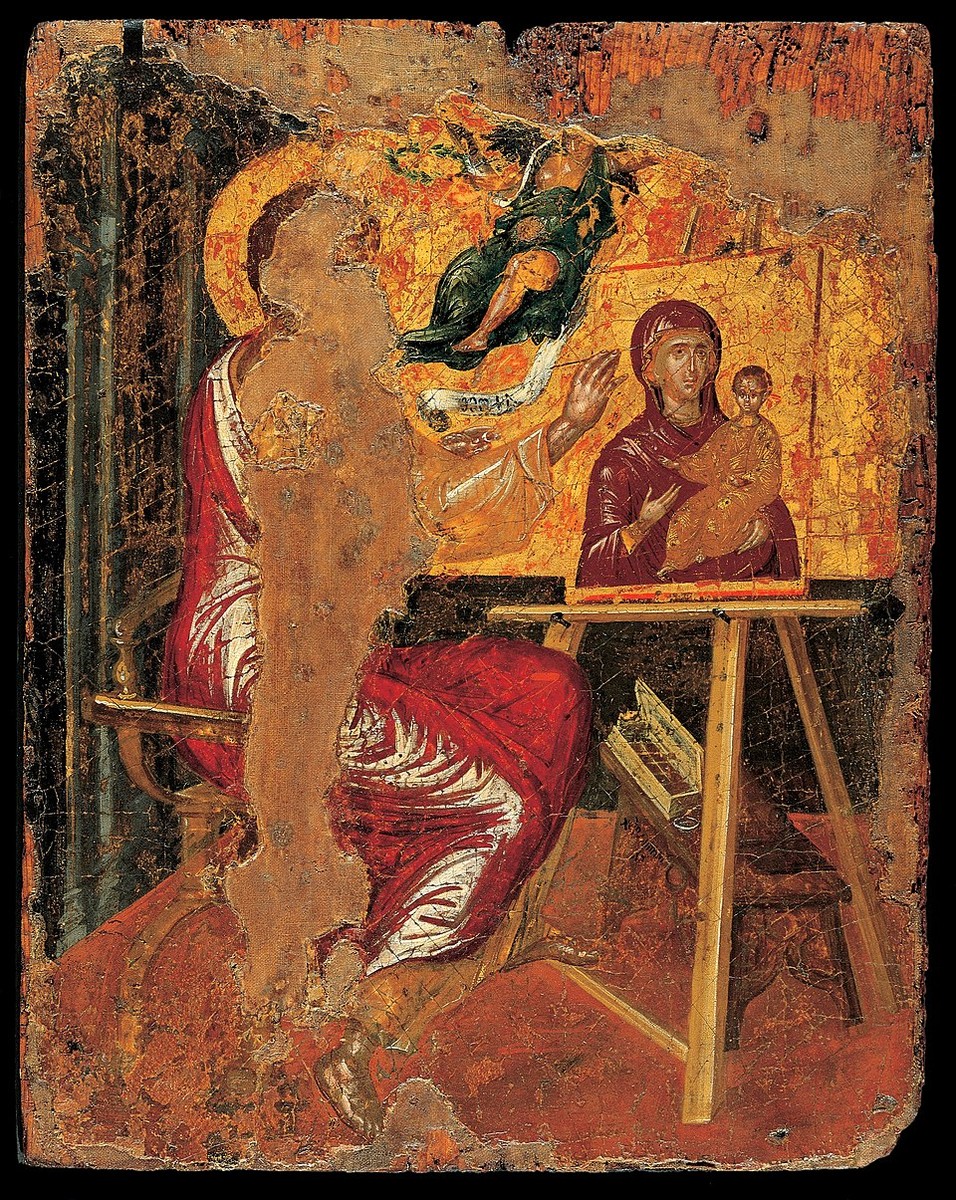
Honesty about the tradition's history is required and does not wound it. No writer of the first five centuries mentions apostolic icons; Augustine remarks in passing that the Church of his day did not know the Virgin's face; the attested icons themselves are dated by art historians between the fifth century and the high Middle Ages, none to the first; and some scholars judge even the Theodore the Reader notice a later interpolation, which would move the tradition's first appearance closer to the iconoclast controversy that made it precious. What the tradition asserts at bottom, however, the Gospel itself secures: Luke is the evangelist of the Theotokos, the writer of her only New Testament portrait, and the Church that calls his Gospel the first icon of the Virgin — painted in words from her own remembering — has said nothing history can refuse. He is in any case the patron of iconographers and of painters everywhere, East and West, whose guilds from Byzantium to Flanders bore the name of St. Luke; and the icon-type of Luke painting the Theotokos, brush in hand before the easel, became itself a fixture of the tradition (see Iconography).
Hymnographic and literary legacy
Luke's literary legacy is the third Gospel and the Acts — between them above a quarter of the New Testament, including nearly everything the Church knows of her own first thirty years. The liturgical year is unimaginable without him: the feasts of the Annunciation and the Meeting rest on his narrative alone, the Nativity cycle overwhelmingly on his; the Magnificat is sung at every Matins, the Nunc Dimittis at every Vespers, the Benedictus in the daily office; the Jesus Prayer's publican and the Prodigal of the Triodion are his; and the eleven Resurrection Gospels of Sunday Matins include his Emmaus. An old tradition reported by Clement of Alexandria and others even gave Luke a hand in the Greek of the Epistle to the Hebrews, as translator or amanuensis of Paul — a father's explanation, still worth recording, of that epistle's Lukan polish. In the Menaion his own feast bears a full proper service: the canon of the day is the work of Theophanes the Branded (Tone plagal 4), the stichera at "Lord, I have cried" include an idiomelon ascribed to Anatolius and another, at the aposticha, to a hymnographer Basil, and the kontakion "Μαθητὴς γενόμενος" with its oikos celebrates the physician-evangelist. The Slavic Menaion carries its own proper troparion (Tone 5) and kontakion (Tone 2), given below.
Feast and commemoration
October 18 (church date; Old Calendar civil October 31) is the universal feast of the apostle's repose, kept by the Antiochian, Greek, Slavic, OCA and all other Byzantine-rite calendars, and — a rare full agreement — by the Roman calendar on the same day. The Greek Menaion appoints a complete proper service; in Greek parochial use the day ranks among the greater apostle-feasts of the autumn, and in Thebes, where the tomb stands, it is kept with panegyric solemnity. Luke is commemorated again on January 4 in the Synaxis of the Seventy Apostles (he is not of the Twelve, and so does not appear in the Synaxis of June 30). The Slavic and OCA calendars give him a third commemoration on April 22, jointly with apostles of the Seventy of the September 10 company — a commemoration that rests on the Slavic identification of the "Luke" of that company with the Evangelist, which the Greek synaxaria do not share (see Disputed questions, and the entry for Apelles, Lucius and Clement of the Seventy). The Russian tradition also commemorates the evangelist among the saints connected with the translation of relics to Constantinople; the translation itself (357) is noted in the synaxaria under June 20 with the apostles Andrew and Thomas — a commemoration to be verified against the Greek sources when that day is authored.
Hymns
Troparion — Tone 5
With sacred songs let us praise the holy apostle Luke, the recounter of the Acts of the Apostles and radiant writer of the Gospel of Christ, glorious in the Church of Christ, the all-praised one: for he is a physician, healing the infirmities of men, the diseases of nature and the wounds of souls, and he prayeth without ceasing for our souls.
Original translation from the Slavonic
Apolytikion — Tone 3
O holy Apostle and Evangelist Luke, intercede with the merciful God, that He grant unto our souls the forgiveness of offences.
Kontakion — Tone 2
Let us praise the divine Luke, the herald of true piety, the orator of ineffable mysteries, the star of the Church: for the Word, who alone knoweth the hearts of men, chose him, together with the wise Paul, to be a teacher of the nations.
Original translation from the Slavonic
Kontakion — Tone 4
Having become a disciple of God the Word, with Paul thou didst enlighten all the earth and drive away the gloom, having written the divine Gospel of Christ.
Original translation from the Slavonic
Magnification
We magnify thee, O Apostle of Christ and Evangelist Luke, and we honour the pains and labours whereby thou didst toil in the good tidings of Christ.
Original translation from the Slavonic
Appointed readings
Epistle — Colossians 4:5–9, 14, 18
5Walk in wisdom toward them that are without, redeeming the time. 6Let your speech be alway with grace, seasoned with salt, that ye may know how ye ought to answer every man. 7All my state shall Tychicus declare unto you, who is a beloved brother, and a faithful minister and fellowservant in the Lord: 8Whom I have sent unto you for the same purpose, that he might know your estate, and comfort your hearts; 9With Onesimus, a faithful and beloved brother, who is one of you. They shall make known unto you all things which are done here. 14Luke, the beloved physician, and Demas, greet you. 18The salutation by the hand of me Paul. Remember my bonds. Grace be with you. Amen.
Gospel — Luke 10:16–21
16He that heareth you heareth me; and he that despiseth you despiseth me; and he that despiseth me despiseth him that sent me. 17And the seventy returned again with joy, saying, Lord, even the devils are subject unto us through thy name. 18And he said unto them, I beheld Satan as lightning fall from heaven. 19Behold, I give unto you power to tread on serpents and scorpions, and over all the power of the enemy: and nothing shall by any means hurt you. 20Notwithstanding in this rejoice not, that the spirits are subject unto you; but rather rejoice, because your names are written in heaven. 21In that hour Jesus rejoiced in spirit, and said, I thank thee, O Father, Lord of heaven and earth, that thou hast hid these things from the wise and prudent, and hast revealed them unto babes: even so, Father; for so it seemed good in thy sight.
Iconography
Luke bears one of the oldest fixed portrait-types in Christian art: the evangelist-portrait of the Gospel books, derived from the author-portraits of antique manuscripts — a seated man of middle years, short dark curling hair and beard, bent over a writing-desk with codex or scroll, pen, ink and knife, sometimes looking up for inspiration. In the now-standard distribution of the four living creatures (Ezekiel 1, Revelation 4), fixed in the West by Jerome and long usual also in Orthodox art, his symbol is the ox or calf — the sacrificial animal, the fathers explain, because his Gospel opens with the priest Zachariah at the altar of sacrifice and ends with the Victim's self-offering; the winged ox often lies at the desk's foot. In apostle-rows and Seventy-synaxis icons he stands book in hand among the evangelists.
The second great type is proper to him alone: Luke painting the icon of the Theotokos — the evangelist at his easel, brush and palette in hand, before a panel of the Virgin Hodegetria, sometimes with the Theotokos herself sitting to him, sometimes with an angel guiding his hand. The type appears in Byzantium by the later Middle Ages and became beloved in both the Orthodox and the Western worlds (where it was the altarpiece-subject of the painters' own Guilds of St. Luke); pre-modern examples abound from Crete, Russia, the Balkans and the Latin West. In the Menologion of Basil II the miniature for October 18 shows instead his burial: three disciples lay the haloed evangelist in a sarcophagus before the walls and domes of Thebes.
The stored primary image is the icon of Luke painting the Virgin by El Greco (Domenikos Theotokopoulos), egg tempera on panel, c. 1560–1567, painted while the young master was still a practising icon-painter of the Cretan school in Candia — the evangelist in the act of painting the Hodegetria, the panel's Byzantine iconography joined to Venetian manner (Benaki Museum, Athens; public domain, pd-old-work). The stored second image is the burial of Luke from the Menologion of Basil II (Constantinople, c. 985, Vatican Library, Vat. gr. 1613; source, public domain, pd-old-work).
Disputed questions
- Was Luke among the Seventy — an eyewitness — or a convert of the apostolic preaching? The Byzantine liturgical tradition counts him of the Seventy and places him on the Emmaus road; the anti-Marcionite prologue calls him "a disciple of the apostles," and his own preface (Luke 1:2) distinguishes him from the eyewitnesses "from the beginning." Some harmonisers reconcile the two by reading the preface as modesty, or the Seventy-tradition as honorific. This entry follows the calendars' usage (apostle-of-the-seventy) while recording that the oldest prose witness stands on the other side.
- The physician and the unmercenary classification. Paul's "beloved physician" (Colossians 4:14) is unquestioned in the tradition, and the hymnography of his feast delights in the healer's art turned to souls. But the calendars style Luke "Apostle and Evangelist" — never "the Unmercenary" — and the hagiographic type of the ἀνάργυροι (Cosmas and Damian, Panteleimon, and their companions: physicians glorified precisely for healing without fee) is not applied to him by any jurisdiction consulted. Following TAXONOMY's rule that a saint is classified as the Church commemorates him, his types are [apostle-of-the-seventy, apostle, evangelist], and the medicine lives in the prose. The Hobart–Cadbury debate over "medical language" is recorded above.
- Manner of death: peaceful repose or martyrdom? The oldest account (the anti-Marcionite prologue) has Luke die in Boeotia at 84, "full of the Holy Spirit"; the later Byzantine tradition, followed by the Greek synaxaristes and the OCA, has him hanged from an olive tree at Thebes, and Gregory the Theologian already numbers him with the martyrs. The calendars do not style him "martyr," and this entry records both traditions without resolving them.
- Date and authorship questions. The attribution of Gospel and Acts to Luke the physician is unbroken from the second century (Irenaeus, the Muratorian canon, manuscript titles); modern critical scholarship divides — some holding the traditional authorship precisely on the strength of the "we-passages" and the improbability of a fabricated minor-figure attribution, others regarding the author as an anonymous Gentile Christian of the 80s, and the "we" as a source or a literary sea-voyage convention (a thesis most specialists have judged weaker than the tradition). Dating ranges from c. 62 (before Acts' silent end) to the 80s or later. The Church's usage is untroubled; the debate is recorded.
- The icon-painting tradition is first attested five centuries after the apostle (and possibly later, if the Theodore the Reader notice is interpolated); its historical assessment, and its theological core, are set out in the Life above. Attributed panels (Hodegetria, Vladimir, Częstochowa, Kykkos, Sumela, and others) are dated by art historians between the fifth and twelfth centuries.
- Not to be confused with Lucius (Loukios) of the Seventy (Romans 16:21; September 10, with Apelles and Clement — see that entry): the Greek synaxaria keep Lucius, bishop of Laodicea, distinct from the Evangelist, while the Slavic tradition (Demetrius of Rostov) identifies the two — whence the Evangelist's April 22 commemoration in the Slavic calendars. Nor with Lucius of Cyrene (Acts 13:1), whom a minority of ancient readers also merged with the Evangelist. Nor with Luke the Stylite (December 11), nor with the tenth-century wonderworker Luke of Steiris (Luke of Hellas, "the Younger," February 7) — from whom the very epithet "the Younger" distinguishes the Evangelist — or the other later Lukes of the calendar.