
Luke of Steiris
Our Venerable Father Luke the Younger, the Wonderworker of Steiris in Hellas
Venerable · Wonderworker · b. c. 896, at Kastorion in Phocis — d. c. 953, at Steiris in Phocis
Commemorated 7 February — Repose of the wonderworker at Steiris, 3 May — Translation of the relics at Steiris (Greek usage)
Luke of Steiris (c. 896 – c. 953), called the Younger and Luke of Hellas, was the most beloved Greek ascetic-saint of the tenth century and one of the great wonderworkers of the Byzantine world. Born of poor Phocian farmers who had fled the Arab raids on Aegina, he gave himself from childhood to prayer, fasting, and an almost reckless charity, and left the world young to live as a monk and hermit in the mountains of central Greece. Driven from place to place by war, he settled at last at Steiris in Phocis, where a community gathered around him. He was famed for healings, for the reading of hearts, for the gift of prophecy — most celebrated of all his foretelling that Crete would be recovered from the Saracens, which came to pass under Nikephoros Phokas eight years after his death — and, the tradition says, for being lifted from the ground in prayer. He reposed on February 7. Over his tomb rose the monastery of Hosios Loukas, one of the supreme monuments of Byzantine art, where his myrrh-flowing relics rest to this day.
_-_Luke_of_Steiris_01.jpg)
Origins and early life
Luke was born about the year 896 in the village of Kastorion (Kastri) in Phocis, in central Greece — the region of ancient Delphi. His parents, Stephen and Euphrosyne, were poor farmers, refugees who had fled the island of Aegina to escape the Arab (Saracen) raids that harried the Aegean in that age; Luke was the third of their seven children. From his earliest years he showed the temper of an ascetic. He was obedient to his parents, temperate in food almost to the point of privation, and possessed by a generosity toward the poor that his family found hard to bear: he would give away his own portion of food and even his clothing to any who lacked, coming home stripped of what he had been given.
The tradition preserves a wonder of these boyhood years that reveals both his charity and the favour of God upon it. Sent to sow a field with seed, Luke gave the greater part of the seed away to the poor and sowed only what was left; yet at harvest that field yielded more abundantly than ever before — as though heaven had made good what he had given for its sake. The story became a byword for the paradox his whole life would embody: that what is given to the poor is not lost but multiplied.
Flight to the monastic life
Drawn wholly toward God, Luke left his home as a youth to become a monk. On the road he fell in with two monks travelling to Rome, and went with them; but when they were detained as suspected runaways, the young Luke's evident holiness secured their release — and word of his flight reached his widowed mother, who, after his father's early death, grieved for her son and prayed for his return. In answer to her prayers (the Life says God moved the abbot to send him back), Luke returned to comfort her, and remained until she, seeing that his heart was fixed on the monastic life, at last gave him her blessing to depart. Freed by her consent, he withdrew to the ascetic life for good, and was tonsured a monk.
The ascetic struggle
For the rest of his life Luke was a hermit and a wanderer for Christ, his solitude broken again and again by the wars of the age. He settled first on Mount Joannitsa (Ioannitza), near the Gulf of Corinth, giving himself to severe fasting, ceaseless prayer, vigil, and manual labour, and enclosing himself for long periods in a cell. There the grace of wonders descended on him: he healed the sick who sought him out, read the secrets of hearts and the sins men had not confessed, and received the gift of prophecy. His fame spread, and with it came the disciples and the crowds that a hermit dreads; more than once he moved on to recover his solitude, and more than once the incursions of the Bulgarians and the Magyars across Hellas drove him and his companions from their refuge to seek another.
The tradition dwells on the intensity of his prayer, and preserves what may be its most extraordinary mark: that Luke was seen raised from the ground, levitating in prayer — his body lifted as his spirit was caught up to God. Whatever the manner of its transmission, the detail belongs to the oldest layer of his memory and sets him among the rarest of the ascetics.
Steiris and the community
In his last years Luke settled at Steiris (Steiri) in Phocis, on the slopes of Mount Helicon, in a quiet and defensible place where at last he could remain. There he built a cell and a small church, which the tradition says he dedicated to the Great-Martyr Barbara, and a community of disciples gathered around him, drawn by his holiness and his gifts. From this hermitage, which would become the nucleus of the great monastery that bears his name, he guided those who came to him, healed the sick, counselled the troubled, and spoke the prophecies for which he is remembered.
The prophecy of Crete
The most famous of Luke's prophecies concerned the island of Crete, which had been seized by Arab (Andalusian) corsairs early in the ninth century and made a base for the piracy that had driven his own family from Aegina. Asked, the tradition says, when the Christian empire would at last recover Crete, Luke foretold that it would be taken — and named the deliverer not by the reigning emperor but by the coming one, saying that "Romanos" would win the island. The prophecy was fulfilled after his death: in 961 the general Nikephoros Phokas (the future emperor) reconquered Crete for Byzantium — in the reign of the emperor Romanos II, whose name Luke had spoken. Coming true some eight years after the saint's repose, the foretelling sealed his fame as a prophet and is told in every account of his life.
Repose
Luke reposed at Steiris on February 7, about the year 953, and was buried in the church he had raised. The year is given variously in the sources — most place his death about 953, some at 946 or 951 — but the day, February 7, is the fixed liturgical anchor, and it was on that day his community first kept his memory.
Relics, the monastery, and the later cultus
Over the tomb of the saint at Steiris rose, in the century after his death, the monastery of Hosios Loukas ("the Holy Luke") — one of the supreme monuments of Middle Byzantine architecture and art. Its great katholikon, built in the first half of the eleventh century, is adorned with gold-ground mosaics and frescoes of the highest Byzantine achievement, and together with the churches of Daphni and Nea Moni of Chios it is inscribed on the UNESCO World Heritage list as a masterpiece of the age. The monastery grew wealthy and famous as a place of pilgrimage and healing, for the saint's relics remained its treasure and worked cures upon those who came.
Luke's relics are venerated at the monastery to this day; the tradition holds them to be myrrh-flowing (myroblytes), exuding a fragrant myrrh that is a sign of the grace still resting on them. Removed for safety in the troubled Ottoman centuries, they were in the twentieth century restored to the monastery, where they are enshrined in the church and remain the goal of pilgrims. Some accounts add a second commemoration in the spring (a translation or uncovering of the relics, reported for May 3); the primary and universal feast is the repose on February 7.
Feast and commemoration
Luke is kept universally in the Byzantine rite on February 7 (church date; Old Calendar civil February 20), within the afterfeast of the Meeting of the Lord. The Greek Menaion appoints a proper office — apolytikion, kontakion, and canon — sung together with that of the hierarch Parthenius of Lampsacus, the other wonderworker of the day. In Greece his veneration is especially warm: the monastery of Hosios Loukas keeps his feast with solemnity, and he is honoured throughout Hellas as a national saint and a healer. The Antiochian, OCA, and GOARCH calendars all keep him on this day.
Not to be confused with the other Lukes of the calendar with whom name and century invite confusion: not with the Apostle and Evangelist Luke (October 18), the writer of the Gospel and the Acts, from whom the epithets "the Younger" and "the New" distinguish this saint; not with Luke the New Stylite of Chalcedon (December 11), the pillar-saint of the same tenth century; not with Luke of Taormina (†c. 820), the Sicilian monastic; and not with Luke of Triglia, the confessor-abbot of Bithynia under the iconoclasts (commemorated December 27). This Luke is the wonderworker of Steiris in Hellas, whose monastery is Hosios Loukas.
Hymns
Troparion — Tone 1
The glory of Hellas and the boast of the venerable, the luminary of Steiris and its holy dweller — Luke the God-bearer — let us honour with piety in songs and hymns; for he poureth forth healings upon those who draw near to him in faith and cry: Glory to Christ who hath glorified thee; glory to him who hath made thee wondrous; glory to him who through thee worketh healings for all.
Original translation from the Greek
Iconography
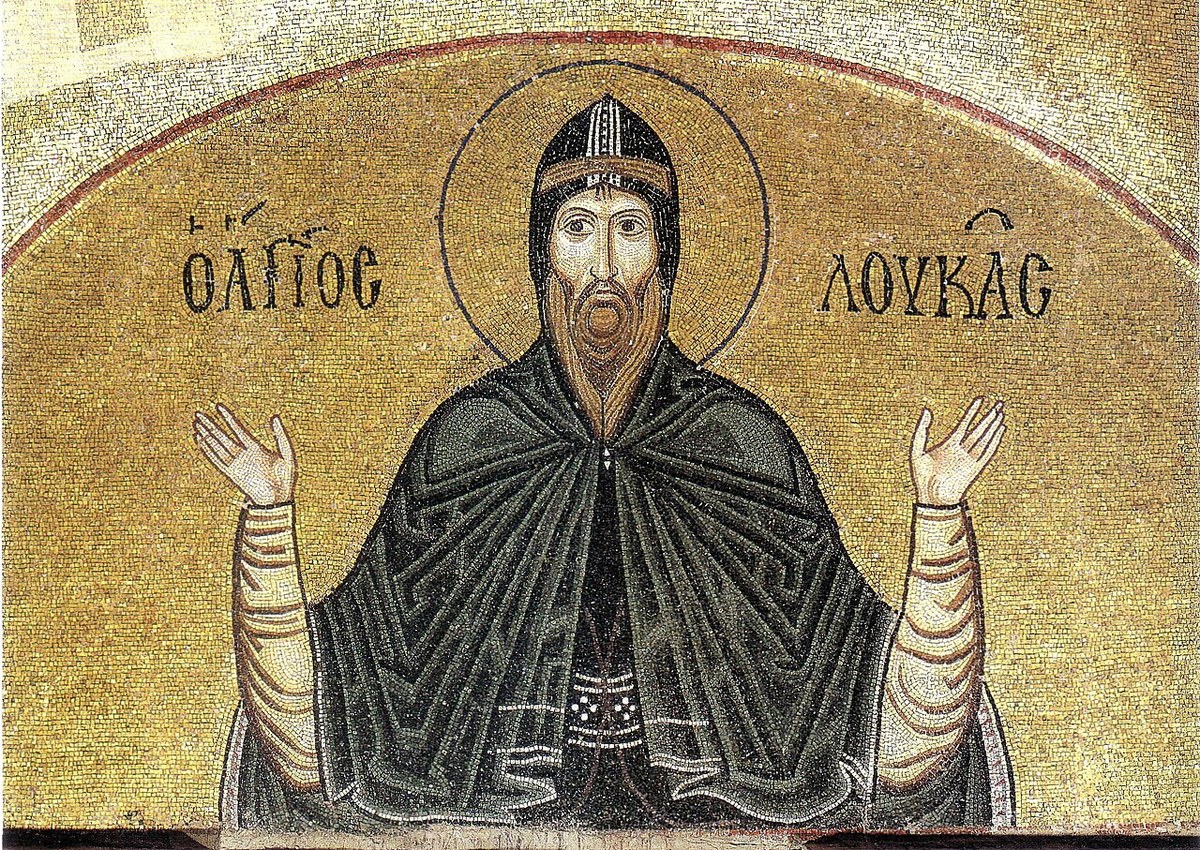
Luke is depicted in the type of a holy monk (ὅσιος): an ascetic of middle or advanced years, in the dark monastic schema and mantle, his hair and beard worn, one hand raised in blessing or holding a scroll. The oldest and greatest of his images belong to his own monastery, whose eleventh-century mosaic programme includes portraits of the founder-saint himself.
The stored image is an eleventh-century Byzantine mosaic of Saint Luke from the katholikon of the Hosios Loukas monastery in Phocis — the saint set within a lunette of the church raised over his tomb, in the gold-ground manner that makes the monastery a landmark of Byzantine art (source, a faithful photographic reproduction of a public-domain work, pd-old-work).