
Macarius of Alexandria
Our Venerable Father Macarius of Alexandria
Venerable · Wonderworker · Priest · b. c. 295, at Alexandria — d. c. 395, in the desert of the Cells (Kellia)
Commemorated 19 January — Repose in the desert of the Cells
Macarius of Alexandria (c. 295 – c. 395), called "the Younger" and "of the City" to distinguish him from his elder friend and namesake Macarius the Great, was, with him, one of the two supreme monastic fathers commemorated on this day. A confectioner of Alexandria until his baptism in middle age, he withdrew to the desert and became priest and superior of the monks of the Cells (Kellia), between Nitria and Scetis, where some five thousand solitaries were gathered. He is remembered above all for ascetic feats of astonishing severity — recorded by his own disciple Palladius — undertaken in a holy contest to outdo every rigour he heard of: seven years on raw food, standing motionless for weeks, six months naked in the marsh in penance for killing a gnat in anger. Exiled with Macarius the Great under the Arian emperor Valens, he returned to the Cells and reposed at a great age. He is kept on January 19, together with Macarius the Great.
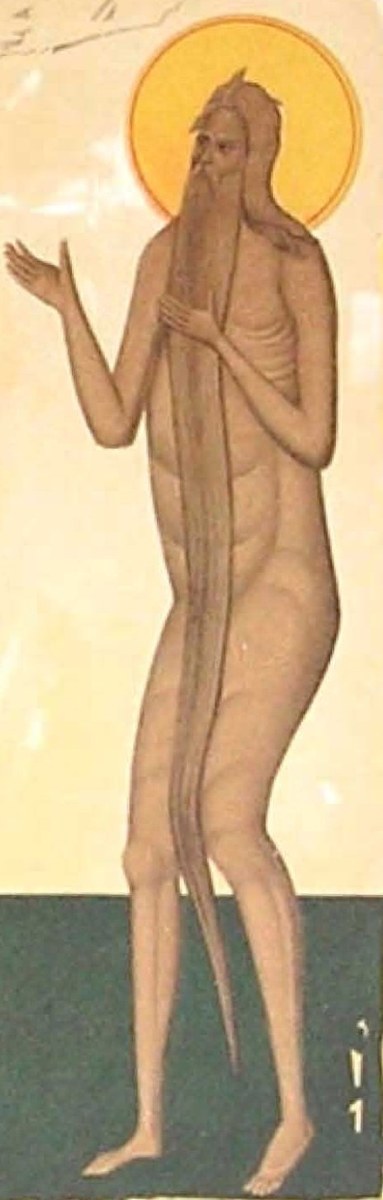

From Alexandria to the desert
Macarius was born about the year 295 and was a citizen of Alexandria, where he made his living in trade — the tradition remembers him as a seller of sweetmeats or a confectioner (whence "the pastry-cook"), and in some accounts a dealer in fruit. He came late to the monastic life: he was baptised only about the age of forty, and thereupon renounced the world and withdrew into the desert, giving the remaining sixty years of his long life to asceticism. He settled in the wilderness of Nitria and above all at the Cells (τὰ Κελλία, Kellia), the colony of scattered hermitages lying deeper in the desert than Nitria, where the more advanced solitaries dwelt in silence, each in his own cell, meeting only for the weekly Synaxis. Ordained priest, he became the spiritual father and superior of the monks of the Cells, a community that grew, the sources say, to some five thousand.
The ascetic contests
Macarius is the desert father of extreme askesis, and his feats are recorded in detail by Palladius of Helenopolis, who lived near him for years and made him a principal figure of the Lausiac History. Where his elder namesake is remembered chiefly for prayer, discernment, and humility, Macarius of Alexandria is remembered for a burning, almost competitive severity of bodily discipline — undertaken, the tradition is careful to say, not in vainglory but in a holy desire to leave no rigour untried:
- Hearing that the monks of Tabennisi (the Pachomian house) ate no cooked food through the whole of Lent, he ate only raw vegetables and pulse for seven years.
- Learning of another's discipline of little sleep, he is said to have remained upright in the open for twenty days and nights to subdue the desire for sleep, until, he confessed, he would have lost his reason had he not relented.
- When a gnat stung him and he crushed it in a flash of anger, in penance for yielding to the passion he sat naked in the mosquito-ridden marsh of Scetis for six months, so that he came out so disfigured by the bites that he was known only by his voice.
- Desiring to see the Pachomian community for himself, he went to Tabennisi in disguise as an ordinary labourer and, through the whole of Lent, stood motionless in a corner eating only a few raw cabbage leaves on Sundays and never sitting or lying — until the astonished monks, learning who he was, begged Pachomius to send him away lest they be shamed.
To these Palladius adds his gift of wonders and of discernment of demons, his combats with the powers of the air, and a vision granted him of the fate of souls; the desert literature pairs him constantly with Macarius the Great, the two "blessed" fathers whose sayings are set side by side.
Exile under Valens and repose
Under the Arian emperor Valens, when the Nicene monks of Egypt were persecuted by the Arian patriarch Lucius, the two Macarii were seized together and exiled to an island in the Delta whose people were pagan; there, the tradition holds, they healed and converted the islanders before being allowed to return. Macarius of Alexandria came back to the Cells and reposed there about the year 395, at a great age, having outlived his elder friend by a few years. He is kept on January 19, together with Macarius the Great.
Feast and commemoration
Macarius of Alexandria is kept universally on January 19 (church date; Old Calendar civil February 1) together with Macarius the Great — the day the Greek synaxaria head with the play on their shared name, "the Makarii obtained the blessed land." The office of the day is common to the two fathers.
Hymns
Troparion — Tone 1
A citizen of the wilderness and an angel in the body wast thou shown to be, and a wonderworker, O our God-bearing Father Macarius. By fasting, vigil, and prayer thou didst receive gifts from heaven, and thou healest the sick and the souls of them that run to thee in faith. Glory to him who gave thee strength; glory to him who crowned thee; glory to him who through thee worketh healings for all.
Original translation from the Greek
Iconography
Macarius of Alexandria is depicted as an aged monk in the habit and Great Schema, distinguished in the paired images of this day from Macarius the Great by his somewhat lesser stature and shorter beard — the "Younger" of the two — though the two are often so alike that only the inscription tells them apart. He is shown as a father of the Cells, holding a scroll or with hand raised in blessing.
The stored image is a drawing of a Russian icon of the saint, from Fyodor Solntsev's Antiquities of the Russian State (1846–1853) — Macarius the Younger at full length in the monastic habit (source, public domain, pd-old-work).
Disputed questions
- Not to be confused with Macarius the Great (†c. 391), "the Egyptian" and "the Elder," his friend, contemporary, and fellow-exile, with whom he shares this feast and with whom the desert literature constantly pairs him. The two are carefully distinguished in the sources: Macarius the Great was the elder, the founder of Scetis, a native Egyptian and camel-driver, remembered for prayer and humility; Macarius of Alexandria — "the Younger," "of the City" — was the townsman and confectioner of Alexandria, priest of the Cells, remembered for extreme asceticism. Later saints named Macarius (of Kios, of the Kiev Caves, of Moscow, of Zhabyn) are distinct again.