
Macarius the Great
Our Venerable Father Macarius the Great of Egypt
Venerable · Wonderworker · b. c. 300, at Ptinapor (Shabshir) in Lower Egypt — d. c. 391, in the desert of Scetis, aged about ninety
Commemorated 19 January — Repose in the desert of Scetis
Macarius the Great (c. 300 – c. 391), called "the Egyptian" and "the Elder" to distinguish him from his younger namesake Macarius of Alexandria, is among the supreme fathers of the Egyptian desert and the founder of monastic life in the wilderness of Scetis (Wadi al-Natrun). A camel-driver and carrier of nitre in his youth, falsely accused of fathering a child and vindicated when the true father was named, he withdrew about the age of thirty into the desert, where he was formed in the example of Anthony the Great, whose disciple the tradition makes him. Ordained priest and gathering a great colony of monks around him, he was granted such gifts of prayer, discernment, and wonderworking that he was called "the boy-elder," an old man's wisdom in a young man's years, and "the god-bearing." Exiled for a time under the Arian emperor Valens, he returned to his cell and reposed at about ninety, having spent some sixty years in the desert. He is one of the most quoted fathers of the Apophthegmata (the Sayings of the Desert Fathers), and the Fifty Spiritual Homilies on the life of prayer are traditionally ascribed to him. He is kept on January 19.

Origins and early life
Macarius was born about the year 300 in the village of Ptinapor (the Coptic Shabshir) in Lower Egypt, of pious parents; a later tradition names his father Abraham and his mother Sarah, and tells of a revelation given to his father that a son would be born to them whose name — Makarios, "blessed" — would be spoken throughout the world. In obedience to his parents he was for a time married, but the marriage was brief and (the tradition holds) never consummated, his wife dying young; and with the death of his parents soon after, the young man found himself free. He earned his bread as a driver of camels, carrying nitre (natron, the desert salt) from the lakes of Scetis to the towns of the Nile — the first of the desert to be given to him, before ever he entered it as a monk.
Even in the village he had begun to live as an ascetic, and the local bishop, seeing his quality, ordained him to minor orders and set him to serve the church. But the peace of his hidden life was broken by a trial that the tradition remembers as the making of him. A young woman of the village, found with child, accused Macarius of being the father. He made no defence. He accepted the disgrace in silence, and — since a supposed father must provide — he took up the weaving of baskets to support the woman and the child she would bear, bearing the beatings and the mockery of her family without a word of protest. When her time came the birth would not proceed until she confessed the truth: Macarius was innocent, and another man was the father. The village, ashamed, came to beg his forgiveness and to honour him; and Macarius, fleeing the praise of men as he had borne their contempt, left for the desert. The tradition dwells on the episode because it shows, before his monastic life had properly begun, the temper of the man: a patience under false accusation that returned good for evil and asked nothing for itself.
The desert of Scetis
About the age of thirty Macarius withdrew into the great inner wilderness of Scetis — the desert of salt-lakes south-west of the Nile Delta, remote, waterless, and terrible, which through him became one of the four cradles of Egyptian monasticism beside Nitria, the Cells, and the Thebaid. He is honoured as its founder: the first to settle that furthest desert, around whom, as his holiness became known, a colony of solitaries gathered, each in his own cell, coming together for the Synaxis and the Eucharist — the loose "lavra" pattern of Lower Egypt, as distinct from the ordered communities of Pachomius in the south. The Monastery of Saint Macarius (Deir Abu Maqar), which still stands in the Wadi al-Natrun and has never ceased to be inhabited, keeps his name and his memory on the ground he opened.
The tradition binds him closely to Anthony the Great, the father of all monks, whose disciple Macarius is called. Journeying to the mountain where Anthony dwelt, he sat under his teaching, and Anthony — so the account runs — recognised in him a chosen vessel and clothed him in the Great Schema, the fullest monastic habit, sending him back to Scetis to be a father in his turn. Whether the meeting was single or repeated, the spiritual descent is the point: Macarius carried into the desert of Scetis the mind of Anthony, and the Apophthegmata preserve sayings in which the two are set side by side.
Ordained priest for the brotherhood — that the monks of Scetis might not lack the Mysteries — Macarius governed his community less by rule than by word and example. He was called παιδαριογέρων, the "boy-elder" or "child-old-man": a man whose maturity of grace outran his years, an elder's discernment given to one still young. His cell had, the sayings tell, a hidden inner chamber to which he would retire; he slept little, ate less, and wove baskets as he prayed. Above all he was a father of prayer and of discernment of spirits: the seekers who came to him — and they came in numbers, of many nations — went away with a word fitted exactly to their state, for he read the heart. To this period belong the many stories gathered in the Sayings: his converse with a skull in the desert that answered him of the state of the dead; his gentleness with a brother overtaken by sin; his flight from the praise of men; his famous counsel that to be saved a man must become "as one already dead," reckoning neither the insults nor the flatteries of the world — "revile the dead, and they answer not; praise the dead, and they are not lifted up."
The gift of wonders, and the struggle with demons
Macarius was granted an abundance of miracles — the raising of a dead man, the tradition says, to confound a heretic who denied the resurrection; the healing of the sick; the discernment of hidden things — and an equal abundance of spiritual combat. The desert fathers understood the wilderness as the arena of the demons, and Macarius is shown contending with them at close quarters: mocked by them for a fasting or a vigil they could not equal, warned by them (against their will) of the negligences of his monks, and overcoming them not by strength but by humility, which the sayings make the one weapon they cannot withstand. A demon, meeting him on the road with a flask of temptations for the brethren, complained that Macarius alone escaped him — "and it is thy humility that defeats me." The theme is constant in his memory: the highest ascetic feats are nothing without the lowliness of heart that Christ requires, and it was in that lowliness, not in his austerities, that his power lay.
Exile under Valens
In the reign of the Arian emperor Valens (364–378), when the heresy that denied the full divinity of the Son had the backing of the state and the Nicene faithful of Egypt were harried by the Arian patriarch Lucius of Alexandria, the two great Macarii — Macarius the Egyptian and Macarius of Alexandria — were seized as pillars of Orthodoxy among the monks and exiled together to an island in the marshes of the Nile Delta, whose inhabitants were pagan. There, the tradition relates, the two elders healed the daughter of the pagan priest, and the whole island was baptised, its temple becoming a church — so that the exile meant to silence them made them apostles. The persecution passing, Macarius returned to his cell in Scetis and to his silence.
Repose
Macarius reposed in the desert of Scetis about the year 391, at the age of some ninety years, of which about sixty had been spent in the wilderness. The sayings tell that the two saints who had gone before him — Anthony, and the prophet-forerunner of monks — appeared to him at the last to carry his soul, and that he died with the words of thanksgiving on his lips. His relics were guarded at Scetis; a portion is claimed by the West at Amalfi in Italy, whither they are said to have been carried, while the Monastery of Saint Macarius in the Wadi al-Natrun venerates his memory on its own ground. He is kept on January 19, together with his namesake of Alexandria.
The Homilies and the sayings
Macarius is one of the most abundantly represented fathers of the Apophthegmata Patrum — the Sayings of the Desert Fathers — where a long sequence of stories and counsels is transmitted under his name: the vindication of his patience, the counsel to "be as the dead," the converse with the skull, his combats with the demons, his tears and his tenderness toward sinners. These sayings, gathered in the fourth and fifth centuries, are the primary and most secure witness to the man.
To him is also ascribed the Fifty Spiritual Homilies (with a further body of Great Letters and discourses) — a corpus on the interior life of prayer, the experience of grace in the heart, the warfare of the soul, and the vision of the divine light, which has been among the most influential of all monastic writings, read and loved in East and West and standing behind the later Byzantine tradition of the prayer of the heart. Their attribution is a genuine scholarly question (see Disputed questions), but the Church has received them under the name of the great father of Scetis, and their spiritual matter is of a piece with his sayings.
Feast and commemoration
Macarius the Great is kept universally on January 19 (church date; Old Calendar civil February 1), his day of repose, together with Macarius of Alexandria — the Greek synaxaria head the day "the Makarii obtained the blessed land," playing on his name (makarios, blessed). The Antiochian, Greek, and Slavic calendars agree on the day. The desert fathers of January — Anthony the Great (January 17), Euthymius the Great (January 20), and the two Macarii between them — form a constellation of the monastic ideal in the Menaion of this month, the "desert" weeks that follow the Leavetaking of the Theophany.
Hymns
Troparion — Tone 1
A citizen of the wilderness and an angel in the body wast thou shown to be, and a wonderworker, O our God-bearing Father Macarius. By fasting, vigil, and prayer thou didst receive gifts from heaven, and thou healest the sick and the souls of them that run to thee in faith. Glory to him who gave thee strength; glory to him who crowned thee; glory to him who through thee worketh healings for all.
Original translation from the Greek
Kontakion — Tone 4
In the Lord's house of abstinence he truly set thee as a star unwandering, that givest light to the ends of the earth, O Father of fathers, Macarius the venerable.
Original translation from the Greek
Prayers
Iconography
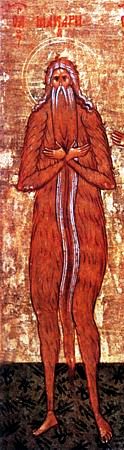
Macarius is depicted as an extremely aged ascetic — among the most distinctive of all the desert fathers in appearance — with a very long white beard reaching to his feet or to the ground, gaunt from fasting, clothed in the plain monastic tunic and often the analavos and koukoulion (cowl) of the Great Schema. A frequent and beloved variant shows a cherub or seraph standing at his shoulder, from a saying in which one of the fathers saw an angel accompanying Macarius; his hand is raised in blessing or in prayer, and he may hold a scroll. He is regularly shown in company with the other fathers of the wilderness — Anthony, Onuphrius, Paul of Thebes, Mary of Egypt — and paired on this day with the smaller-statured Macarius of Alexandria.
The stored image is a Russian icon of the saint from before the nineteenth century — the aged father of Scetis, in the monastic habit, his long beard the mark of his desert years (source, public domain, pd-old-work).
Disputed questions
- The authorship of the Homilies. Modern scholarship has long observed that the Fifty Spiritual Homilies and the associated corpus bear marks of the fourth-century Syrian and Mesopotamian milieu and show affinities with the spirituality condemned as Messalian (an over-realised expectation of the felt experience of grace). Many scholars accordingly speak of a "Macarius-Symeon," locating the corpus in the ambit of a Symeon of Mesopotamia rather than in the hand of Macarius of Egypt himself, while others defend a substantial connection to the Egyptian father or to his circle. The question turns on origin, not on orthodoxy: read within the Church's mind, the homilies have nourished the saints, and the tradition keeps them under Macarius's name while the historical attribution remains open.
- The distinction of the two Macarii. He is not to be confused with Macarius of Alexandria (†c. 395), his younger contemporary, friend, and fellow-exile, "the Younger," priest of the Cells, with whom he shares this feast of January 19 and with whom the desert literature constantly pairs him — nor with the several later saints of the same name: Macarius of Kios the new-martyr (†1590), Macarius the Faster and Macarius the Deacon of the Kiev Caves, Macarius of Zhabyn, Macarius Metropolitan of Moscow, or Macarius the Roman of Novgorod. "The Great," "the Egyptian," and "the Elder" belong to this Macarius of Scetis.