
Marcian and Martyrius
The Holy Martyrs and Notaries Marcian the Reader and Martyrius the Subdeacon of Constantinople
Martyr · d. c. 355
Commemorated 25 October — Martyrdom at Constantinople
Marcian and Martyrius were two clergy of the Great Church of Constantinople — Marcian a reader, Martyrius a subdeacon — who served together as notaries, the secretaries and record-keepers, of Paul the Confessor, the Nicene archbishop of the capital repeatedly driven from his see by the Arian party. After Paul was exiled and murdered and the Arian Macedonius seized the throne, the two men continued openly to confess the consubstantiality of the Son and to defend the faith of Nicaea. The Arians tried in vain to buy their silence with gold and the promise of high office; when bribery failed, they had them condemned and beheaded, about the year 355. They are commemorated on October 25, and a martyrium was raised over their relics at Constantinople.

Origins and service in the Great Church
Nothing is recorded of the birth or family of Marcian and Martyrius; they enter history already in the service of the church of Constantinople during the long Arian crisis of the mid-fourth century. Marcian held the office of reader (anagnostes) and Martyrius that of subdeacon (hypodiakonos) — the lesser orders of the clergy — and both were employed as notarioi, the trained secretaries who took down correspondence, kept the archives, and drafted the documents of the patriarchate. In that capacity they became the close assistants of Paul the Confessor, the archbishop whom the Nicene party of the capital elected and the Arians, backed by the emperor Constantius II, four times expelled.
The Arian crisis and the death of Paul
The see of Constantinople was the chief prize of the Arian struggle after the Council of Nicaea (325). Paul, an unbending confessor of the Nicene faith, was set against the Arian claimant Macedonius; the city was torn between them, and Paul was banished again and again. In his final exile he was carried off to Cucusus in Armenia and there, according to the tradition the Church received, strangled to death by his persecutors — a bishop martyred for the Nicene confession. With Paul gone, Macedonius held the throne by imperial force.
Confession and martyrdom
Marcian and Martyrius did not fall silent. As men who had kept the records of the orthodox patriarch and knew the whole history of the intrigues against him, their continued witness was dangerous to the Arian party: they went on confessing the eternal and consubstantial divinity of the Son against the Arian denial, and reproaching those who had compassed Paul's ruin. The Arians first attempted to win them over, offering money and the dignity of high ecclesiastical office — by some accounts the rank of bishop — if they would embrace the Arian creed. The two notaries refused every inducement, holding fast to the faith of the Fathers. Persuasion failing, their enemies procured a sentence of death, and Marcian and Martyrius were led outside the city and beheaded, about the year 355, sealing with their blood the confession they had kept in the archives.
Relics and veneration
The bodies of the martyrs were buried by the faithful, and their tomb became a place of healing. The tradition holds that a martyrium was afterwards built in their honour at Constantinople — the ascription of its building or adornment to John Chrysostom, archbishop of the city a generation later, is repeated in the received accounts — and there their memory was kept. As notaries who died for the orthodox confession they were remembered with particular affection by the clergy of the capital, and their commemoration passed into the synaxaria of the whole Byzantine world.
Feast and commemoration
October 25 (church date; Old Calendar civil November 7). The feast is kept universally in the Byzantine rite, and Marcian and Martyrius are the principal commemoration of the day, furnished with proper hymnography in the Menaion. The Slavic and Greek books agree on the date and rank.
Hymns
Troparion — Tone 4
Thy Martyrs, O Lord, in their struggle received incorruptible crowns from Thee, our God; for possessed of Thy might, they cast down the tyrants and shattered the powerless insolence of the demons. By their supplications, O Christ God, save our souls.
Original translation from the Greek
Kontakion — Tone 4
Having contended nobly from your youth, O Marcian with wise Martyrius, ye cast down the apostate Arius and kept the Orthodox faith unharmed, following Paul the wise teacher; wherefore, together with him, ye have found life, as excellent champions of the Trinity.
Original translation from the Greek
Iconography
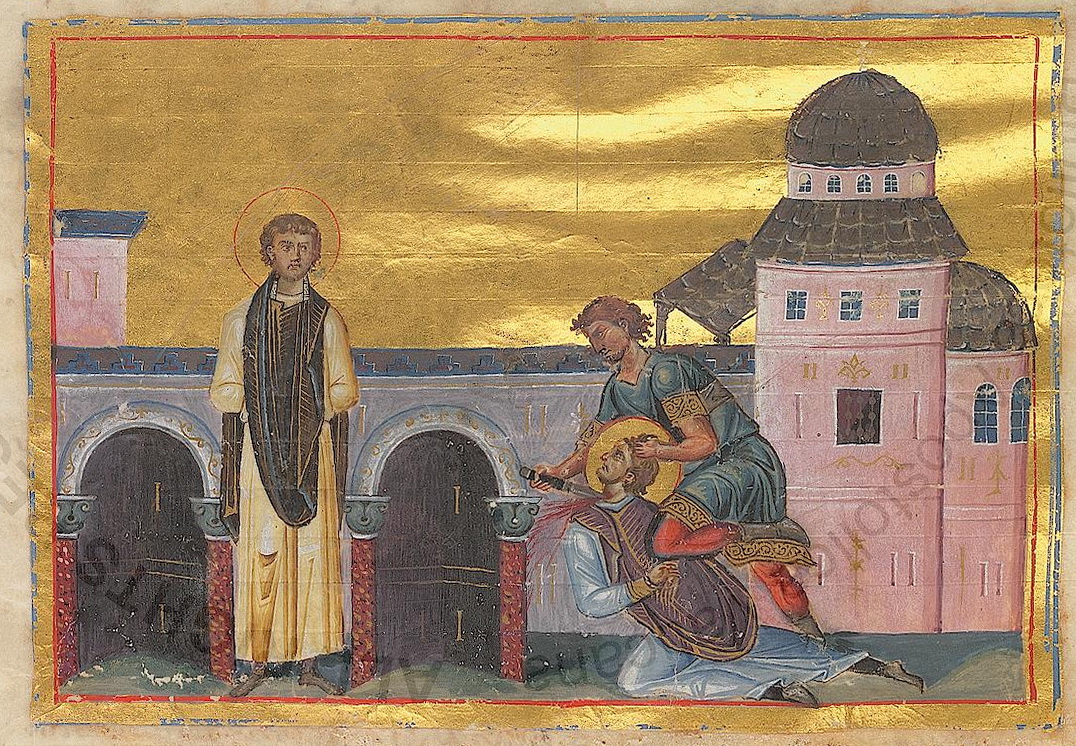
Marcian and Martyrius are shown together as a pair of youthful martyrs in the short tunic and cloak of Byzantine laymen or minor clergy, each holding the cross of martyrdom; being notaries, they are sometimes depicted with the implements of their office. The stored image is the miniature from the Menologion of Basil II (Constantinople, c. 985, now in the Vatican Library), which shows the two saints standing side by side.
Disputed questions
- Not to be confused with other saints of the name Martyrius: this Martyrius the subdeacon and notary is distinct from Martyrius the Deacon of the Kiev Caves (a later Russian venerable also remembered on October 25) and from Martyrius, the fifth-century patriarch of Antioch who buried Symeon the Stylite. Marcian the Reader is likewise distinct from the several other Marcians of the calendar — in particular from Marcian the Oikonomos, presbyter and steward of the Great Church of Constantinople (†c. 471, kept January 10), another Marcian of the same city but of a later generation.
- Date of death. The received date is about 355, in the years after Paul's murder and Macedonius's seizure of the see; the sources give the event without a precise year, and some place it slightly earlier.