
Paul the Confessor
Our Father among the Saints Paul the Confessor, Archbishop of Constantinople
Confessor · Patriarch · Bishop · Martyr · d. c. 350
Commemorated 6 November — Repose in exile (martyrdom) at Cucusus
Paul the Confessor (died c. 350) was archbishop of Constantinople during the height of the Arian crisis, a firm champion of the Nicene faith who was four times driven from his see by the emperor Constantius II and the Arian party. In his final banishment he was carried off to Cucusus in Armenia and there, the tradition holds, strangled with his own omophorion as he stood at the altar — so that the Church honours under the title "Confessor" a hierarch who in the end sealed his witness with a martyr's death. His secretaries, the notaries Marcian and Martyrius, were killed for continuing his cause. His feast is November 6.
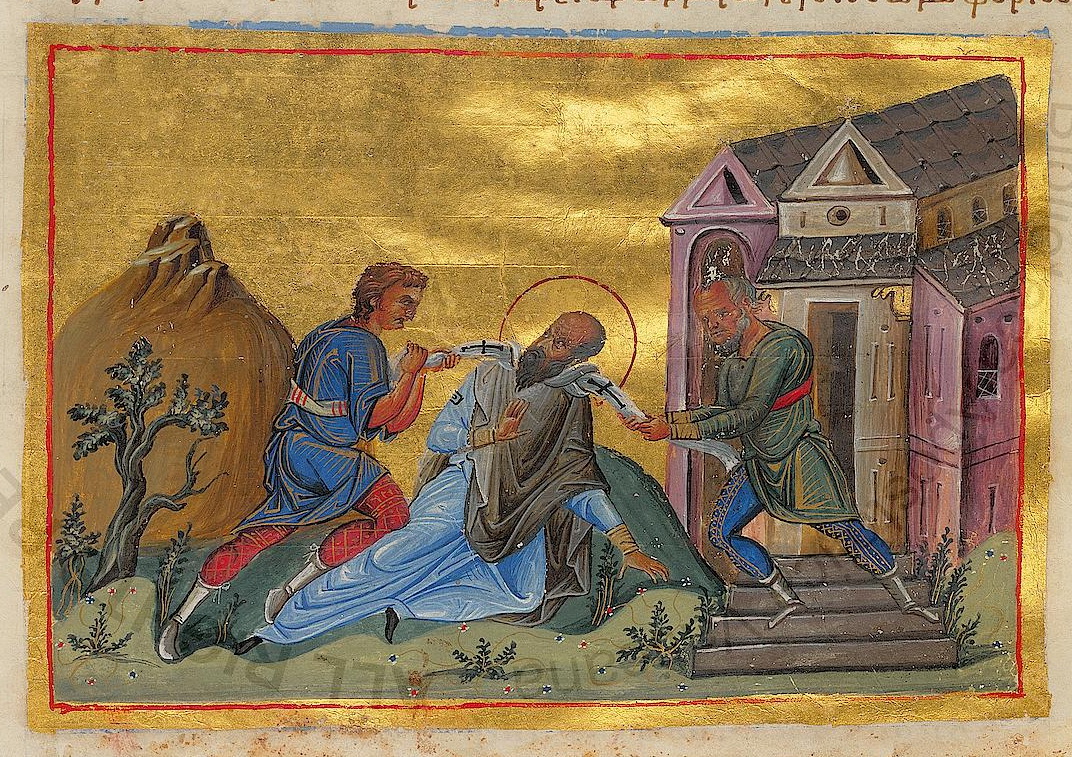
.jpg)
Origins and elevation to the see
Little is preserved of Paul's early life beyond that he was a native of Thessalonica who served as a deacon and secretary of Alexander, the aged archbishop of Constantinople who had confessed the Nicene faith at the first Ecumenical Council. On the death of Alexander (around 340), when the Arian controversy had again broken into open conflict, Paul was chosen to the patriarchal throne. Many Arians were present at the electing council and rose in opposition, but the Orthodox were in the majority and Paul was consecrated. The emperor Constantius II, who ruled the Eastern half of the empire and had gone over to the Arian party, was absent from the capital, so that the election took place without his consent — the flaw upon which his enemies would seize again and again.
The four exiles
Paul's episcopate became a running battle for the chief see of the East. On his return to Constantinople the emperor convened a council which deposed Paul as uncanonically chosen and banished him from the city, installing in his place Eusebius of Nicomedia, the leading bishop of the Arian cause. Paul withdrew to Rome, where he found other Nicene bishops likewise exiled, among them Athanasius of Alexandria, and where the Western church and the bishop of Rome upheld his cause. When Eusebius died not long after, Paul returned and was received by his flock with joy — only to be expelled a second time by Constantius and to go again to Rome. The Western emperor Constans, a defender of the Orthodox, took up his cause and sent to his brother Constantius a sharp letter, carried to Constantinople together with the exiled archbishop himself; before the threat of his brother's arms Constantius yielded and Paul was restored.
The reprieve did not last. When Constans was murdered in a palace coup (350) and Constantius was left sole master of the empire, Paul was seized once more and sent into a distant exile, this time to Cucusus, a bleak town in the Taurus mountains on the Armenian border. Athanasius the Great, his contemporary and fellow-sufferer, summed up the successive banishments: Paul, he wrote, was first sent by Constantine to Pontus, a second time bound in chains by Constantius, then shut up in Singara of Mesopotamia and moved from there to Emesa, and a fourth time to Cucusus in Cappadocia, in the Taurian wilderness.
Martyrdom at Cucusus
At Cucusus the archbishop was kept in harsh confinement. According to the account the Church received, as Paul was celebrating the Divine Liturgy his Arian keepers fell upon him and strangled him with his own omophorion — the very stole of his office become the instrument of his death. This is placed about the year 350. Thus a hierarch whom the calendars honour as "the Confessor," for the imprisonments and exiles he endured without yielding, in fact ended his life as a martyr, put to death for the confession of the consubstantial Trinity. The Greek synaxarion verse of the day plays on the manner of it — that the throat which had confessed God was itself throttled — and his hymnography likens his shed blood to the innocent blood of Abel and of Zacharias crying to the Lord.
The witness of his notaries
The killing of Paul did not silence his household. His two secretaries and notaries, Marcian and Martyrius — a reader and a subdeacon of the Great Church who had kept the archbishop's correspondence and archives — continued after his death to confess the Nicene faith and to denounce those who had compassed his ruin under the Arian Macedonius. Offered gold and high office to embrace the Arian creed and refusing, they were beheaded about 355. Their memory is kept on October 25, and their kontakion names them as faithful "unto Paul the wise teacher."
Relics and translations
In 381, in the reign of Theodosius the Great and the year of the Second Ecumenical Council which vindicated the Nicene cause in the capital, the relics of Paul the Confessor were brought back with honour from Cucusus to Constantinople and enshrined there. In 1326 they were carried to Venice, where the body is venerated to this day; a portion of the skull is kept at the Monastery of Simonopetra on Mount Athos, and a fragment came to the Alexander Nevsky Lavra in Saint Petersburg.
Feast and commemoration
November 6 (church date; Old Calendar civil November 19). The feast is kept universally in the Byzantine rite, with a full proper office in the Menaion whose canon bears the acrostic "I hymn Paul the initiator of mysteries" and is ascribed to Theophanes. The same day carries in the Greek books a secondary commemoration of the "fall of ash sent down in mercy" upon Constantinople under the emperor Leo the Great — the ashfall of 472, remembered as an act of divine warning and sparing (not treated here). Paul's principal assistants, the notaries Marcian and Martyrius, are commemorated on October 25.
Hymns
Troparion — Tone 3
By thy confession of the divine faith the Church proclaimed thee another Paul, a zealot among the priests. Together with thee cry out to the Lord both Abel and the righteous blood of Zacharias. O venerable Father, entreat Christ God to grant us great mercy.
Original translation from the Greek
Kontakion — Tone 2
Shining forth upon the earth as a star lit with the light of heaven, thou dost now illumine the catholic Church, for which thou didst contend, laying down thy soul, O Paul; and like the blood of Zacharias and of Abel, thy blood cries out plainly to the Lord.
Original translation from the Greek
Appointed readings
Epistle — Hebrews 7:26–8:2
26For such an high priest became us, who is holy, harmless, undefiled, separate from sinners, and made higher than the heavens; 27Who needeth not daily, as those high priests, to offer up sacrifice, first for his own sins, and then for the people’s: for this he did once, when he offered up himself. 28For the law maketh men high priests which have infirmity; but the word of the oath, which was since the law, maketh the Son, who is consecrated for evermore. 1Now of the things which we have spoken this is the sum: We have such an high priest, who is set on the right hand of the throne of the Majesty in the heavens; 2A minister of the sanctuary, and of the true tabernacle, which the Lord pitched, and not man.
Gospel — John 10:9–16
9I am the door: by me if any man enter in, he shall be saved, and shall go in and out, and find pasture. 10The thief cometh not, but for to steal, and to kill, and to destroy: I am come that they might have life, and that they might have it more abundantly. 11I am the good shepherd: the good shepherd giveth his life for the sheep. 12But he that is an hireling, and not the shepherd, whose own the sheep are not, seeth the wolf coming, and leaveth the sheep, and fleeth: and the wolf catcheth them, and scattereth the sheep. 13The hireling fleeth, because he is an hireling, and careth not for the sheep. 14I am the good shepherd, and know my sheep, and am known of mine. 15As the Father knoweth me, even so know I the Father: and I lay down my life for the sheep. 16And other sheep I have, which are not of this fold: them also I must bring, and they shall hear my voice; and there shall be one fold, and one shepherd.
Iconography
Paul is depicted as a bishop of middle age with a short, rounded dark beard, vested in the phelonion and omophorion and holding the Gospel book, blessing with his right hand; where his martyrdom is shown, the omophorion is drawn about his throat. The stored image is his miniature from the Menologion of Basil II (Constantinople, c. 985, now in the Vatican Library), which shows the archbishop standing in full hierarchical vesture.
Disputed questions
- Confessor or martyr — and why not "hieromartyr." Paul is styled in every Byzantine book "the Confessor" (ὁ Ὁμολογητής), the title fixed by his long endurance of prison and exile; yet the same tradition holds that he died by strangulation for the faith, which is martyrdom. This entry follows the Church's own emphasis and leads his classification with confessor (with patriarch and bishop for his office), while recording martyr honestly, because he was in fact killed. The compound hieromartyr — a martyred bishop — is deliberately not used, since to lead with it would displace the received title under which he is universally commemorated; his own hymnography holds the two together, calling him at once "venerable father" and, in the apostichon, an "unconquered martyr and acceptable hierarch."
- His Arian rival. The received Greek office names Paul's opponent as Macedonius, later the eponym of the Macedonian (Pneumatomachian) heresy, who seized the see by imperial force; some accounts introduce Eusebius of Nicomedia as the first intruder and Macedonius as the last. The historians Socrates and Sozomen preserve the fuller and not wholly harmonious record of these years.
- Date of death. The tradition and the Menaion place the martyrdom about 350, after the murder of Constans; a precise year is not transmitted, and some reckonings give 351.
- Not to be confused with Paul the Confessor of Plousias (†c. 850, kept March 7), a ninth-century bishop of a small Bithynian see who confessed the holy icons in the second iconoclasm — a different saint of a different age, sharing only the title "the Confessor."
- Not to be confused, further, with Paul the New, Paul IV of Constantinople (patriarch 780–784), commemorated on August 30 with Alexander and John, Patriarchs of Constantinople. Both are patriarchs of Constantinople named Paul who came up against a heresy; but this Paul was intruded upon and killed by the Arians about 350, whereas Paul the New outwardly conformed to iconoclasm out of fear, repented, abdicated the throne for a monastic cell, and from it urged the calling of the Seventh Ecumenical Council. It is precisely to keep the two apart that the later one is always styled "the New."