
Maria Skobtsova
The Holy Venerable Martyr Maria of Paris (Skobtsova)
Venerable Martyr · New Martyr · b. 8 December 1891, Riga — d. 31 March 1945, in the gas chamber at Ravensbrück
Commemorated 20 July — Commemoration of Mother Maria and those with her
Mother Maria — Elizaveta Pilenko, twice married, poet of the Petersburg Symbolist circle, briefly mayor of Anapa in the revolution, and from 1932 a nun in Paris — is the great modern Orthodox witness to the identity of the Liturgy with the service of the poor. Tonsured with the blessing that her monastery should be the world, she ran houses of hospitality in Paris for the destitute of the Russian emigration; and under the German occupation she and her chaplain Fr Dimitri Klepinin hid Jews, issued them baptismal certificates, and moved them out of the city. She was arrested in February 1943 and died in the gas chamber at Ravensbrück on 31 March 1945, Holy Saturday, by one account in the place of another woman. The Ecumenical Patriarchate glorified her in 2004 together with Fr Dimitri, her son Yuri Skobtsov and Ilya Fondaminsky, and the Church keeps them on July 20.
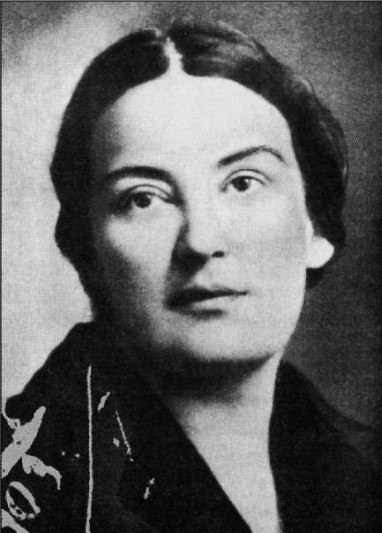

Elizaveta Pilenko
She was born Elizaveta Yurievna Pilenko at Riga on 8 December 1891, and grew up at Anapa on the Black Sea, where her father managed the family vineyards and held public office. His death when she was fourteen threw her into an adolescent atheism which she describes in her own writings with some severity; she came back to faith gradually, in the intellectual and literary world of St Petersburg, where she moved in the Symbolist circles around Alexander Blok, with whom she carried on a long and searching correspondence, and published her first books of verse. She is said to have been the first woman admitted, by correspondence, to study at the St Petersburg Theological Academy.
In 1910 she married Dimitri Kuzmin-Karavaev, a marriage she afterwards described as made more out of pity than love; it produced a daughter, Gaiana, and had broken down by 1913. In the chaos of the revolution she was elected to office at Anapa — deputy mayor and then mayor — tried by the Whites for collaboration with the Bolsheviks, and defended at her trial by Daniel Skobtsov, a Kuban schoolmaster and judge, whom she then married. They had two children, Yuri (b. 1920) and Anastasia (b. 1921).
Emigration and the death of a child
The family fled Russia in the civil war, passing through Georgia and Yugoslavia, and settled in Paris in 1923. There, in 1926, four-year-old Anastasia died of meningitis after a long illness through which her mother nursed her. Mother Maria's own account of what happened to her at that graveside is the hinge of her life: she came away with the conviction that all motherhood was now hers, that there was no such thing as another person's misery, and that she must find "a more authentic and purified life."
She threw herself into the work of the Russian Student Christian Movement, travelling among the scattered and destitute Russian emigration of France — the miners and factory hands of the north and east, the tubercular, the alcoholic, the abandoned — and became a familiar and unusual figure among them. Her second marriage having ended, and the ecclesiastical release being granted, she was tonsured a nun in the spring of 1932 by Metropolitan Evlogy, taking the name Maria after Mary of Egypt. The Metropolitan's charge to her, endlessly quoted since, was that her monastic obedience would be lived not behind walls but in the world.
Rue de Lourmel
She took a house at 9 villa de Saxe and then, in 1934, the larger premises at 77 rue de Lourmel in the fifteenth arrondissement, and made of them a house of hospitality: a chapel in the old stable, a canteen that fed up to a hundred and twenty people a day, dormitories, a sanatorium for the tubercular at Noisy-le-Grand, and a constant traffic of the unemployed, the sick and the half-mad. She bought at Les Halles at dawn, cooked, scrubbed, sat up all night in argument, and wrote — essays on monasticism and on the meaning of asceticism in the modern world, and the embroideries and icons she made with her own hands. Her theology was worked out in that setting and is inseparable from it: that the sacrament of the altar and the "sacrament of the brother" are one movement; that the ascetic tradition is not a private discipline but the school of a love which must be spent; and that the danger of Christian piety is its retreat into an aesthetic or psychological safety. Fr Sergius Bulgakov was her spiritual father; Fr Dimitri Klepinin was appointed chaplain of the house in 1939; her son Yuri and the writer Ilya Fondaminsky, a Jewish revolutionary intellectual who was baptised in the house's chapel, belonged to the same circle.
The occupation
When Paris fell in 1940 the house on the rue de Lourmel became a refuge for Jews. Mother Maria and Fr Dimitri sheltered them, fed them, and obtained for them the papers that could save a life — Fr Dimitri writing out baptismal certificates for people he had never baptised, and refusing all argument about it. After the mass arrests of July 1942, when thousands were penned in the Vélodrome d'Hiver before deportation, Mother Maria got inside among the rubbish collectors and, it is reported, brought children out in the bins. The house served as a link in the routes by which Jews were passed out of the city.
In February 1943 the Gestapo came. Yuri was arrested first, then Fr Dimitri — who was offered his freedom if he would undertake to help no more Jews, and answered by holding up his pectoral cross and asking the officer whether he knew this Jew — and then Mother Maria, on 10 February. Yuri Skobtsov and Fr Dimitri Klepinin died in the camp at Dora in February 1944; Ilya Fondaminsky had already died at Auschwitz in 1942.
Ravensbrück
Mother Maria was deported to Ravensbrück, the women's camp north of Berlin, where she was prisoner 19,263 and lived two years in conditions that killed most of those who arrived with her. The testimony of the survivors is unusually consistent: she talked, taught, argued, organised discussion in the block, embroidered an icon of the Mother of God holding the crucified Christ, and kept alive in others the refusal to be reduced. She grew steadily weaker through the winter of 1944–45.
On 30 March 1945, Good Friday of that year, she was selected for the gas chamber, and died on 31 March, Holy Saturday, a week before the camp was liberated. A persistent account, reported by survivors, is that she went in the place of another prisoner who had been chosen; the Church has received the story while acknowledging that it cannot be documented.
Glorification
On 16 January 2004 the Holy Synod of the Ecumenical Patriarchate resolved to number among the saints Mother Maria Skobtsova, the priest Dimitri Klepinin, her son Yuri (George) Skobtsov, and Ilya Fondaminsky; the glorification was celebrated at the cathedral of St Alexander Nevsky in Paris that spring, and their memory was appointed for July 20. They are the first of the martyrs of the German camps to be canonised by an Orthodox Church, and their cult has spread quickly beyond the Russian emigration, in part through Mother Maria's own writings.
Feast and commemoration
July 20 (Old Calendar civil August 2), together with Fr Dimitri Klepinin, Yuri Skobtsov and Ilya Fondaminsky, on the feast of the Prophet Elijah. The commemoration is modern, dating from the glorification of 2004, and is kept chiefly in the parishes of the Western European Archdiocese, in France, and increasingly in English-speaking Orthodoxy. The proper hymns composed for the glorification remain in copyright and are not reproduced here.
Hymns
Troparion — Tone 4
Thou didst find thy cell in the streets of the city and thy monastic rule in the feeding of the hungry, O venerable martyr Maria; and when the hunters came for the innocent, thou didst hide them at the cost of thy life, and wast offered up in the fire on the day of the Lord's burial. Intercede with Christ God that our souls may be saved.
Original translation from the Greek
Iconography
All icons of Mother Maria are modern, the glorification being of 2004, and none may be reproduced. The type that has established itself shows her as she was photographed: a heavy-featured, spectacled woman of middle age in the black monastic riasa and veil, with round wire glasses — almost unique among Orthodox saints in wearing them — holding a scroll or a cross; behind her, in the fuller compositions, the barbed wire and the chimney of the camp, and sometimes a small loaf or a cooking pot at her feet, for the canteen at the rue de Lourmel. She is frequently painted together with Fr Dimitri Klepinin, Yuri Skobtsov and Ilya Fondaminsky in a single panel of the martyrs of Paris. A distinct strand of the imagery quotes her own hand: she embroidered at Ravensbrück an image of the Mother of God holding not the infant but the crucified Christ, and that composition — the Theotokos with the grown, crucified Son — is now painted as an icon in its own right and associated with her name.
The stored image is a lifetime photograph of Elizaveta Skobtsova, stored per the §50 ruling as a labelled portrait. A free-licensed painted icon remains the eventual want and is listed among the upgrade-wanted icons.
Disputed questions
- The substitution at the gas chamber. The account that she took another woman's place comes from camp survivors at second hand and cannot be verified; it is transmitted in the lives with that qualification, and her sanctity does not rest upon it.
- Her irregularity. Mother Maria was a divorced woman twice married, a chain-smoker, careless of monastic form, and an outspoken critic of what she called the aestheticism and the false otherworldliness of much émigré piety; she was in open disagreement with parts of her own church community, and the tonsure of such a person was contested at the time. The glorification of 2004 did not tidy this away, and neither does this entry: what the Church has recognised is a particular and difficult holiness, not a conventional one.
- The companions. Fr Dimitri Klepinin (1904–1944), Yuri Skobtsov (1920–1944) and Ilya Fondaminsky (1880–1942) were glorified with her and share the July 20 commemoration; each warrants an entry of his own, which this corpus has not yet made. Modern calendars list Alexis Medvedkov (†1934), the priest of Ugine glorified at the same time, on this day also, though he was not of the Paris house and did not die a martyr's death.
- Jurisdiction. She was glorified by the Ecumenical Patriarchate, under whose Archdiocese of Russian Orthodox Churches in Western Europe her community stood; she is not at present in the general calendar of the Moscow Patriarchate, and the OCA lists her.