
Mariamne
The Holy Righteous Mariamne, Sister of the Apostle Philip
Righteous · Virgin · d. 1st century
Commemorated 17 February — Repose after the apostolic mission
Mariamne (first century) was the sister of the holy Apostle Philip, one of the Twelve, and a fellow-labourer in his apostolic mission. A virgin who had consecrated her life to Christ, she travelled with her brother and with the Apostle Bartholomew through the cities of Asia Minor — Lydia, Mysia, and Phrygia — sharing their preaching, tending them in their hardships, and herself proclaiming the Gospel and turning many to the faith. She was with them at Hierapolis in Phrygia, where Philip was crucified and Bartholomew, taken down from the cross, survived; Mariamne too was seized and threatened but was delivered. After her brother's martyrdom she continued to preach — the tradition takes her into Lycaonia — and there she reposed in peace. The Church honours her as a righteous virgin and apostolic helper, commemorated on February 17.

Of Mariamne the historical record is slender, and what the Church transmits comes chiefly from the tradition of the mission of the Apostle Philip and from the apocryphal Acts of Philip, used with the caution such texts require. She was Philip's sister, and — like him — gave herself wholly to Christ; the tradition is firm that she remained a virgin, consecrated to God, and that she attached herself to the apostolic band not as a spectator but as a full sharer in its labours.
When the Apostles divided the world among them for the preaching of the Gospel, Philip went into Asia Minor, and Bartholomew with him; and Mariamne went with the two, travelling the roads of Lydia and Mysia and Phrygia, through persecutions, hunger, and the perils of the pagan cities. The tradition remembers her as the one who cared for the apostles' bodily needs and encouraged them in danger, but also as a preacher in her own right, whose word and holiness of life drew many — women especially — to baptism. In some tellings she shared in the wonders of the mission, the healings and the casting-out of the serpents that the Phrygians worshipped.
The mission reached its climax at Hierapolis in Phrygia, a city given to the cult of a great serpent or viper. There, the tradition holds, the apostles' preaching and the destruction of the idol so enraged the priests and the governor that Philip was crucified — hung head downward, as the memory has it — and Bartholomew was likewise fastened to a cross; Mariamne was seized with them. An earthquake and the terror of the people won Bartholomew's release, and he was taken down alive; Philip died upon the cross, and the two survivors buried him. Mariamne, delivered from the danger, did not turn back to a quiet life but continued the apostolic work. The tradition carries her into Lycaonia — the inland region of Asia Minor — where she went on preaching Christ, and where, her course finished, she reposed in peace, not by martyrdom but in the honour of a confessor and virgin who had spent her life in the Gospel.
Feast and commemoration
Mariamne is commemorated on February 17 (church date; New Calendar civil February 17, Old Calendar civil March 2), together with the great-martyr Theodore the Recruit who leads the day. The Greek Menaion and the synaxaria name her "the sister of the Apostle Philip"; the Slavic calendars keep her as the righteous Mariamna (Maria). Her brother Philip is commemorated on November 14 among the Twelve, and the mission the two shared is told more fully in his entry.
Iconography
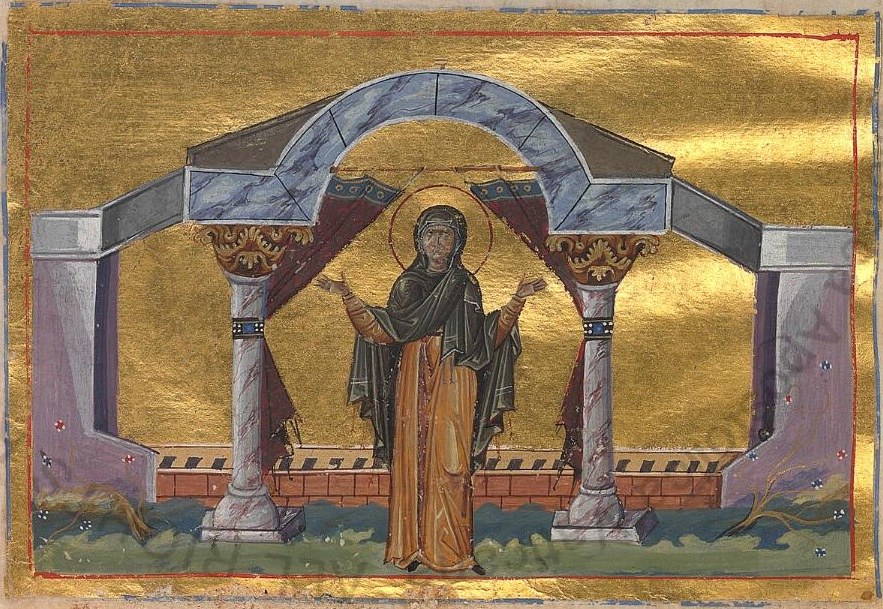
Mariamne is depicted as a holy woman in the modest robe and veil (maphorion) of the apostolic age, often holding a cross as the sign of her confession, and in the narrative programs of the Acts of Philip she appears at the side of the Apostles Philip and Bartholomew — present at the crucifixion of her brother at Hierapolis, or preaching among the newly baptised. The stored image is the miniature of the Menologion of Basil II (Constantinople, 985), a portrait of Mariamne alone: the holy woman stands orans beneath a marble arch, veiled in the dark maphorion over an ochre tunic — the manuscript's single-figure image for her February commemoration.
Disputed questions
- Mariamne and the "Mary" of the apocryphal literature. The name Mariamne is a form of Mary/Miriam, and in certain apocryphal and gnostic-tending writings a "Mariamne" appears who has sometimes been identified with Mary Magdalene or made a figure of esoteric teaching. The Orthodox tradition keeps Mariamne strictly as the sister of the Apostle Philip and his companion in mission, and does not confuse her with the Magdalene or with any other of the myrrh-bearing Marys; her memory rests on the tradition of Philip's apostolate, not on the speculative texts that borrow her name.
- The apocryphal Acts of Philip. Much of the colour of the Hierapolis mission — the serpent-cult, the wonders, the crucifixion head-downward — comes from the Acts of Philip, a work of varying and legendary value. The Church's commemoration affirms the person of Mariamne and her share in Philip's labours and holy repose; the narrative details are received as tradition, with the reserve their source requires.