
Philip the Apostle
The Holy and All-praised Apostle Philip, of the Twelve
Apostle · b. Bethsaida of Galilee, 1st century — d. c. 80, at Hierapolis in Phrygia — by crucifixion
Commemorated 30 June — Synaxis of the Holy, Glorious and All-praised Twelve Apostles, 14 November — Martyrdom at Hierapolis; the eve of the Nativity Fast
Philip, of the city of Bethsaida in Galilee, is one of the Twelve Apostles — the third called by Christ, who found him the day after Andrew and Peter and said to him simply, "Follow me" (John 1:43). It was Philip who then found Nathanael and answered his doubt with the words that have become the watchword of Christian enquiry, "Come and see." The Fourth Gospel gives him three further scenes found nowhere else: the feeding of the five thousand, where Christ tests him; the Greeks at the Passover who tell him, "Sir, we would see Jesus"; and the request at the Mystical Supper, "Lord, show us the Father," which drew from Christ the revelation, "He that hath seen me hath seen the Father." After Pentecost the tradition sends him to preach through Asia Minor — in Phrygia, at Hierapolis, with the Apostle Bartholomew and his own sister Mariamne — where he was martyred by crucifixion, hung head downward. He is commemorated on November 14, the eve of the Nativity Fast, and again with the Twelve on June 30. He is to be distinguished from Philip the Deacon, of the Seventy (October 11).

Origins and early life
Philip was of Bethsaida, the fishing town on the north shore of the Sea of Galilee, "the city of Andrew and Peter" (John 1:44). His name is Greek — "lover of horses" — as were the names of a number of Galileans of the period, and the Gospel of John shows Greek-speakers approaching Christ through him (see below), which the tradition has taken as a mark of his ease in that world. Beyond his townsmen the Fourth Gospel tells nothing of his family; but the ancient witness of Asia Minor, transmitted by Papias and by Polycrates of Ephesus and preserved in Eusebius, knew of a Philip "of the Apostles" who ended his days at Hierapolis with daughters who had grown old in virginity — a memory the Byzantine tradition attaches rather to his sister Mariamne, and which is entangled with the namesake deacon (see Disputed questions).
The calling and "Come and see"
Philip is the first person in the Gospels whom Christ calls with the bare command that would afterwards define discipleship. On the day after the Baptist had pointed out the Lamb of God and Andrew had brought his brother Simon, "Jesus would go forth into Galilee, and findeth Philip, and saith unto him, Follow me" (John 1:43). The initiative is wholly Christ's: where Andrew and Peter were drawn by the Forerunner's testimony, Philip is sought out and found by the Lord himself.
His first act as a disciple is to do for another what has just been done for him. "Philip findeth Nathanael, and saith unto him, We have found him, of whom Moses in the law, and the prophets, did write, Jesus of Nazareth, the son of Joseph." When Nathanael objects, "Can there any good thing come out of Nazareth?" Philip does not argue but invites: "Come and see" (John 1:45–46). The tradition treasures the phrase as the whole method of the Gospel — not demonstration but encounter — and the hymns of his feast return to it, hailing him as the one who "leads to the light of knowledge" those sitting in darkness. From the beginning, then, Philip is drawn as the apostle who brings others to Christ.
The three scenes in John
The Fourth Gospel, alone among the four, gives Philip a speaking part in three later episodes, and each shows him being led from a literal or earthbound reckoning to a higher understanding.
At the feeding of the five thousand, Christ turns to Philip and asks, "Whence shall we buy bread, that these may eat?" — and the Evangelist adds, "this he said to prove him: for he himself knew what he would do." Philip answers by counting the cost: "Two hundred pennyworth of bread is not sufficient for them, that every one of them may take a little" (John 6:5–7). His arithmetic is exact and beside the point; the sign that follows corrects it.
At the last Passover, "certain Greeks" who had come up to worship at the feast approach Philip with the request that has echoed down the centuries as the petition of every seeker: "Sir, we would see Jesus." Philip tells Andrew, and together they bring the request to Christ, who answers with the word about the grain of wheat that must fall into the ground and die (John 12:20–24). That these God-fearing Greeks come to Christ through Philip has been read since antiquity as a foreshadowing of his own apostolate to the Greek-speaking nations.
At the Mystical Supper, when Christ has said, "If ye had known me, ye should have known my Father also," it is Philip who voices the longing of them all: "Lord, shew us the Father, and it sufficeth us." The answer is one of the summits of the Gospel: "Have I been so long time with you, and yet hast thou not known me, Philip? he that hath seen me hath seen the Father; and how sayest thou then, Shew us the Father? Believe me that I am in the Father, and the Father in me" (John 14:8–11). The kontakion of the feast is built upon this scene: because Philip's question drew forth the confession of the Father's presence in the Son, the Church hymns him as "the God-proclaiming Philip," who "declared thee to be God unto the whole world."
He is named, finally, in the list of the Eleven who "continued with one accord in prayer" in the upper room after the Ascension (Acts 1:13), and so among those who received the Spirit at Pentecost.
The mission in Asia Minor
Beyond the New Testament, the received tradition — carried by the synaxaria and the apocryphal Acts of Philip — sends the Apostle to preach through the lands of Asia Minor: in Galilee first, then in Greece, Parthia, Azotus, and above all in Phrygia. His companions in the labour are the Apostle Bartholomew (commemorated June 11 and August 25) and Philip's own sister Mariamne, a virgin who travelled with the two apostles, tended them, and shared their preaching. The accounts are rich in the marvels of missionary legend — the healing of a ruler's blind and ailing kin, the confounding of a great serpent venerated by the pagans of Hierapolis, the conversion of the wife of the city's proconsul — but their fixed and sober core is the place of his death: Hierapolis in Phrygia, the city above the white terraces of Pamukkale, where a Christian community of apostolic antiquity is attested and where Philip was honoured as its founding apostle from the earliest times.
Martyrdom or repose
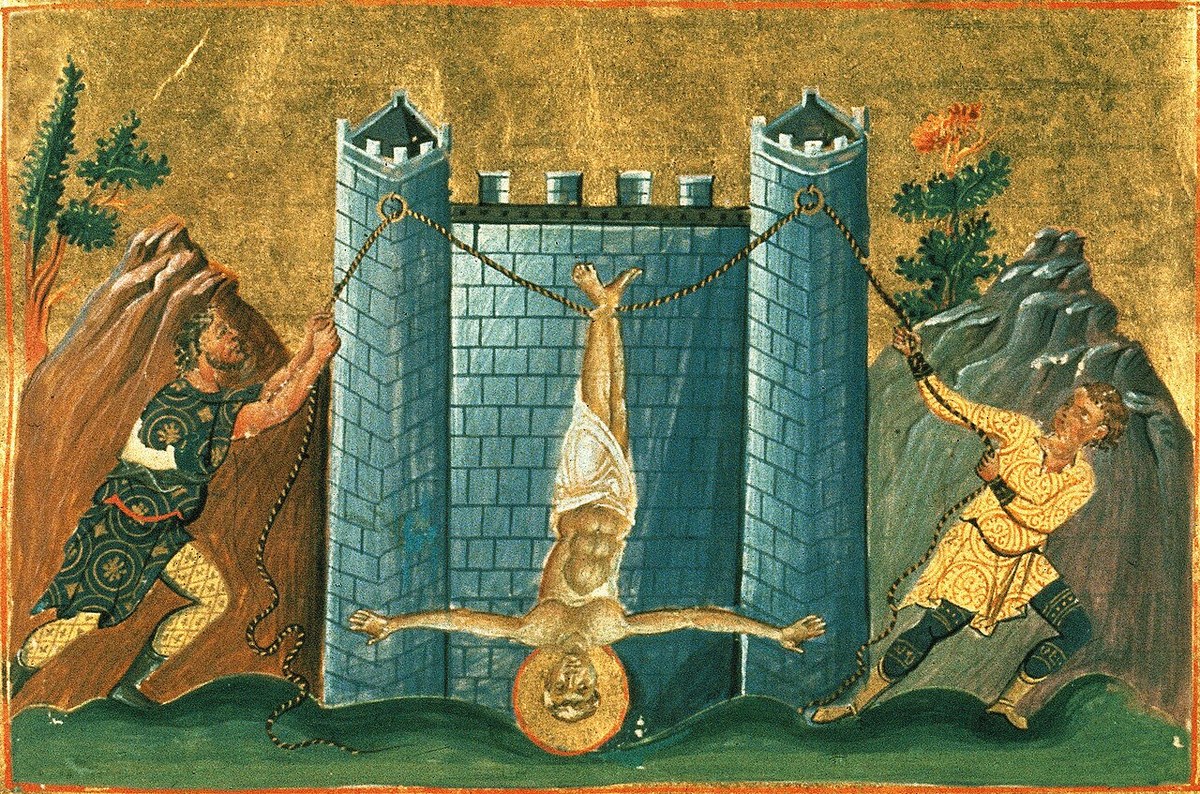
At Hierapolis, the tradition relates, the apostles' preaching and the overthrow of the serpent-cult roused the authorities, who seized Philip and Bartholomew and condemned them to death. Philip was crucified — the synaxarion and the hymnography agree that he was hung upon the cross head downward, in imitation, like Peter, of a death he counted himself unworthy to share with his Master in the same posture. An earthquake is said to have shaken the city during the execution; at the prayers of Philip, dying, Bartholomew was taken down alive and released, while Philip gave up his spirit upon the cross. The kontakion names him "the imitator of thy Passion," and the whole service reads his crucifixion as the seal of a life spent proclaiming the crucified God. No year is fixed by the sources; the tradition places his martyrdom in old age, in the reign of Domitian (81–96), so about the year 80 and after.
Relics and later cultus
Hierapolis kept the Apostle's memory as its own from antiquity: Polycrates of Ephesus, writing to Rome about the year 190, numbers "Philip, one of the twelve apostles," among the "great luminaries" fallen asleep in Asia, buried at Hierapolis. A martyrium church was raised on the hill above the city in his honour. In 2011 archaeologists working at Hierapolis identified the foundations of a first-century tomb beneath the Byzantine martyrium as the apostle's traditional grave — a discovery that, whatever its final assessment, confirms the antiquity and the tenacity of the local cult. Relics venerated as Philip's were later carried westward and are honoured, with those of the Apostle James, in the Roman basilica of the Holy Apostles, whence the Western calendar keeps the two together (see Disputed questions).
Feast and commemoration
November 14 (church date; Old Calendar civil November 27) is the Apostle's principal feast throughout the Byzantine rite — Greek, Slavic, and Antiochian alike — with a full proper service in the Menaion. It falls, by an appointment the Church has treasured, on the last day before the Nativity Fast, which opens on November 15 and runs forty days to the Nativity of Christ; because it begins the morrow of the Apostle's feast, that fast is popularly called "Philip's Fast" (the Philippian fast, ἡ νηστεία τῶν Χριστουγέννων / Филиппов пост), and in the traditional reckoning its first evening — "Philip's Eve" — is kept on this day. The Apostle is commemorated a second time, with all his fellows, at the Synaxis of the Holy, Glorious and All-praised Twelve Apostles on June 30.
Hymns
Troparion — Tone 3
O holy Apostle Philip, intercede with the merciful God, that He may grant unto our souls the forgiveness of offences.
Original translation from the Greek
Kontakion — Tone 8
Thy disciple and friend, and imitator of thy Passion, the God-proclaiming Philip, preached thee as God unto the whole world. By his supplications, and through the Theotokos, preserve thy Church and every city from lawless enemies, O most merciful One.
Original translation from the Greek
Appointed readings
Epistle — 1 Corinthians 4:9–16
9For I think that God hath set forth us the apostles last, as it were appointed to death: for we are made a spectacle unto the world, and to angels, and to men. 10We are fools for Christ’s sake, but ye are wise in Christ; we are weak, but ye are strong; ye are honourable, but we are despised. 11Even unto this present hour we both hunger, and thirst, and are naked, and are buffeted, and have no certain dwellingplace; 12And labour, working with our own hands: being reviled, we bless; being persecuted, we suffer it: 13Being defamed, we intreat: we are made as the filth of the world, and are the offscouring of all things unto this day. 14I write not these things to shame you, but as my beloved sons I warn you. 15For though ye have ten thousand instructers in Christ, yet have ye not many fathers: for in Christ Jesus I have begotten you through the gospel. 16Wherefore I beseech you, be ye followers of me.
Gospel — John 1:43–51
43The day following Jesus would go forth into Galilee, and findeth Philip, and saith unto him, Follow me. 44Now Philip was of Bethsaida, the city of Andrew and Peter. 45Philip findeth Nathanael, and saith unto him, We have found him, of whom Moses in the law, and the prophets, did write, Jesus of Nazareth, the son of Joseph. 46And Nathanael said unto him, Can there any good thing come out of Nazareth? Philip saith unto him, Come and see. 47Jesus saw Nathanael coming to him, and saith of him, Behold an Israelite indeed, in whom is no guile! 48Nathanael saith unto him, Whence knowest thou me? Jesus answered and said unto him, Before that Philip called thee, when thou wast under the fig tree, I saw thee. 49Nathanael answered and saith unto him, Rabbi, thou art the Son of God; thou art the King of Israel. 50Jesus answered and said unto him, Because I said unto thee, I saw thee under the fig tree, believest thou? thou shalt see greater things than these. 51And he saith unto him, Verily, verily, I say unto you, Hereafter ye shall see heaven open, and the angels of God ascending and descending upon the Son of man.
Iconography
Philip is one of the more distinctly drawn of the Twelve: a young apostle, beardless or only lightly bearded, with a full head of hair, holding a scroll or the Gospel book, and — in the developed Byzantine type — a slender cross or cross-staff, the instrument of his martyrdom. In the apostle tiers of an iconostasis and in Deesis rows he stands among the Twelve so marked; narrative cycles show his crucifixion head downward at Hierapolis, often paired with Bartholomew.
The stored primary image is the miniature for November 14 in the Menologion of Basil II (Constantinople, c. 1000; Vat. gr. 1613, fol. 182, by the painter Nestor): the Apostle bound upon a tall cross and raised inverted, head toward the ground, while executioners at either side complete the work — the crucifixion "head downward" of the received tradition.
The first stored variant is an eighteenth-century Russian icon from the iconostasis of the Dormition Church at Kondopoga in Karelia, showing the Apostle standing full-length, in tunic and himation, holding an open Gospel; the identifying inscription and the open book fix the identity.
The second variant is a central-Russian icon of the later eighteenth century depicting the joint martyrdom of the Apostles Bartholomew and Philip — the two companions of the Hierapolis mission crucified together — a rare narrative type that gathers the tradition of their shared end into one frame.
Disputed questions
- Not to be confused with Philip the Deacon, the evangelist of Caesarea, one of the Seven and of the Seventy (commemorated October 11). The confusion is ancient and, in part, irreducible: already in the second century Papias and Polycrates of Ephesus speak of a Philip "the apostle" buried at Hierapolis with virgin daughters who prophesied, while Acts 21:8–9 ties four prophesying virgin daughters to Philip the evangelist of Caesarea; Eusebius, quoting both witnesses, conflates the two men. The Byzantine calendars keep them cleanly apart — the Apostle of the Twelve on November 14, the deacon of the Seventy on October 11 — but the Hierapolis traditions of daughters (or, in the Byzantine telling, a sister, Mariamne) cannot now be fully disentangled from those of the deacon. This entry follows the calendar's division and treats the Hierapolis martyrdom as the Apostle's.
- Philip and James in the West. The Roman calendar, following the Western identification of James the son of Alphaeus with James "the Less," keeps Philip together with that James on a single feast (long May 1, now May 3), and venerates relics of both in the basilica of the Holy Apostles at Rome. The Orthodox calendars know nothing of this pairing and keep Philip's feast on November 14. See James son of Alphaeus.
- Not to be confused, further, with the sixteenth-century Russian hierarch-martyr Philip of Moscow, Metropolitan of Moscow and All Russia (†1569, kept January 9) — a saint of a wholly different age and order who shares only the English name.
- The Hierapolis tomb. The 2011 identification of a first-century tomb beneath the Byzantine martyrium at Hierapolis as the Apostle's grave is reported here as it stands — a striking confirmation of the antiquity of the cult, not a settled proof of the relics' identity.