
Mary and Martha, Sisters of Lazarus
The Holy and Righteous Myrrhbearers Mary and Martha of Bethany, the Sisters of Saint Lazarus
Righteous · Myrrhbearer · d. 1st century
Commemorated 4 June — Fixed commemoration of the two sisters in the Greek and Russian synaxaria, Pascha offset 14
Mary and Martha of Bethany are the sisters of Lazarus the Four-Days-Dead and, with him, the household in which the Lord was most at home. The Gospels give them to the Church in three scenes: Martha serving and Mary sitting at the Lord's feet (Luke 10:38–42); the two sisters meeting Jesus outside their brother's tomb, where Martha makes the confession "I believe that thou art the Christ, the Son of God" and hears the words "I am the resurrection and the life" (John 11); and the supper six days before the Passover, at which Mary anointed the Lord's feet with the pound of costly spikenard and wiped them with her hair (John 12:1–8). They believed in Christ before the raising of their brother, followed him to the tomb with the myrrhbearing women, and — after the martyrdom of Stephen drove Lazarus from Jerusalem — shared his exile and his preaching. The Church remembers them on the movable Sunday of the Myrrhbearers and, as a fixed commemoration, on June 4.

The household at Bethany
Bethany lay some fifteen stadia from Jerusalem on the eastern slope of the Mount of Olives, and in it was the house of Lazarus and his two sisters. The evangelist John, who alone names the family, states the fact that governs everything else said of them: "Now Jesus loved Martha, and her sister, and Lazarus" (John 11:5). It is the only place in the Gospels where the Lord's love is declared for a named household, and the Church has always read the Bethany narratives in that light: this was the house where, in the phrase of the Greek synaxaristes, he "enjoyed so much holy quiet in the days before his Passion."
Martha appears throughout as the elder and as the mistress of the house — it is "her house" that receives him (Luke 10:38), she who serves at table both in Luke and at the later supper in John, she who goes out first to meet him on the road. Mary is the sister of the one thing needful: she sits at his feet and hears his word, and when Martha, "cumbered about much serving," asks the Lord to send her sister to help, she receives the answer the whole ascetic tradition of the East has turned over ever since — "Martha, Martha, thou art anxious and troubled about many things; but Mary has chosen the good portion, which shall not be taken away from her" (Luke 10:41–42).
The Fathers are careful not to let this become a rebuke of Martha or a licence for idleness. Martha's service is not condemned; what is corrected is anxiety and the impulse to draw another out of prayer. The two sisters are read as the two lives, the active and the contemplative, in one household and one obedience — and the Church, by commemorating them together on a single day and in a single hymn, refuses to separate them.
At the tomb of their brother
When Lazarus fell sick the sisters sent to Jesus the shortest and most confident message in the Gospels: "Lord, behold, he whom thou lovest is sick" (John 11:3). The Lord remained where he was two days, and Lazarus died; and when he came to Bethany the brother had lain four days in the grave. Martha, hearing that he was near, went out to meet him and spoke the words that are at once reproach, faith and hope: "Lord, if thou hadst been here, my brother would not have died. But even now I know that whatsoever thou shalt ask of God, God will give thee." To her the Lord said, "I am the resurrection and the life: he that believeth in me, though he were dead, yet shall he live"; and asked whether she believed it. Her answer — "Yea, Lord: I believe that thou art the Christ, the Son of God, which should come into the world" — stands in the Gospel of John as the counterpart of Peter's confession in the Synoptics, and is spoken by a woman, before the tomb, in the teeth of death.
Mary came after, fell at his feet, and said the same first words; and it was at her weeping and that of the Jews with her that Jesus groaned in the spirit, was troubled, and wept. Martha it is, too, who makes the blunt objection when the stone is to be taken away — "Lord, by this time he stinketh, for he hath been dead four days" — a sentence the Church treasures, because it is her frankness that establishes the reality of the corruption and therefore the greatness of the sign.
The anointing at Bethany
Six days before the Passover, at the supper in Bethany, "Martha served" and Mary took a pound of ointment of spikenard, very costly, anointed the Lord's feet and wiped them with her hair, so that the house was filled with the fragrance; and when Judas objected at the waste, the Lord said, "Let her alone: against the day of my burying hath she kept this" (John 12:1–8). The Greek office of the sisters makes this the ground of their title myrrhbearers: Mary poured out the myrrh upon the living Christ before his burial as the women afterwards carried it to his tomb. The synaxaria, following the same logic, count both sisters among the women who came with spices to the sepulchre and heard the angel, and it is for this that their common commemoration falls on the Sunday of the Myrrhbearers.
After Pentecost
Of what followed the tradition is brief and consistent. The sisters were members of the Jerusalem community; and when the killing of the archdeacon Stephen unleashed the persecution that scattered the church, and Lazarus was cast out of Jerusalem, Mary and Martha went with their brother and assisted him in the preaching of the Gospel in the lands to which he came — in the Cypriot tradition, to Kition, where Lazarus was bishop thirty years. Both sisters, the Greek synaxaristes observes, were granted to die in peace and not under persecution, "for the Lord did not wish to let those hearts suffer under whose roof he had enjoyed such holy calm on the eve of his Passion."
Feast and commemoration
June 4 (church date; New Calendar civil June 4, Old Calendar civil June 17) is their fixed commemoration, kept in the Greek and Russian synaxaria after that of Saint Metrophanes of Constantinople. Their principal commemoration is movable: the Sunday of the Myrrhbearers, the third Sunday of Pascha (14 days after Pascha), on which the whole company of the women, with Joseph and Nicodemus, is honoured. Because that Sunday floats with Pascha it belongs to the movable calendar and not to any fixed day, and the fixed June 4 entry carries the primary rank for the purposes of this collection's index while the movable rule is recorded alongside it.
Their brother's feasts are October 17 (the translation of his relics to Constantinople), May 4 (the dedication of his church there), and the movable Lazarus Saturday. The Greek synaxarion prefaces the sisters' notice with two verses:
The sisters of Lazarus, out of Bethany — believe that even in death they have power to save.
On the fourth, Martha and Mary went to the shining vault of heaven.
Hymns
Troparion — Tone 4 (common of righteous women)
Ye ministered without blame unto the Saviour, O holy sisters of Lazarus: thou, O honoured Martha, in the service of thy hands, and thou, O all-modest Mary, in the hearing of his word and in the myrrh poured out for his burial. Wherefore, having learned of his Resurrection with the myrrhbearing women, ye were filled with the light of God: entreat him that our souls may be saved.
Original translation from the Greek
Iconography
Mary and Martha are almost always shown in narrative rather than alone. In the great feast icon of the Raising of Lazarus — one of the fixed compositions of the Byzantine repertory — they are the two women prostrate at the Saviour's feet in the foreground, in maphorion and tunic, their hands sometimes veiled, sometimes lifted toward the risen brother who stands bound in his grave-bands at the mouth of the tomb while a youth unwinds them; the apostles stand behind Christ, the Jews with the stone at the right. In the icon of the Myrrhbearing Women they may be numbered among the women at the sepulchre. Mary appears again in the Supper at Bethany, kneeling at the Lord's feet with the alabaster flask, Martha serving at the table; and in the Luke 10 scene the pair are contrasted directly, Mary seated at the Lord's feet and Martha standing with a dish.
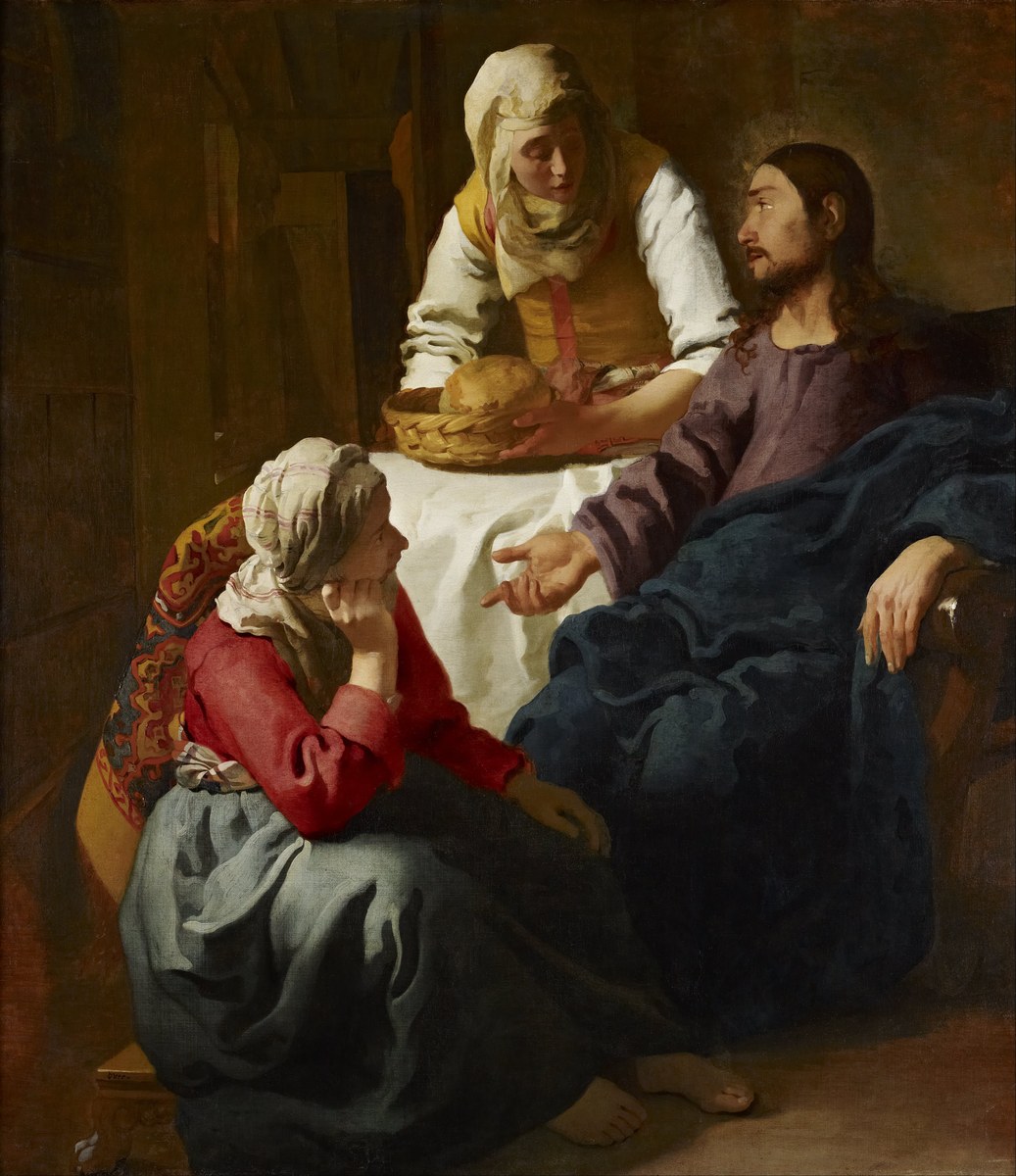
Where they are painted alone as a diptych of saints, they are two mature women in tunic and maphorion, holding crosses or, for Mary, the myrrh-vessel of the myrrhbearers. No pre-1900 icon of the two sisters alone has been located for this collection; the eastern pictorial tradition places them in the Lazarus and Myrrhbearer compositions instead. Modern Greek panels of "the sisters of Lazarus," painted for their June 4 feast, exist but are the copyright of living iconographers and are not stored here. The stored image is therefore a Western work per §34, and a great one: Vermeer's Christ in the House of Martha and Mary (1654–1655, National Gallery of Scotland), the one Gospel scene that belongs to the two sisters alone — Martha setting the bread on the table, Mary at the Lord's feet, and Christ between them speaking the word the Church reads on their feast. An Orthodox icon of the pair remains the true want and is listed among the upgrade-wanted icons.
Disputed questions
- Mary of Bethany and Mary Magdalene. Western tradition from the sixth century onward identified Mary of Bethany with Mary Magdalene and with the sinful woman of Luke 7, and read the three as one penitent. The Orthodox Church has never made that identification: Mary Magdalene is commemorated on July 22 as the myrrhbearer out of whom seven demons were cast, the sinful woman of Luke 7 is anonymous, and Mary of Bethany is the sister of Lazarus and Martha. That the two anointings resemble one another is a problem of Gospel harmony, not evidence of one woman: the Byzantine tradition keeps them distinct and the June 4 commemoration presupposes the distinction.
- The Provençal legend. Medieval Western hagiography carried Lazarus, Martha and Mary Magdalene by sea to Gaul and made Martha the dragon-taming apostle of Tarascon. The Orthodox tradition knows nothing of it; the legend is traced to an eleventh-century conflation, and the eastern accounts keep the sisters with their brother in Cyprus. The point is discussed further in the entry for Lazarus.
- A fixed day and a movable day. Their principal commemoration in practice is the Sunday of the Myrrhbearers, the third Sunday of Pascha — a movable feast, which therefore has no place in a fixed calendar day. That the two sisters also have a fixed synaxarion memory on June 4 is sometimes doubted; it is however well attested. The Greek Synaxaristes and the Menaion give them under June 4 with their own distichs, the Constantinopolitan reading of the day is headed "Metrophanes, archbishop of Constantinople; Martha and Mary, the sisters of Lazarus," and the Russian Lives keep the same day. The two commemorations are recorded here separately and neither is allowed to absorb the other.
- Which sister is elder. The Greek accounts make Martha the elder, on the ground that the house is called hers and that she directs the serving; the Gospels do not say so explicitly, and Luke's "a certain woman named Martha received him into her house, and she had a sister called Mary" is the whole of the evidence.