
Lazarus of the Four Days
The Holy and Righteous Lazarus of the Four Days, the Friend of Christ, Bishop of Kition
Righteous · Bishop · d. c. 63
Commemorated 4 May — Dedication of the church of St Lazarus at Constantinople by Leo VI (912), with the translation of the relics of Mary Magdalene, 17 October — Translation of his relics from Kition in Cyprus to Constantinople (898), Pascha offset 8
Lazarus of Bethany, "the Four-Days-Dead" (ὁ τετραήμερος) and "the friend of Christ," is the man whom the Lord raised from the tomb four days after his death (John 11) — the last and greatest sign before the Passion, and the Church's pledge of the general resurrection. Brother of Martha and Mary, he afterwards fled the plots of the high priests, was made first bishop of Kition in Cyprus by the apostles, shepherded that church some thirty years, and reposed in peace about the year 63. His principal feast is the movable Lazarus Saturday, the eve of Palm Sunday; October 17 commemorates the translation of his relics from Kition to Constantinople by the emperor Leo VI the Wise in 898.
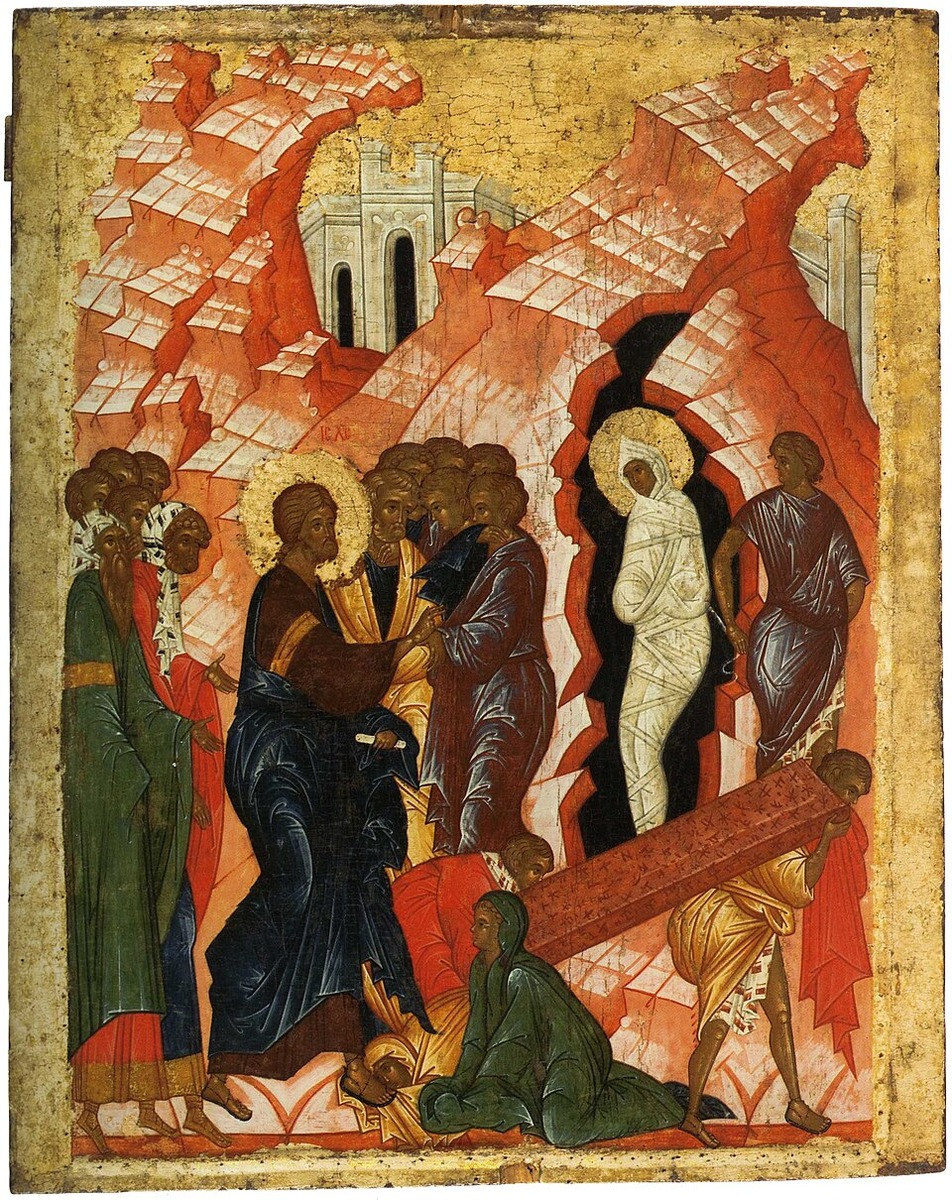

The friend of Christ at Bethany
Lazarus (the Greek form of Eleazar, "God has helped") lived with his sisters Martha and Mary — who are themselves saints of the calendar, commemorated on June 4 and on the Sunday of the Myrrhbearers — in Bethany, a village on the eastern slope of the Mount of Olives, "about fifteen furlongs" from Jerusalem (John 11:18). Their house was one of the few places on earth where the Lord was simply at home: Luke records Martha serving and Mary at his feet (Luke 10:38–42), and John introduces the family with the assumption that the reader knows them — "Now a certain man was sick, named Lazarus, of Bethany, the town of Mary and her sister Martha." The sisters' message to Jesus is the shortest and most confident prayer in the Gospels: "Lord, behold, he whom thou lovest is sick" (John 11:3). The Lord's affection for this household is stated three times in a chapter — "Now Jesus loved Martha, and her sister, and Lazarus" — and it is from his own lips that the Church takes the saint's abiding title: "Our friend Lazarus sleepeth; but I go, that I may awake him out of sleep" (John 11:11).
The raising of the four-days-dead
The eleventh chapter of John, read entire at the Liturgy of Lazarus Saturday, tells the story on which the whole cultus rests. Jesus, beyond Jordan when the message came, abode still two days where he was — so that, as the Fathers observe, no one could say the death was a swoon — and came to Bethany when Lazarus had lain in the grave four days already. Martha met him with the double confession that the Church sings in her name: "Lord, if thou hadst been here, my brother had not died. But I know, that even now, whatsoever thou wilt ask of God, God will give it thee"; and drew from him the word that stands over every Christian grave: "I am the resurrection, and the life: he that believeth in me, though he were dead, yet shall he live" (John 11:21–25). At the tomb — a cave, a stone upon it — the evangelist records the two shortest and deepest verses of the Gospel: "Jesus wept," the tears of a true man over his friend; and then the command of true God, "with a loud voice, Lazarus, come forth." "And he that was dead came forth, bound hand and foot with graveclothes: and his face was bound about with a napkin. Jesus saith unto them, Loose him, and let him go" (John 11:43–44). By the fourth day, as Martha's frankness attests ("Lord, by this time he stinketh"), corruption had begun; the sign was therefore not resuscitation at the edge of death, as with Jairus's daughter or the widow's son at Nain, but resurrection out of manifest corruption — the reason the tradition never names him without the epithet "of the four days."
The consequences fill the next chapter. Many of the Jews who had come to mourn believed; the chief priests and Pharisees, from that day forth, took counsel to put Jesus to death (John 11:45–53). Six days before the Passover, at the supper in Bethany where Martha served and Mary anointed the Lord's feet, "much people of the Jews" came "not for Jesus' sake only, but that they might see Lazarus also, whom he had raised from the dead" — and the chief priests consulted "that they might put Lazarus also to death; because that by reason of him many of the Jews went away, and believed on Jesus" (John 12:1–11). The crowd that met the Lord with palms on the next day did so, John says expressly, because it had heard of this sign (John 12:17–18): in the Church's liturgical memory the raising of Lazarus and the Entry into Jerusalem are one two-day feast, the "assurance of the general resurrection" given before the Passion.
Bishop of Kition in Cyprus
Of Lazarus's later life the New Testament says nothing, and the void was filled by a firm and ancient Cypriot tradition, received by the Byzantine synaxaria. Marked for death by the priestly party, Lazarus left Judaea — the persecution that arose after Stephen's stoning is the setting usually supplied — and came to Cyprus. There, when Paul and Barnabas passed through the island (Acts 13), they ordained him bishop of Kition (Kiteia, the modern Larnaca), about the year 45. He shepherded that church for some thirty years, spreading the faith of Christ, and reposed in peace about the year 63, some thirty years after the raising — dying, as every man dies, a second time, and buried at Kition.
Around the silent decades Cypriot piety preserved a handful of traditions of great tenderness. It was said that in all the years after his four days in Hades, Lazarus was never seen to laugh save once — when, watching a man steal a clay pot, he smiled and said, "the clay steals the clay"; the memory of what he had seen among the dead kept his gravity to the end. It was said too that he was one of those the Mother of God visited: the tradition of the Church of Cyprus holds that the Theotokos, with John, sailed to see Lazarus (the storm-driven landing at Athos belongs to the same voyage-cycle of traditions), and that she gave the bishop of Kition an omophorion woven by her own hands. However these accounts be weighed, the fact they adorn — an apostolic-age bishopric of Lazarus at Kition — was never doubted in the island, and his second tomb was shown there.
The discovery and translation of the relics
In 890, in the reign of Leo VI the Wise, a marble sarcophagus was found at Kition (Larnaca) bearing the inscription that has become the saint's liturgical style: "Lazarus the four-days-dead, the friend of Christ" (Λάζαρος ὁ τετραήμερος καὶ φίλος τοῦ Χριστοῦ). In 898 the emperor had the relics translated by sea to Constantinople, where they were laid in a church of Saint Lazarus which Leo built for them; the Synaxarion of Constantinople keeps on October 17 both the translation (ἀνακομιδή) and the deposition (κατάθεσις) of the relic, with a pair of verses that catch the capital's sense of the event — the City, lifting her gates to the friend of Christ, says in imitation of Christ, "Lazarus, come hither!"; and, "New Rome, hiding the corpse of Lazarus, is shown to be among us another Bethany." In recompense to the despoiled see, Leo sent craftsmen and money to Larnaca, and there rose over the emptied tomb the great three-domed church of Saint Lazarus (Agios Lazaros) which, altered and restored, stands in Larnaca to this day — one of the notable surviving Byzantine churches of Cyprus.
The relics in Constantinople disappeared from history in the sack of the City by the Fourth Crusade (1204), into which most scholars trace the later Western relic-claims (Marseille among others). In Larnaca, in 1972, during restoration work in the church of Saint Lazarus, a marble sarcophagus was found under the altar containing human remains — venerated by the Church of Cyprus as a portion of the relics of the saint left behind (or restored) at the translation; a portion of these was solemnly given to the Russian Church in modern times. The skull of the saint is among the treasured relics claimed at Larnaca, and the tomb in the crypt bears still the inscribed style of the friend of Christ.
Feast and commemoration
Lazarus's principal celebration is movable: Lazarus Saturday, the Saturday before Palm Sunday (eight days before Pascha — rule 8 days before Pascha), when the whole service of the Church is given to the raising at Bethany as the "assurance of the general resurrection before thy Passion"; it is, with the Entry into Jerusalem which it opens, the joyous hinge between the Forty Days and Holy Week. Uniquely in the year, the Saturday Matins sings the resurrectional hymns of Sunday ("Having beheld the Resurrection of Christ…" and the evlogitaria), honouring the day as an image of the Lord's own rising.
The fixed calendar keeps, on October 17 (Old Calendar civil October 30), the translation of his relics to Constantinople in 898, together with the deposition in the church Leo VI built; the day is shared with the prophet Hosea, the venerable-martyr Andrew of Crete, and the unmercenaries Cosmas and Damian of Arabia. Because the principal feast is movable, this saint has no fixed feast of primary rank — the one fixed feast is the translation; the schema's expectation of exactly one fixed primary is met in his case by the movable rule, and this deviation is recorded deliberately rather than forcing a false primary onto the translation.
Hymns
Troparion
As a great treasure and wealth that none can steal, thou art come to us from Cyprus, O Lazarus, by the providence of the God of all and the command of a right-believing emperor, bestowing on those who honour thee the gift of healings, delivering from perils and from every harm them that cry to thee with faith: save us all by thy prayers, O Lazarus our father.
Original translation from the Slavonic
Kontakion
Like a most radiant star, thy precious relics have risen from Cyprus, O Lazarus, hallowing the Imperial City, gladdening the Christ-loving emperor and enriching his people, bestowing through thee the grace of healings on them that faithfully cry to thee: Rejoice, O Lazarus, friend of God.
Original translation from the Slavonic
Apolytikion
Giving us before thy Passion an assurance of the general resurrection, thou didst raise Lazarus from the dead, O Christ God; wherefore we also, like the children, bearing the tokens of victory, cry to thee, the vanquisher of death: Hosanna in the highest; blessed is he that cometh in the name of the Lord.
Iconography
The Raising of Lazarus is among the oldest fixed compositions of Christian art, painted in the catacombs from the third century (Christ with a wand before a tomb-aedicula, the mummy-bound figure upright in the door) and settled by the Byzantine centuries into the festal type stored here: Christ at the head of the apostles, Martha and Mary prostrate at his feet, the tomb in the rock at the right with Lazarus upright in his grave-bands, a bystander loosing him — and another pressing his cloak to his nose, the painters' unflinching witness to the four days. The scene stands in the festal tier of the iconostasis, first of the Passion sequence. Cypriot iconography also paints Lazarus as a bishop, vested with omophorion, grave of face (the tradition of his unlaughing gravity), often holding the Gospel; the church of Agios Lazaros in Larnaca preserves notable examples. The stored image is a fifteenth-century Novgorod-school festal icon of the Raising (Russian Museum, St. Petersburg).
Disputed questions
- The Western (Provençal) legend. Medieval Western tradition made Lazarus, with Mary Magdalene and Martha, sail to Gaul, and venerated him as first bishop of Marseille, martyred there; Autun cathedral claimed his body. Modern scholarship — Catholic included — traces the legend to an eleventh-century conflation, aided by confusion with the fifth-century bishop Lazarus of Aix. The Orthodox tradition knows only the Cypriot episcopate, and the two accounts are irreconcilable; the Western legend is recorded here as history of the cultus, not as a rival biography.
- Not to be confused with the eleventh-century stylite Lazarus of Mount Galesius (the Wonderworker of Galesion near Ephesus, †1053, commemorated November 7 and July 17), nor with Lazarus the Iconographer, the ninth-century confessor-painter of Constantinople (November 17). This entry is Lazarus of Bethany, the friend of Christ.
- The parable's Lazarus. The beggar Lazarus of the parable of the rich man (Luke 16:19–31) is a figure in a parable told by the Lord, not the man of Bethany, though the shared name — and the parable's closing word, "neither will they be persuaded, though one rose from the dead," so strikingly answered in John 11 — has intertwined them in art and popular devotion since antiquity.
- A second fixed commemoration (March 17). Some synaxarion witnesses and calendar traditions carry a memory of righteous Lazarus also on March 17. The live witnesses consulted for this entry (the OCA calendar and the received Greek Menaion service for March 17) do not list him on that day, so no feast entry is asserted here; the question is left to the author of March 17 to settle against the Synaxarion of Constantinople.
- Chronology. The dates c. 45 (ordination) and c. 63 (repose), and the "thirty years" they bracket, are the round numbers of the received tradition, not of documentary record; the discovery year 890 and translation year 898 rest on the Byzantine sources for Leo VI's reign and are stable in the tradition.