
Mary (called Marinos)
Our Venerable Mother Mary, who was called Marinos the Monk
Venerable · b. 5th century — d. 5th–6th century
Commemorated 12 February — Principal commemoration, with her father Eugene
Mary, called Marinos (fifth-to-sixth century), is the ascetic woman who lived out her whole monastic life disguised as a man, and bore in silence a slander that would have crushed a lesser soul. Left motherless, she would not be parted from her father Eugene when he resolved to become a monk; cutting her hair and putting on man's clothing, she entered the monastery with him as the young "monk Marinos," and so excelled in humility and obedience that none suspected her. Falsely accused by an innkeeper's daughter of having fathered her child, "Marinos" made no defence, accepted expulsion, and for years lived outside the gate, raising the child as her own. Restored at last to the monastery and set to the hardest labours, she bore all without complaint; only when she died was her secret revealed, to the confusion and repentance of her accusers. She is a beloved image of humility, patience, and unjust blame borne for Christ.

The daughter who followed her father
The saint was born in the Christian East — the tradition places her in Bithynia in Asia Minor, some accounts in the region of Egypt — in the later fifth century. Her mother died while she was young, and her father, Eugene, a devout man, resolved to withdraw from the world and enter a monastery. His only child, unwilling to be separated from him and set herself on the same life, begged to go with him; and so Eugene cut his daughter's hair, dressed her in man's clothing, and presented her at the monastery as his son, the young Marinos. The disguise was never penetrated. The girl grew to adulthood within the walls, and gave herself so wholly to the monastic virtues — humility, obedience, silence, unremitting labour — that "Marinos" was reckoned among the best of the brethren. When Eugene died, "Marinos" redoubled the ascetic struggle, and (the tradition says) received the gift of healing, casting out unclean spirits.
The false accusation
The monastery had need of supplies from abroad, and Marinos was among the monks sent with the ox-cart on the journey, lodging on the way at an inn. The innkeeper's daughter — who had in truth been seduced by a soldier lodging there, and was with child — cast her eye on the comely young "monk"; and when her advances were refused, she took her revenge, and when her pregnancy could no longer be hidden, named Marinos as the father of her child. The charge was brought to the abbot. Marinos, who could have ended the slander with a word, said nothing in defence but only "I have sinned; forgive me" — and accepted the shame. The saint was expelled from the monastery.
The blame borne, and the restoration
Marinos did not go away. For years the saint lived outside the monastery gate, in poverty and disgrace, an object of scorn; and when the innkeeper's daughter bore her son and, refusing to keep him, left the infant at the gate, Marinos took the child and raised him — begging milk from the shepherds, enduring the reproach of the sin "his" own weeping seemed to confess. After some years the brethren, moved by the saint's meekness under so long a punishment, prevailed upon the abbot to receive Marinos back — but to the hardest and most menial labours of the house, which the saint undertook with joy, together with the boy, who grew up in the monastery.
The revelation at death
Not long after the restoration, Marinos died. When the brethren came to prepare the body for burial, they discovered that the monk who had borne the name and the blame of a father was a woman — that "Marinos" was Mary. The abbot and the whole brotherhood were stricken with amazement and with grief for the injustice they had done her, and they honoured her body as that of a saint. The innkeeper and his daughter, hearing of it, were seized with terror; the daughter, tormented by a demon, was brought to the saint's tomb and there, confessing her lie, was healed. The boy Mary had raised remained in the monastery and lived out his days a monk in her memory. Her relics were later translated — to Constantinople, and (the Western tradition holds) afterward to Venice.
Feast and commemoration
Mary is kept on February 12 (church date; Old Calendar civil February 25), together with her father Eugene, who shares the commemoration of the day as the one who received the monastic life with her. The Greek and Slavic calendars keep her memory; she was widely venerated in the medieval West as well (under the name Marina), where her story entered the Golden Legend. The Menaion appoints the common office of a venerable woman ascetic.
Hymns
Troparion — Tone 8
In thee, O Mother, was the image of God preserved unshaken; for taking up the Cross, thou didst follow Christ, and by thy deeds thou hast taught us to despise the flesh, which passes away, but to care for the soul, a thing immortal. Wherefore thy spirit, O venerable Mary, rejoices with the angels.
Original translation from the Greek
Iconography
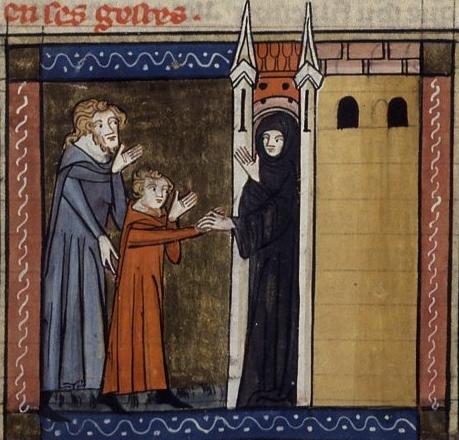
Mary/Marinos is depicted in two ways. Most often she appears as a beardless young monk in the dark habit and hood, indistinguishable from her brethren — sometimes shown holding a child, the infant she raised, which is her distinguishing attribute; in narrative cycles she is shown presented at the monastery by her father, accused before the abbot, and revealed at death. The stored image is a fourteenth-century miniature from a manuscript of the Golden Legend (the Legenda aurea in its French translation, illuminated in the workshop of Richard de Montbaston), depicting Saint Marina/Mary as the monk received into the monastery (source, public domain, pd-old-work).
Disputed questions
- Place and date. The sources differ over her homeland — Bithynia in Asia Minor, or Egypt near Alexandria — and over the exact century, the tradition ranging from the fifth into the sixth; the entry gives the range. The kernel of the story is constant in East and West.
- Not to be confused with Marina (Margaret) the Great-Martyr of Antioch in Pisidia (kept July 17), a wholly different saint of the pagan persecutions, nor with Mary of Egypt the penitent (Fifth Sunday of Lent / April 1), nor with the male martyrs Marinus of the calendar; this Mary is the woman who lived and died as the monk Marinos.