
Marina of Antioch
The Holy Great-martyr Marina of Antioch in Pisidia
Great Martyr · Virgin · d. c. 304
Commemorated 17 July — Martyrdom by beheading at Antioch in Pisidia
Marina — known in the West as Margaret — is the shepherd-girl of Antioch in Pisidia, daughter of a pagan priest, who was catechised in secret by her Christian nurse, disowned by her father, and about the year 304 put to death under the prefect Olybrius, whose offer of marriage she refused with the single sentence "I am a Christian." Her passion is one of the most crowded in the whole hagiographic record — rods, iron combs, torches, the cauldron, and above all her night in the prison, where the devil came at her as a dragon and she overcame him and then, in the most famous image in Eastern iconography, beat him about the head with a hammer. The East ranks her among the great-martyrs and has never allowed her cult to weaken; the Latin West, which loved her no less, nevertheless declared her Acts apocryphal. She is the patroness of those tormented by the spirits of malice and, in Serbian usage, is Ognjena Marija, "Fiery Mary."

Origins at Antioch in Pisidia
The Greek synaxaria place Marina's birth at Antioch in Pisidia, the inland Antioch of Asia Minor — the city of St Paul's first recorded synagogue sermon — and not the great Syrian Antioch on the Orontes with which Western writers frequently confused it. Her father is named Aedesius (Αἰδέσιος), a priest of the idols; her mother died within days of the birth, and the infant was given out to a Christian nurse who kept an estate some five or six miles from the city.
There, among the flocks she was set to watch, Marina was taught the faith. The synaxarion attributes her instruction to the nurse; other recensions bring in a wandering man of God who told her of the Incarnation and of the Virgin's conception of Christ. The effect was the same: before she was twelve she had renounced the gods of her father's temple, and by fifteen she had vowed her virginity to Christ and would not be moved from it. When she confessed her Christianity openly, Aedesius disowned her as no child of his; the nurse took her as a daughter, and the girl went on keeping the sheep.
Olybrius
The Acts make the encounter happen in the open country: Olybrius, prefect (ἔπαρχος) of the region, riding past, saw her at the flocks and was taken with her beauty. He proposed to make her his wife — the Greek life is careful to say he offered marriage, publicly, from the tribunal in the middle of the city, and not merely concubinage — and, when she would not answer to the name of any bride but Christ's, he first put her into the keeping of a noblewoman of rank in the hope that persuasion would do what he could not.
It did nothing. Marina met each approach with the same words, "I am a Christian," and the courtship turned into a trial. She was thrown on the ground and torn with rods until, in the words of the Greek notice, the earth was reddened with her blood; she was hung up and raked with iron combs or tridents; nails were driven into her; she was burned with torches. Between the sessions she was thrown back into the prison.
The night in the prison: the dragon and the hammer
It is the night in the cell, not the tribunal, that made Marina one of the most painted saints of the Christian East. The Acts relate that she prayed — with her arms crossed, the Coptic version specifies — and asked expressly that she might see, face to face, the enemy who was fighting against her, and that God would judge between them.
The prayer was answered. The devil came at her in the form of a serpent, a dragon, and swallowed her; but she prayed within him and made the sign of the Cross, and the dragon burst asunder and she stood free. Then she saw him a second time, crouched in the corner of the cell in his own shape — a black, horned, dwarfish thing — and here the story does what no other virgin-martyr's passion does: she went for him. Seeing a copper hammer lying on the prison floor, she seized it, took him by the horn, set her foot on his neck, and beat him about the head, saying, "Depart from me, thou lawless one." The roof of the cell opened, a light came down, and her wounds of the previous day were healed. A third assault followed, a subtler one: under cover of confessing his own crimes the devil tried to draw her into speech that would entangle her, and she ended it by signing him with the Cross, at which the earth swallowed him.
The next morning Olybrius began again. She was hung on a tree and scorched with fire, and then plunged into a great vessel of water — which the passion reads as her baptism: as she went under, a light shone about her and a white dove came down bearing a crown in its beak, and her bonds fell away. The crowd that had gathered to watch cried out that they were Christians. The prefect ordered them killed, and the Acts number the beheaded of that day, with Marina at their head, at fifteen thousand. She herself was beheaded, fifteen years old, about the year 304, in the persecution of Diocletian.
Relics and their dispersal
The tradition of her veneration is credited to a witness of her imprisonment and death, the notary Theotimos, who is said to have anointed the body and laid it first in the house of a devout senator's wife at Antioch; a stone tomb in a purpose-built martyrion followed, where the Liturgy was served on her feast every year. (Theotimos appears in the Latin passion and not in the Greek, which is one of the reasons the whole document has been questioned.)
From there the relics scattered as widely as the cult. One Greek line of transmission says they were kept at Constantinople until the sack of 1204 and carried off by the Latins; another says they remained at Antioch until 908 and were then taken to Italy. Both may be partially true of different portions, since the body was divided early. Today the principal Greek portion rests in the church of Agia Marina at the Theseion in Athens, and her hand is treasured at the Monastery of Vatopedi on Mount Athos. In the West her relics were claimed at Montefiascone, at Venice, and — the 1910 Catholic Encyclopedia lists them — at Rome, Brussels, Bruges, Paris, Froidmont and Troyes; a right hand venerated as hers is kept in Cairo, where the Coptic Church also honours her.
Veneration and later cultus
In the East her cult has never needed defending. She is a great-martyr (μεγαλομάρτυς) in the Greek books, ranked with George, Euphemia, Barbara and Irene; she is the patroness of Leros and of many villages and islands; her feast is one of the great village panegyria of the Greek summer. Because she overcame the devil in his own person while still in the body, she is invoked with peculiar confidence against demonic oppression and mental affliction, for the possessed and the disturbed, and at deathbeds, to drive the accusers away; already in the fourth century, on the witness of the Athonite proskynitaria, she was called a deliverer from unjust judgement and lawless sentences. Among the Serbs, July 17 is the day of Ognjena Marija, "Fiery Mary," paired in folk reckoning with the Prophet Elias two weeks later, and popular iconography shows her beating the demon with a club.
In the West she became Margarita — the pearl, a name given, it seems, for her beauty and nobility — and was one of the most universally kept saints of the Middle Ages. She was numbered among the Fourteen Holy Helpers; the Council of Oxford in 1222 made her feast general in England, where more than two hundred and fifty churches carry her name, St Margaret's, Westminster, among them; and because she came out of the dragon's belly unharmed she became the patroness of women in childbirth. Her Latin feast is 20 July.
Feast and commemoration
July 17 (church date; New Calendar civil July 17, Old Calendar civil July 30), and the principal feast of the day in every Orthodox jurisdiction. The day carries a full festal service with proper apolytikion, kontakion, oikos and canon; in Greek parish use the feast is often kept with a vigil and the Antiochian and Greek calendars appoint the readings of a woman martyr, Galatians 3:23–4:5 and Mark 5:24–34. The Latin Church keeps her, as Margaret, on 20 July; the Copts on 23 Epip. In Serbian usage the day is Ognjena Marija. Because the day falls in the open season between the Apostles' Fast and the Dormition Fast, only the ordinary weekly rule applies; Greek calendars note that oil and wine are permitted when the feast falls on a Wednesday or Friday.
Hymns
Apolytikion — Tone 5 (plagal of the first — *Τὸν συνάναρχον Λόγον*)
Betrothed unto the Word, O glorious Marina, thou didst forsake every tie to the things of earth, and didst contend in splendour as a comely virgin; for when the unseen enemy showed himself to thee, thou didst trample him down with steadfast heart, O bearer of the prize. And now thou pourest forth upon the world the gifts of healings.
Kontakion
Adorned with the loveliness of virginity, O virgin, thou wast crowned with crowns that fade not, O Marina; and reddened with the blood of thy martyrdom, thou wast made resplendent with the wonders of healings, and didst receive the prizes of victory, O martyr, from the hand of thy Creator.
Original translation from the Greek
Magnification
The shining lamp, and the treasury of virginity that no man could plunder, the bride of the Lord and spotless ewe-lamb, holy Marina, let us all honour with hymns.
Original translation
Appointed readings
Epistle — Galatians 3:23–4:5
23But before faith came, we were kept under the law, shut up unto the faith which should afterwards be revealed. 24Wherefore the law was our schoolmaster to bring us unto Christ, that we might be justified by faith. 25But after that faith is come, we are no longer under a schoolmaster. 26For ye are all the children of God by faith in Christ Jesus. 27For as many of you as have been baptized into Christ have put on Christ. 28There is neither Jew nor Greek, there is neither bond nor free, there is neither male nor female: for ye are all one in Christ Jesus. 29And if ye be Christ’s, then are ye Abraham’s seed, and heirs according to the promise. 1Now I say, That the heir, as long as he is a child, differeth nothing from a servant, though he be lord of all; 2But is under tutors and governors until the time appointed of the father. 3Even so we, when we were children, were in bondage under the elements of the world: 4But when the fulness of the time was come, God sent forth his Son, made of a woman, made under the law, 5To redeem them that were under the law, that we might receive the adoption of sons.
Gospel — Mark 5:24–34
24And Jesus went with him; and much people followed him, and thronged him. 25And a certain woman, which had an issue of blood twelve years, 26And had suffered many things of many physicians, and had spent all that she had, and was nothing bettered, but rather grew worse, 27When she had heard of Jesus, came in the press behind, and touched his garment. 28For she said, If I may touch but his clothes, I shall be whole. 29And straightway the fountain of her blood was dried up; and she felt in her body that she was healed of that plague. 30And Jesus, immediately knowing in himself that virtue had gone out of him, turned him about in the press, and said, Who touched my clothes? 31And his disciples said unto him, Thou seest the multitude thronging thee, and sayest thou, Who touched me? 32And he looked round about to see her that had done this thing. 33But the woman fearing and trembling, knowing what was done in her, came and fell down before him, and told him all the truth. 34And he said unto her, Daughter, thy faith hath made thee whole; go in peace, and be whole of thy plague.
Iconography
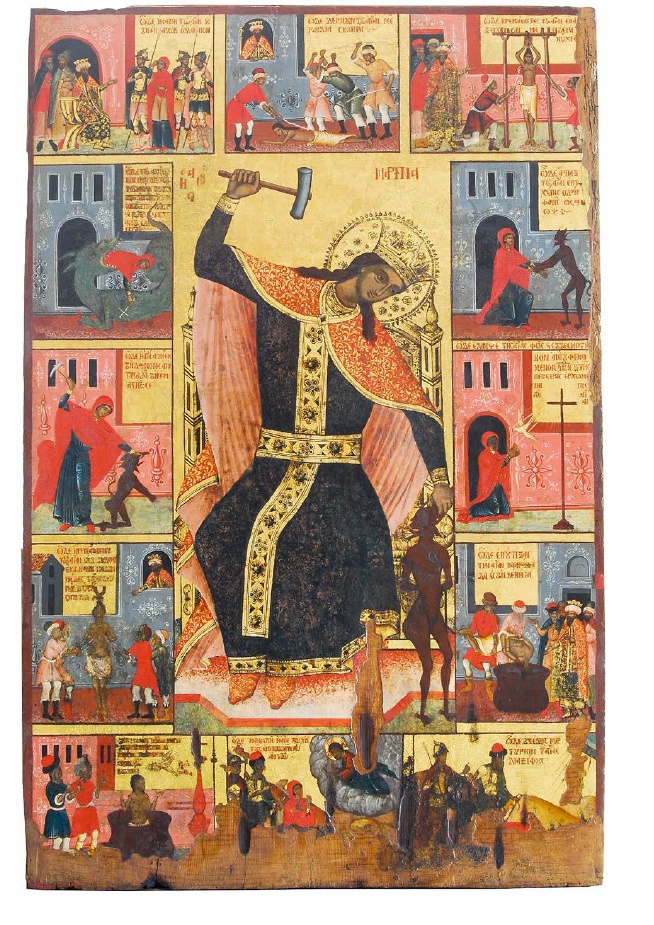
Marina's iconographic type is among the most immediately recognisable in the Orthodox world. She is painted as a young woman, beardless and slight, in a red maphorion or a jewelled maniakion and crown, holding the martyr's cross; and at her feet, or in her grip, is the devil — a small dark horned figure, seized by the hair or the horn with the left hand while the right is raised with a hammer or mallet. The dragon appears too, most often in a scene at the side rather than at her feet, since the Eastern tradition keeps the two encounters distinct: the serpent that swallowed her and burst, and the demon she thrashed. In the West she is instead shown leading a chained dragon, or as a shepherdess, or beside the great vessel of the cauldron. Because her combat is the model of every Christian's, she is a favourite subject for vita icons — a central standing figure ringed with the episodes of her passion.
The stored image is exactly such an icon: a vita icon of St Marina, c. 1754, of the Ohrid school (Icon Gallery, Ohrid), inscribed in Slavonic МАРИНА. She stands centrally in a dark gold-bordered mantle, the hammer raised above her head in her right hand and the black demon cowering at her feet, while sixteen border scenes carry the narrative round her — her trial before Olybrius, the scourging, the iron combs, the green dragon in the cell, the demon dragged by the hair, the cauldron and the descending dove, the beheading. It is a complete visual synaxarion of the saint.
Disputed questions
- The rank. The Greek service books and the daily fylláda of the Greek Church style her flatly Μαρίνης μεγαλομάρτυρος — great-martyr — and the Slavonic and OCA calendars agree (великомученица). This corpus therefore types her great-martyr, not simply martyr.
- The Acts, and the dragon. This is the honest difficulty, and it should not be smoothed over. Her passion survives in Greek, Latin, Coptic and Syriac recensions that differ substantially, and it is written in the flamboyant "epic" manner rather than the sober manner of a court record. In the West the Decretum Gelasianum tradition placed the passion of Margaret among the writings non recipiuntur — received with suspicion — and Jacobus de Voragine, who nevertheless retold the story in the Golden Legend, expressly labelled the swallowing by the dragon apocryphum et frivolum, a thing not to be taken as history. The 1910 Catholic Encyclopedia concluded that "even the century to which she belonged is uncertain," and modern Western reference works generally treat the narrative as legend; the Roman calendar reform of 1969 dropped her from the general calendar. The East did none of this. The Orthodox Church has never suppressed or demoted her, for the reason that her cult is older and independent of the document: what is transmitted is a martyr venerated at Antioch from the fourth century, around whom a passio of the popular epic type accumulated, as it did around George and Panteleimon. The proper course is to distinguish the two: the martyr is not in doubt, the details of her passion are transmitted in a legendary form, and the dragon is to be read as the Church has always read it — as a portrait of the real combat with the real enemy, a picture and not a police report. That reading is precisely what her own hymnography does: the apolytikion says only that "the unseen enemy, when he showed himself to thee, thou didst trample down."
- Dates. The Greek synaxarion says she was born at Antioch in Pisidia in the reign of Claudius II, in 270, and elsewhere that she was fifteen at her martyrdom under Diocletian in 304 — figures which cannot both stand. The corpus records died: c. 304 and leaves the birth-year alone.
- The day. The Greek and Slavonic churches keep her on 17 July; the Latin Church on 20 July; the Coptic Church on 23 Epip. The Catholic Encyclopedia article of 1910 states that "the Greek Church honours her under the name Marine on 13 July," which is an error: the Greek Menaion, the Synaxarion of Constantinople and every current Greek and Antiochian calendar have 17 July.
- Marina, Margarita, and the two names. Latin hagiography renamed her Margarita, "pearl," at some stage; south and east of the Adriatic she stayed Marina. They are one saint, and the Western dossier of Margaret of Antioch and the Eastern dossier of Marina of Pisidian Antioch are the same dossier.
- Not to be confused with Mary, called Marinos (February 12), the woman who lived out her life as a monk under a man's name — a different person, a venerable and not a martyr; nor with the martyrs Marinus of Rome (December 16) and Marinus the Elder (October 18); nor with Veronica of Paneas (July 12), although a Veronica is commemorated with Speratus on this same July 17 (see Speratus and Veronica).