
Matthew the Evangelist
The Holy, Glorious, All-laudable Apostle and Evangelist Matthew
Apostle · Evangelist · b. 1st century — d. 1st century
Commemorated 30 June — Synaxis of the Holy, Glorious and All-praised Twelve Apostles, 16 November — Feast of the Apostle and Evangelist Matthew
Matthew the Evangelist — called Levi in two of the Gospels — was the tax-collector of Capernaum whom Christ summoned from the toll-booth with the single word "Follow me," and who rose, left his money-table, and became one of the Twelve Apostles. He is the author of the first of the four Gospels, the "Jewish" Gospel written for Hebrew Christians, which opens with the genealogy of Christ "the son of David, the son of Abraham," threads the whole story on citations of the prophets fulfilled, and gathers the Lord's teaching into five great discourses beginning with the Sermon on the Mount. In the symbolism of the four living creatures he is the man — the winged man or angel — for his Gospel begins with Christ's human descent. The tradition sends him to preach in Syria, Persia, Parthia, and above all Ethiopia, where the legend of King Fulvian and the fire that would not burn him is told of his martyrdom; other strands record a peaceful repose. His relics rest at Salerno in Italy. His feast is November 16, and he is honoured again with his fellows in the Synaxis of the Twelve on June 30. He is not to be confused with Matthias, the apostle chosen by lot to replace Judas (August 9).

The call from the toll-booth
Matthew was a Galilean of Capernaum, the lakeside customs-town on the road from Damascus to the sea, and he sat there as a telōnēs — a publican, a tax-collector or toll-gatherer in the service of Rome and of Herod Antipas the tetrarch. It was the most despised of trades among the Jews: the publican collected the duties of an occupying power from his own countrymen, commonly at a profit wrung above the appointed rate, and the rabbis ranked him with robbers and reckoned his testimony worthless and his money unclean. In the Gospels "publicans and sinners" are named in one breath, and "publican and harlot" in another. That a man of this trade should be called to the apostolate is the whole meaning of his story, and the Church never lets it be forgotten: Matthew alone, of all the evangelists, sets down his own former calling as a title of shame in the very list of the Twelve — "Matthew the publican" (Matthew 10:3) — where the other lists pass it in silence.
The three Synoptic Gospels each tell the call, and their differences hold the key to his identity. Matthew's own Gospel: "And as Jesus passed forth from thence, he saw a man, named Matthew, sitting at the receipt of custom: and he saith unto him, Follow me. And he arose, and followed him" (Matthew 9:9). Mark and Luke tell the same scene at the same place and moment, but name the man Levi — Mark calls him "Levi the son of Alphaeus" (Mark 2:14), Luke simply "a publican, named Levi" (Luke 5:27). That the tax-collector of the toll-booth whom Matthew's Gospel names "Matthew" is the Levi of Mark and Luke is the ancient and unbroken tradition of the Church: the man bore two names, Levi his given name and Matthew — Mattithyah, "gift of the Lord" — the name under which he entered the apostolic company, as Simon became Peter and Saul Paul. (A minority of modern critics have tried to prise the two apart, making Levi a disciple who was not of the Twelve; the identity of scene, place, and act, and the universal witness of antiquity, stand against them, and the Church knows one man.) Because Mark names Levi "son of Alphaeus," an old tradition — held by the Slavic synaxaria and the Orthodox Church in America's Lives — makes Matthew a brother of the Apostle James the son of Alphaeus; the equation is possible but unproven, and is recorded here as tradition (see that entry's Disputed questions).
The banquet
The call was answered by a feast. "And Levi made him a great feast in his own house: and there was a great company of publicans and of others that sat down with them" (Luke 5:29); Matthew and Mark set the scene in the house where "many publicans and sinners came and sat down with Jesus and his disciples" (Matthew 9:10; Mark 2:15). The newly called apostle gathered his old associates — the only society a publican had — around the Lord's table, and it was the scandal of the meal that drew from Christ the words the Church has treasured as the charter of repentance. The Pharisees and scribes murmured to the disciples, "Why eateth your Master with publicans and sinners?" and Jesus, hearing, answered: "They that be whole need not a physician, but they that are sick. But go ye and learn what that meaneth, I will have mercy, and not sacrifice: for I am not come to call the righteous, but sinners to repentance" (Matthew 9:11–13). It is Matthew's own Gospel that alone adds the citation from Hosea, "I will have mercy, and not sacrifice" — the evangelist, characteristically, reaching back to a prophet to interpret the deed, and setting at the head of his apostolic life the sentence by which he himself had been called.
Apostle among the Twelve
From the toll-booth Matthew passed into the innermost history of the Gospel. He is named in every list of the Twelve — Matthew 10:3, Mark 3:18, Luke 6:15, Acts 1:13 — was sent out with the others two by two to preach the Kingdom and heal, ate the Mystical Supper, saw the risen Lord, and stood in the upper room at the election of Matthias and among those on whom the Holy Spirit descended in tongues of fire at Pentecost. Beyond the call and the banquet the Gospels record no separate word or deed of his; like most of the Twelve his person is absorbed into the apostolic company. What sets him apart from the rest is not a recorded act but a book.
The Gospel
Matthew is the author of the first Gospel, and the tradition of the Church from the second century has held it the earliest written. Papias of Hierapolis, about the year 120 — a man within living reach of the apostolic age — recorded that "Matthew composed the logia (the oracles, or sayings) in the Hebrew dialect (Hebraïdi dialektō), and each interpreted them as he was able." Irenaeus, Origen, Eusebius, and Jerome repeat and expand the notice: Matthew, they say, wrote first, in Hebrew (that is, in the Aramaic of Palestine), for the Hebrew believers, before departing to preach among the nations, and his Gospel was afterward rendered into the Greek in which the Church has always possessed it. Whether the Greek Matthew is a translation of a lost Aramaic original or a fresh Greek composition drawing on Hebrew sources is a question disputed since antiquity and unresolved; what the whole tradition agrees is that this is the Gospel of the Hebrews — written by a Jew, for Jews, to show their own Scriptures fulfilled in Jesus the Christ.
Everything in the book bears that stamp. It opens not, like Mark, in the wilderness, nor, like John, in eternity, but with a genealogy: "The book of the generation of Jesus Christ, the son of David, the son of Abraham" — tracing the Lord's human descent through the royal line of Judah from the father of the chosen people, and so answering, at the very threshold, the Jewish question of the Messiah's pedigree. Through the whole narrative runs the refrain of the fulfilment-citations — "that it might be fulfilled which was spoken of the Lord by the prophet" — some dozen and more times, binding the events of Christ's life to Isaiah, Micah, Hosea, Jeremiah, Zechariah, and the Psalms, so that the Gospel reads as the harvest of the whole Old Testament. And the Lord's teaching is gathered, with an evangelist's architectural care, into five great discourses, each closed by the formula "when Jesus had finished these sayings": the Sermon on the Mount (chapters 5–7), with the Beatitudes, the new law of the Kingdom, and the Lord's Prayer; the missionary charge to the Twelve (chapter 10); the parables of the Kingdom (chapter 13); the ecclesial discourse on life in the community (chapter 18); and the discourse on the last things (chapters 24–25) with the judgement of the nations. Matthew's is the only Gospel to name the Church (ekklēsia) — "upon this rock I will build my Church" (16:18), and "tell it unto the Church" (18:17) — and it closes with the Great Commission from the mountain in Galilee: "Go ye therefore, and teach all nations, baptizing them in the name of the Father, and of the Son, and of the Holy Ghost… and, lo, I am with you alway, even unto the end of the world" (28:19–20). From the genealogy of Abraham's son to the sending of the apostles to all nations, the book carries the reader from Israel to the world; and its dominant phrase, "the kingdom of heaven," reverent Jewish circumlocution for "the kingdom of God," betrays the hand and the audience of the tax-collector of Capernaum.
The mission
Of the apostle's labours after Pentecost the New Testament says nothing, and the later traditions diverge widely, as they do for most of the Twelve. The common account, gathered from the synaxaria and the Lives, sends Matthew first to preach among his own people in Palestine and Syria, and then to the East and South — to Media, Persia, and Parthia in some traditions, and above all to Ethiopia, the land most firmly attached to his name. The "Ethiopia" of his apostolate is that of the apocryphal Acts and Martyrdom of Matthew — a land of dark-skinned peoples reckoned by the storytellers as anthropophagi, men of savage custom — which the ancient geographers placed vaguely, some toward the Black Sea and Colchis, some in Africa proper; the tradition should not be pressed into modern cartography. There, the account runs, Matthew founded the Church, built a temple in the city of Myrmene, and set his companion Plato over it as bishop.
Martyrdom and repose
The manner of the apostle's end is told in two strands, and the Church has never harmonised them. The fuller tradition, drawn from the apocryphal Acts and repeated in the Slavic Lives, is a martyrdom by fire bound up with the legend of King Fulvian of Ethiopia. As Matthew prayed for the conversion of the people, the Lord appeared to him as a youth and gave him a staff to plant by the church door, from which grew a tree bearing fruit and a spring of sweet water, so that the fierce people who ate and drank of it were made gentle. Fulvian's own wife and son, tormented by unclean spirits, were healed by the apostle in the name of Christ, and many believed; but the king, unwilling to lose his gods and his sway, charged Matthew with sorcery and condemned him to the flames. They laid him bound upon the ground, heaped brushwood over him, and kindled it — and the fire did not touch him. Fulvian piled on more wood and set twelve idols round the pyre; the flames melted the idols and leapt out toward the king, who, terrified, begged the saint's prayers, and at the martyr's word the fire died. Matthew's body lay unharmed, and he gave up his spirit to the Lord. Still doubting, Fulvian shut the body in an iron coffin and cast it into the sea, saying that if the God who had kept it from the fire kept it also in the waters, he would worship him alone. The apostle appeared by night to Bishop Plato and led him to the shore, where the coffin had been borne to the very church Matthew had built; and Fulvian, believing at last, was baptised with the name Matthew at the apostle's own command, laid down his crown, was ordained presbyter, and in time — again by the apostle's heavenly bidding — succeeded Plato as bishop of the Ethiopian Church.
Against this dramatic passion stands a quieter tradition, followed by part of the Greek synaxaria, that Matthew died in peace, without a martyr's death, after a long apostolate — and yet others that report his end by the sword or by transfixion. The divergence is old and unresolved; the calendars style him Apostle and Evangelist without insisting on the crown of blood, and the fullest legend is recorded above frankly as tradition, the deposit of the apocryphal Acts rather than of history. What is certain is that he laboured and died in the apostolic age, in the first century, one of the eyewitnesses who carried the Gospel he had written out to the nations.
Relics
The relics venerated as the apostle's have rested since the tenth century at Salerno in southern Italy. The tradition brings them from the East by way of Paestum (Velia) on the Lucanian coast, whence they were translated into the city in 954 and enshrined in the cathedral that bears his name, San Matteo; Pope Gregory VII consecrated the rebuilt Norman cathedral over the apostle's tomb in 1084. Matthew is the patron of Salerno, and the crypt beneath the high altar, where the relics lie, has been a place of pilgrimage through the centuries — the westward resting-place of the evangelist of the Hebrews.
Feast and commemoration
The Church keeps the memory of the Apostle and Evangelist Matthew on November 16 (church date; Old Calendar civil November 29), his principal feast throughout the Byzantine rite, with a full sung service in the Menaion; the day is kept universally — Antiochian, Greek, Slavic, and OCA calendars agree. He is commemorated again with his fellow apostles at the Synaxis of the Holy, Glorious and All-praised Twelve Apostles on June 30. In the West he is kept on September 21. The Menaion of November 16 also numbers among the day's commemorations the martyr-king Fulvian, baptised Matthew, whom the legend above makes the apostle's own convert and successor; and the various jurisdictions join local saints to the day (see the calendar entry).
Hymns
Troparion — Tone 3
O holy Apostle and Evangelist Matthew, intercede with the merciful God, that he may grant unto our souls forgiveness of offences.
Original translation from the Greek
Kontakion — Tone 4
Having cast off the yoke of the tax-collector's booth, thou wast yoked instead to the yoke of righteousness, and wast shown to be a merchant most excellent, who gained as thy wealth the wisdom from on high. Therefore thou didst proclaim the word of truth, and didst rouse up the souls of the slothful, setting down in writing the hour of the Judgement.
Original translation from the Greek
Exaposteilarion
Having cast off the yoke of the toll-booth with a sound mind, thou didst follow after Christ, O godly-minded Matthew; and wondrously treading in his footsteps, thou becamest a partaker of his Kingdom and a sharer of his glory, an initiate of things ineffable.
Appointed readings
Epistle — 1 Corinthians 4:9–16
9For I think that God hath set forth us the apostles last, as it were appointed to death: for we are made a spectacle unto the world, and to angels, and to men. 10We are fools for Christ’s sake, but ye are wise in Christ; we are weak, but ye are strong; ye are honourable, but we are despised. 11Even unto this present hour we both hunger, and thirst, and are naked, and are buffeted, and have no certain dwellingplace; 12And labour, working with our own hands: being reviled, we bless; being persecuted, we suffer it: 13Being defamed, we intreat: we are made as the filth of the world, and are the offscouring of all things unto this day. 14I write not these things to shame you, but as my beloved sons I warn you. 15For though ye have ten thousand instructers in Christ, yet have ye not many fathers: for in Christ Jesus I have begotten you through the gospel. 16Wherefore I beseech you, be ye followers of me.
Gospel — Matthew 9:9–13
9And as Jesus passed forth from thence, he saw a man, named Matthew, sitting at the receipt of custom: and he saith unto him, Follow me. And he arose, and followed him. 10And it came to pass, as Jesus sat at meat in the house, behold, many publicans and sinners came and sat down with him and his disciples. 11And when the Pharisees saw it, they said unto his disciples, Why eateth your Master with publicans and sinners? 12But when Jesus heard that, he said unto them, They that be whole need not a physician, but they that are sick. 13But go ye and learn what that meaneth, I will have mercy, and not sacrifice: for I am not come to call the righteous, but sinners to repentance.
Iconography
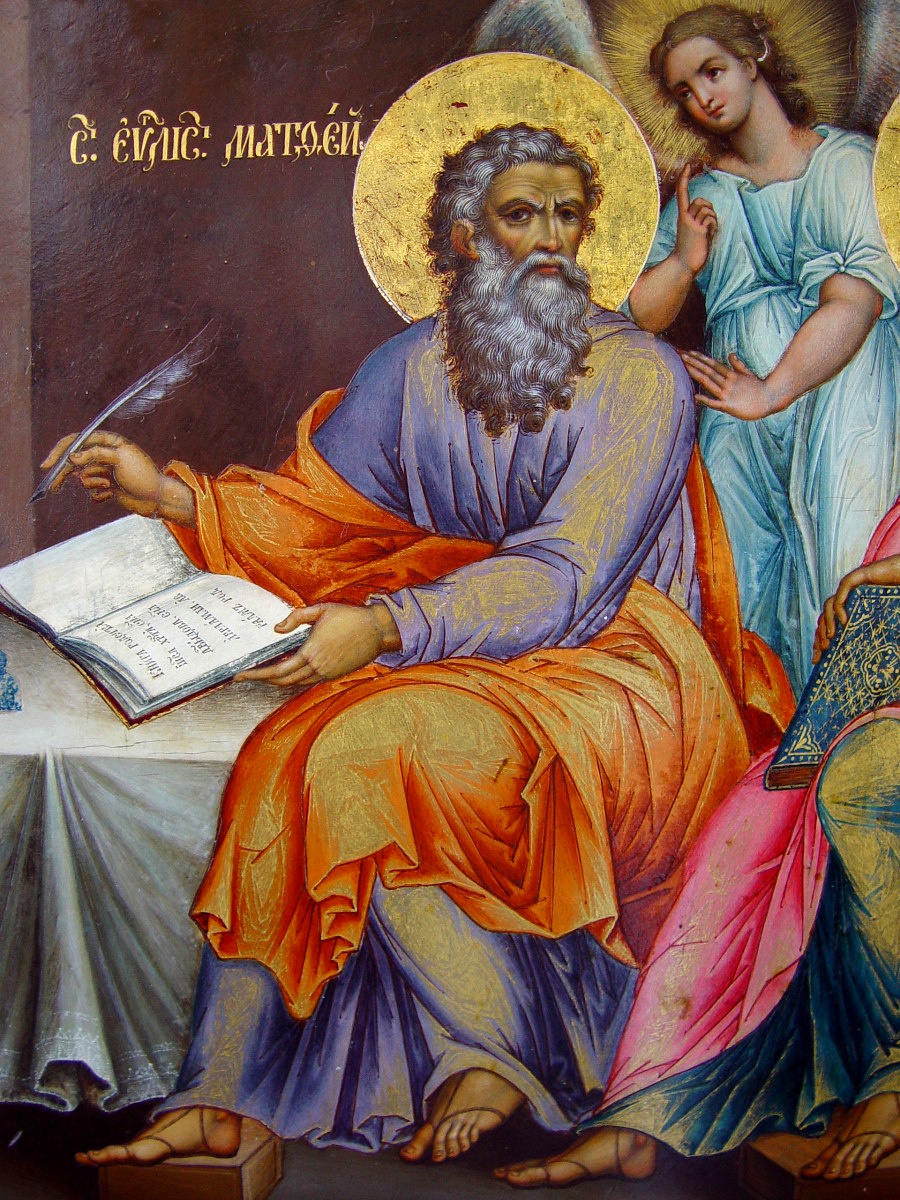
Matthew is depicted in two principal ways. As one of the Twelve he stands in every full apostle-tier and Deesis row, and in scenes of Pentecost and the Communion of the Apostles: an aged apostle with a high forehead and a full, rounded grey beard, holding a Gospel book or scroll. His individual evangelist-portrait — the type that fills the opening leaf of countless Gospel books and the pendentives and drums of church domes — shows him seated at his writing, composing the Gospel, a codex or scroll open on a desk, pen in hand, his head turned to the source of his inspiration. That source is his symbol: in the fourfold distribution of the four living creatures of the Apocalypse (Revelation 4:7; Ezekiel 1:10) — man, lion, ox, eagle — the received scheme, that of Jerome and of universal Orthodox usage, assigns to Matthew the man, or the winged man that iconography renders as an angel, because his Gospel begins with the human genealogy and birth of Christ. (Earlier fathers distributed the creatures otherwise — Irenaeus gave Matthew the man but Mark the eagle and John the lion, and Augustine differed again — but the man-Matthew, lion-Mark, ox-Luke, eagle-John arrangement long ago prevailed.) So Matthew is the human face of the tetramorph, and in the evangelist-portrait the winged man hovers at his shoulder, sometimes handing him the book or guiding his hand — the angel of his inspiration. The other narrative type, frequent in Western art and known also in the East, is the Calling of Matthew: the publican at his money-table, Christ before him with the summoning gesture.
The stored icon is a Russian panel of the mid-nineteenth century, of the Palekh school (Ivanovo region), inscribed in Slavonic "С[вятый] ЄѴГЛ[истъ] МАТѲЕЙ" — "the holy Evangelist Matthew." It shows the apostle seated, quill in hand, the Gospel open before him at its first words — the genealogy, "The book of the generation… Abraham begat…" (Matthew 1:1) — with the angel, his symbol and the messenger of his inspiration, standing close behind his shoulder: the very image of the evangelist writing his Gospel with the angel.
Disputed questions
- Levi and Matthew. The tax-collector called "Matthew" in the first Gospel (Matthew 9:9) is the "Levi" of Mark 2:14 and Luke 5:27 — one man of two names, by the ancient and universal tradition of the Church. A minority of modern scholars distinguish them; the identity of the scene stands against the distinction, and the Church commemorates one apostle.
- Not to be confused with Matthias. Matthew the tax-collector, evangelist, and one of the original Twelve, is a wholly distinct person from Matthias, the disciple chosen by lot to fill the place of Judas Iscariot after the Ascension (Acts 1:15–26) — one of the Seventy raised to the number of the Twelve, whose feast is August 9. The names are near-identical in Greek (Ματθαῖος / Ματθίας) and are perennially confused: a not-uncommon labelling error even attaches the name "St Matthias" to icons of the evangelist Matthew. The two are separate apostles with separate feasts and separate lives.
- Brother of James. The tradition making Matthew a brother of James the son of Alphaeus rests on the "son of Alphaeus" of Mark 2:14 and is affirmed in the Slavic books; it cannot be proven and is not pressed by the Greek sources.
- The Hebrew Gospel. Whether the canonical Greek Matthew is a translation of a lost Aramaic/Hebrew original (Papias's logia) or a Greek composition using Hebrew materials is an ancient and open question; the tradition of a Hebrew first edition is firm, its relation to the Greek text disputed.
- Martyrdom or peaceful repose. The apocryphal Acts and the Slavic Lives give a martyrdom by fire under King Fulvian in Ethiopia; part of the Greek synaxarion tradition reports a peaceful death, and other strands a death by the sword. The divergence is recorded, not resolved.