
Melitina of Marcianopolis
The Holy Martyr Melitina of Marcianopolis
Martyr · d. between 138 and 161
Commemorated 16 September — Martyrdom at Marcianopolis
Melitina was a martyr of Marcianopolis in Lower Moesia (near modern Devnya, Bulgaria) who suffered in the reign of Antoninus Pius (138–161) — one of the comparatively few martyrs transmitted from that mild emperor's time. A bold confessor whose preaching drew pagans to Christ, she is said to have shattered the idols of Apollo and Herakles by her prayer and to have converted the wife of her persecutor, the governor Antiochus, before both women were beheaded. A Macedonian Christian named Akakios obtained her body and died at sea carrying it home; both were buried on the island of Lemnos. She is commemorated on September 16.
.jpg)
The tradition places Melitina in Marcianopolis, the chief city of Lower Moesia, in the reign of Antoninus Pius, when Antiochus governed the province (the accounts call it Thrace, within whose wider administration the region lay). A Christian of fearless speech, Melitina preached Christ openly and converted many; the synaxarion tradition adds that by her prayers the idols of Apollo and Herakles fell shattered. Arrested on the governor's order, she could be moved neither by argument nor by threat to sacrifice; Antiochus then gave her into the keeping of his own wife and other women, who were to win her over with kindness and flattery. The stratagem inverted itself: the governor's wife was herself converted, and for a time the two women together brought pagans to the faith in secret. When Antiochus learned of it he had both beheaded. The Greek synaxarion's verse for the day plays on her name: cut down by the sword, she offered her blood to Christ sweet as honey (meli).
Her body remained unburied until a Christian of Macedonia named Akakios, passing through Marcianopolis on his way home, asked the governor for it, intending burial in his own country. Carrying the relics by sea in a chest, Akakios fell ill and died on the voyage; the ship put in at a promontory of the island of Lemnos, where the martyr was buried and the man who loved the martyrs was laid near her tomb.
Feast and commemoration
September 16 (church date; Old Calendar civil September 29), within the afterfeast of the Elevation of the Cross. The commemoration is carried by the Greek Menaion's synaxarion (which for this day names only Euphemia and Melitina), by the Slavic calendars, and by the OCA. No proper hymns are appointed to her in the Greek Menaion, the day's service belonging to the feast of the Cross and to the great-martyr Euphemia; the OCA appoints her a troparion (Tone 3) and kontakion (Tone 2) that exist in English only in copyrighted translations — fresh translations from the originals are wanted (Pass 2).
Iconography
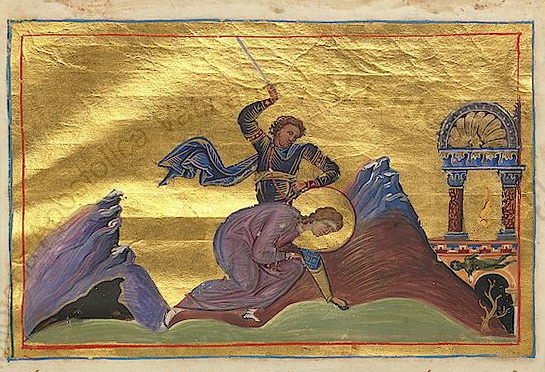
The Menologion of Basil II (c. 985) depicts her martyrdom for September 16: the young martyr kneels on rocky ground, already haloed, as the executioner raises his sword, with an architectural canopy — the pagan shrine of the city — at the right. The stored image is that miniature, from the Vatican manuscript of the Menologion.