
Menas, Hermogenes and Eugraphus
The Holy Martyrs Menas Kallikelados, Hermogenes and Eugraphus of Alexandria
Martyr · d. c. 313
Commemorated 10 December — Martyrdom at Alexandria
Menas Kallikelados ("the fair-spoken"), Hermogenes and Eugraphus were three martyrs of the early fourth century, commemorated together on December 10. Menas, a Christian of great eloquence, was sent by the emperor from Athens to Alexandria to quiet the strife between Christians and pagans, but instead preached Christ openly and won many converts. The imperial official Hermogenes, despatched to try him, was himself converted by the martyr's endurance under torture and his miraculous healing; and Eugraphus, Menas's own secretary, confessed Christ on witnessing their steadfastness. The emperor, unmoved by their constancy and by the miracles wrought among them, put all three to death.
.jpg)
Origins and mission to Alexandria
Menas was a man of Athens, distinguished above his fellows for learning and for the gift of speech, from which he received the surname Kallikelados — "of the beautiful voice," or "the sweetly-speaking." He held a place of trust under the emperor (the Acts name Maximian, ruling in the years 305–313, with whom the persecuting Caesar Maximinus is in places confused), and when serious unrest broke out at Alexandria between the Christians and the adherents of the old gods, Menas was sent down from Athens to Egypt to pacify the city and restore order. He was, in the event, a secret or newly-convinced Christian; and once at Alexandria he set aside the commission he had been given and used his renowned eloquence to a different end, preaching the one true God openly in the public places and drawing many of the pagans to faith in Christ.
Martyrdom
Word of this reached the emperor, who sent to Alexandria a high official named Hermogenes — the tradition styles him an eparch or prefect — to sit in judgment on Menas and to purge the city of its Christians. Hermogenes, though himself still a pagan, was a man of grave and upright bearing. He had Menas brought before him and subjected to savage torments; but the martyr endured them without flinching, and when his mutilated body was seen to be healed of its wounds, Hermogenes was so struck by the constancy of the sufferer and by the miracle that he too came to believe in Christ and confessed the faith.
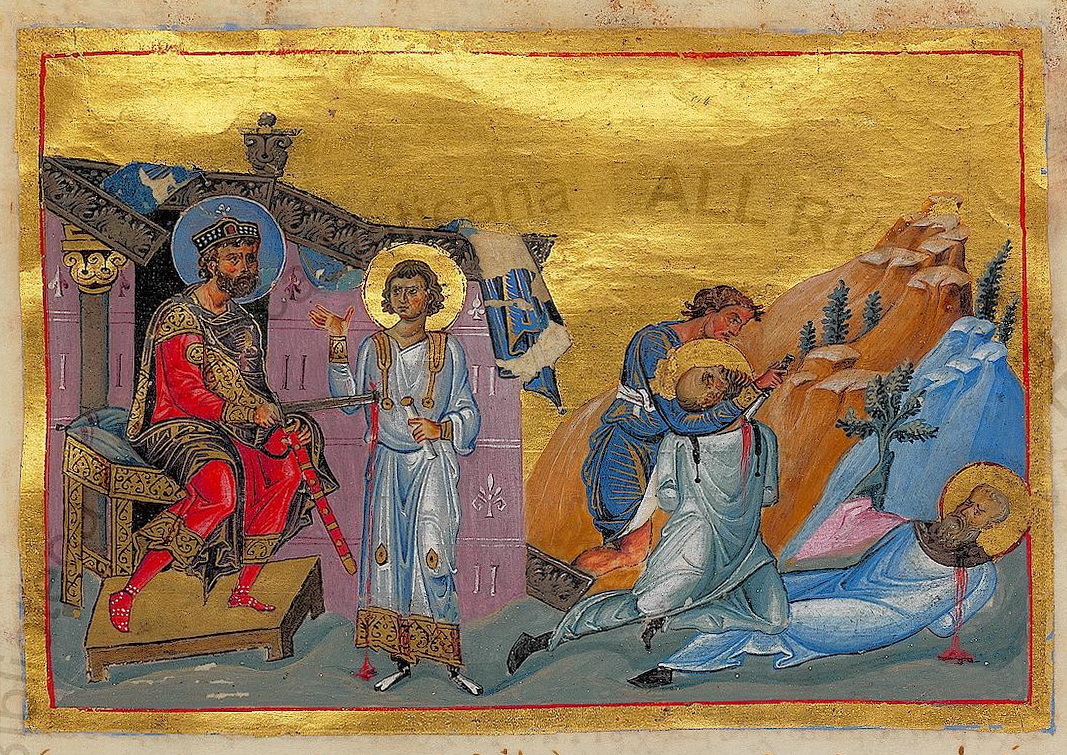
The emperor then came in person to Alexandria. Neither the unshaken endurance of Menas and Hermogenes under fresh tortures, nor the wonders that God worked in the city, softened him; rather they provoked him the more. Eugraphus, Menas's secretary, seeing the courage of the two, declared himself openly a Christian, and the emperor with his own hand ran him through with a sword. He then gave orders that Menas and Hermogenes be beheaded. So the three received the crown of martyrdom together, about the year 313.
Relics and translations
The bodies of the martyrs were enclosed in an iron chest and cast into the sea. They were afterwards recovered — the finding of the relics is kept on February 17 — and in the ninth century translated to Constantinople, where the emperor Justinian had earlier built a church in honour of the martyr Menas. There their memory was cherished, and Hermogenes came to be venerated as a wonderworker of the imperial city.
Feast and commemoration
December 10 (church date; Old Calendar civil December 23), within the Nativity Fast and the forefeast season of the Nativity of Christ, so that the canon of the martyrs in the Menaion is sung together with the pre-festal hymns of the coming feast. The commemoration is kept universally in the Byzantine rite. The Greek books entitle the day with the full style "Menas Kallikelados, Hermogenes and Eugraphus," while the Slavonic and OCA calendars name them "of Alexandria," the city of their contest.
Hymns
Troparion — Tone 4
Thy martyrs, O Lord, in their contest received incorruptible crowns from Thee our God; for possessed of Thy strength, they cast down the tyrants and broke the feeble insolence of demons. By their prayers, O Christ God, save our souls.
Original translation from the Greek
Kontakion — Tone 4
The Lord snatched thee, O Menas, from the passing warfare, and made thee, together with thy fellow-strugglers, a fellow-heir of that which is incorruptible, granting thee the unfading crown.
Original translation from the Greek
Iconography
The three martyrs are shown together as a group of the slain: the miniature of the Menologion of Basil II (c. 1000) depicts their martyrdom, the executioner standing over the fallen saints. Menas, the eloquent advocate, is sometimes distinguished by the scroll of his preaching; Hermogenes by the dress of a Roman official; Eugraphus, the secretary, as a younger beardless figure. The stored image is the Menologion miniature.
Disputed questions
- Place of the contest. The synaxarion tradition followed here, and the OCA and Slavonic calendars, set the martyrdom at Alexandria, whither Menas was sent. A parallel strand of the received account makes Menas an Athenian martyred at Constantinople; the discrepancy is bound up with the ninth-century translation of the relics to the capital and the church of Menas there.
- The persecuting emperor. The Acts name Maximian; the fuller synaxaria associate the persecution with Maximinus (Daza), and the two names are interchanged in the manuscript tradition. The date c. 313 is that of the close of the persecution in the East.
- Not to be confused with the great-martyr Menas of Egypt (commemorated November 11), the Egyptian soldier-martyr and wonderworker of Cotyaeum. The two Menases are distinct saints, frequently conflated in older calendars and image collections; the November 11 entry carries the reciprocal note. Nor with Menas of Polotsk (†1116, June 20), the Kiev Caves monk who became bishop of Polotsk — a Slavonic Мина who is regularly indexed among the Greek martyrs of the name. As regards Hermogenes: he is not to be confused with Hermogenes the Martyr of July 24, a bare name of the Synaxarion of Constantinople whose teeth were drawn out and of whom nothing further is transmitted, nor with the Hermogenes of Callista, Evodus and Hermogenes (September 1).