
Menas of Egypt
The Holy Great-Martyr Menas the Wonderworker
Great Martyr · Wonderworker · b. c. 285 — d. c. 309
Commemorated 11 November — Martyrdom at Cotyaeum in Phrygia
Menas of Egypt (c. 285 – c. 309) was an Egyptian soldier of the Roman army who, at the height of the Diocletianic persecution, cast down his military belt, withdrew to the wilderness, and then returned to confess Christ openly before a pagan festival at Cotyaeum in Phrygia, for which he was tortured and beheaded. Buried in the desert west of Alexandria, his tomb became one of the greatest healing shrines of the Christian East: the vast pilgrimage city of Abu Mena grew around it, and the clay flasks stamped with his image — the saint standing in prayer between two camels — were carried by pilgrims across the whole Mediterranean world. One of the most beloved military martyrs and wonderworkers of the Church, he is commemorated on November 11.

Origins and early life
Menas was an Egyptian by birth, born about the year 285. The tradition makes him a soldier of the Roman army who served in the region of Cotyaeum (Kotyaeion) in Phrygia, under an officer named Firmilian, during the reign of the emperors Diocletian (284–305) and Maximian. He was esteemed for his courage in war, his endurance, and his sober self-command. When, about the year 298, the imperial edicts commanded universal sacrifice to the gods and set the legions themselves to the hunting-down of Christians, Menas would not be made an instrument of that impiety. He unbound the soldier's belt that was the badge of his rank, laid it aside, and withdrew from the army into the mountains above Cotyaeum, where he gave himself to fasting, vigil, and prayer.
Martyrdom
After a long solitude in which, the Lives say, he purified his soul of every passion, Menas received an inward assurance — described as a vision — that he was called to the further contest of martyrdom. He came down from the mountain into the city, where a pagan festival with its games and dancing was in progress, and standing in the midst of the crowd he cried out that there is one only true God, the Lord Jesus Christ, and that the idols the people honoured were lifeless things of metal, wood, and stone, and their gods demons. The festival broke up in astonishment at his boldness; he was seized, beaten, and brought before the prefect of the city, named Pyrrhus.
Questioned, Menas answered that he was an Egyptian and a servant of Jesus Christ, that he had long served in the imperial army, but that rather than obey rulers who did not know God he had chosen the company of the wild beasts in the desert. The prefect had him imprisoned, and the next day offered to restore him to his former rank if he would sacrifice. When Menas refused, he was put to prolonged and cruel torture — scraped, scourged, and burned — but through it all he would not deny Christ. Seeing that nothing moved him, Pyrrhus ordered him taken outside the city and beheaded. On the way to execution the martyr asked the Christians who followed him secretly to carry his body back to Egypt when the persecution should end. He was put to the sword on the eleventh of November, about the year 309 (some accounts place his death a few years earlier, around 304).
Relics and translations
His friends gathered up the relics by night and hid them until the peace of the Church. They were then brought back, as he had asked, into Egypt and laid to rest in the desert of Lake Mareotis, southwest of Alexandria. Over the tomb there rose in the following centuries one of the largest pilgrimage complexes of late antiquity, the city known as Abu Mena (the "Place of Menas"), with basilicas, a martyrium, baths, and hostels served by a sacred spring whose waters were held to carry the martyr's healing power. The site flourished under the Christian emperors — Arcadius, and above all the reconstruction associated with Zeno and the sixth-century emperors — before declining after the Arab conquest; its ruins in the western desert of Egypt are today a UNESCO World Heritage site.
Veneration and later cultus
The fame of Menas spread far beyond Egypt through the ampullae — small two-handled flasks of moulded clay, stamped on each face with the figure of the saint standing with arms outstretched in prayer between two kneeling camels — in which pilgrims carried away oil from his lamp or water from his spring. These "Menas flasks" have been excavated all round the Mediterranean, from the Near East to the Rhineland, Carthage, and the British Isles, and are among the most widely distributed and datable objects of early Christian pilgrimage. His feast was kept universally in the Byzantine rite, and he entered the Coptic, Greek, Slavonic, and Latin calendars alike as a great healer and helper. In Egypt he remains one of the most venerated of all the saints, styled simply "the Wonderworker."
Miracles and traditions
Menas is invoked above all as a healer of illnesses and a deliverer of the demon-possessed, and — from a cycle of miracle stories attached to his shrine — as a defender of the wronged and a finder of what is lost or stolen. As a former soldier he is counted among the protecting military saints and is invoked in time of war. In the Greek tradition of the twentieth century his intercession was credited at El Alamein in the Egyptian desert near his shrine, in the autumn of 1942, where the tide of the North African campaign turned; the story is a modern addition to a very old reputation as a guardian of Egypt.
Feast and commemoration
November 11 (church date; Old Calendar civil November 24), the day of his martyrdom, kept universally. In the Byzantine service books his commemoration is joined with those of the martyrs Victor and Stephanida and the deacon-martyr Vincent of Spain, and with the venerable confessor Theodore the Studite, so that the canons and stichera of the day weave the several commemorations together around the figure of the "great-martyr Menas." The Coptic Church, in whose land his shrine lies, keeps his memory with especial solemnity.
A distinct martyr, Menas Kallikelados ("of the beautiful voice"), sent from Athens to Alexandria and commemorated on December 10 together with Hermogenes and Eugraphus, is frequently confused with the Egyptian great-martyr in older calendars and image collections; the two are separate saints. A third, wholly distinct, is Menas of Polotsk (†1116, June 20), the monk of the Kiev Caves who became bishop of Polotsk — a Russian hierarch whose Slavonic name Мина is identical to the Egyptian martyr's and who is often lost among the Greek Menases in indexes.
Hymns
Troparion — Tone 4
Thou didst forsake the warfare of this world, O champion, and didst receive an inheritance in heaven and an unfading crown; for thou didst spurn the glory of an earthly king and finish the contest of a valiant martyrdom. Therefore, O Great-martyr Menas, intercede that our souls may be saved.
Original translation from the Greek
Kontakion — Tone 4
Christ our God drew thee out of the passing warfare and showed thee a partaker of that which is heavenly and incorruptible, O passion-bearer Menas; for He Himself is the unfading crown of the martyrs.
Original translation from the Greek
Iconography
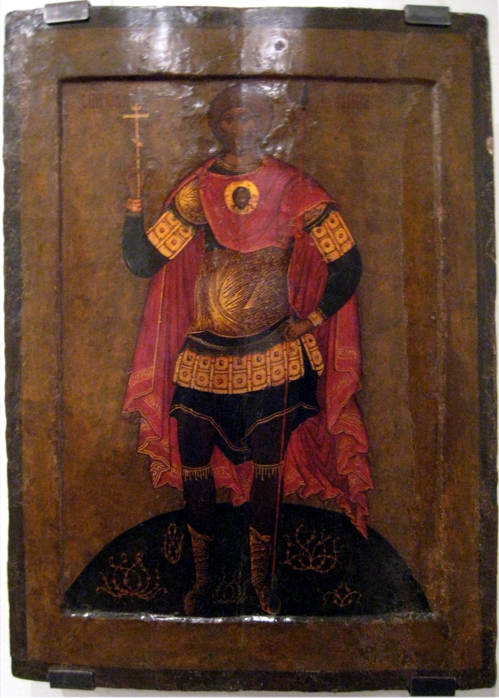
Menas is shown as a young beardless (or lightly bearded) soldier-martyr, in the military tunic and cloak, holding the cross of martyrdom and often a sword or lance. His most ancient and distinctive image, from the Egyptian pilgrim flasks and their prototypes, presents him frontally in the orans posture, arms raised in prayer, flanked by two crouching camels — a type unique to him among the saints. The stored image is a seventeenth-century Russian icon of the martyr.
The celebrated sixth-century encaustic panel from Bawit now in the Louvre, which shows Christ with his arm about the shoulder of a monastic figure, is popularly called "Christ and Saint Menas" but in fact depicts an Abbot Mena of the Bawit monastery, not the Egyptian great-martyr; it is therefore not used here.